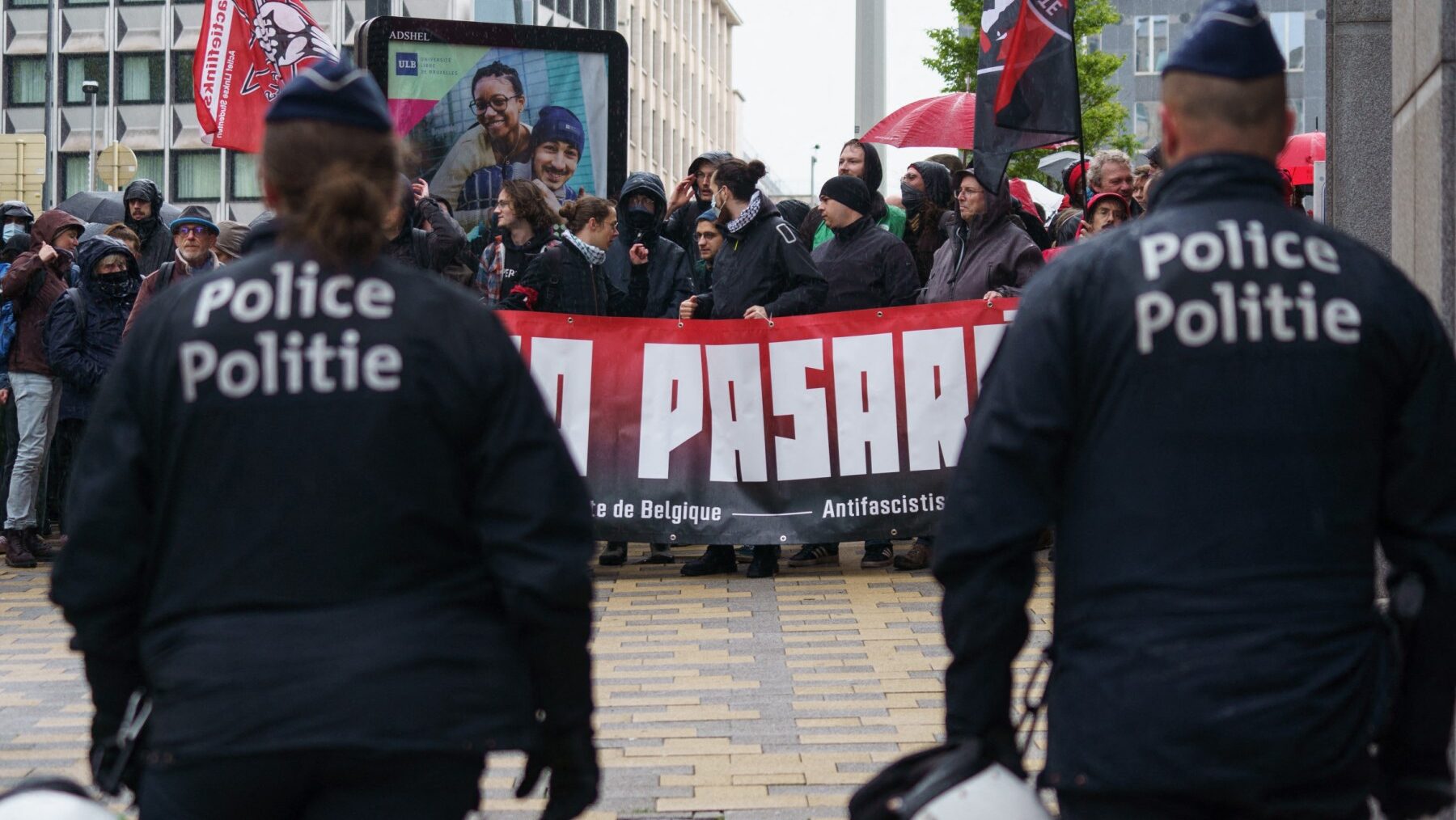
Far-left militants demonstrate outside the “NatCon” conference on April 16, 2024, in Brussels
Simon Wohlfahrt / AFP
A Brussels court has ruled that the mayor of Saint-Josse-ten-Noode unlawfully banned the National Conservatism Conference (NatCon) last year, delivering a major legal defeat for a local authority that attempted to shut down the event using police powers without adequate justification.
The judgment, handed down by the French-speaking Court of First Instance in Brussels, condemns a police decree issued by Mayor Emir Kir—a powerful local executive—for blocking a lawful political conference organised by MCC Brussels on 16 and 17 April 2024. The court found that the ban violated fundamental rights to free expression and peaceful assembly.
Kir, who serves as both mayor and head of the local police authority, issued a police decree preventing NatCon from going ahead, citing security concerns. The court ruled that he did so without evidence and without exhausting less restrictive options. In plain terms, the mayor chose to cancel the event rather than protect it.
The decision follows two earlier rulings by Belgium’s Conseil d’État in 2024, issued under emergency procedures and later on the merits, which also found against the commune. With this latest judgment, both Belgium’s French-speaking and Dutch-speaking courts have now reached the same conclusion: public authorities may not suppress lawful events simply because they attract controversy.
That alignment is rare in Belgium’s fragmented institutional system. It also sends a clear signal. Courts across the country agree that political discomfort is not a valid reason to silence speech.
The Brussels court made another point explicit. Authorities are not only required to avoid unlawful restrictions on fundamental rights. They are also required to take reasonable, proportionate steps to ensure those rights can be exercised in practice. If a lawful event faces protests or disruption, the state must manage the risk. It may not cancel the event to spare itself inconvenience.
In the NatCon case, the court found that Saint-Josse-ten-Noode failed on both counts.
According to the 26-page judgment, the commune imposed a blanket ban without showing that public order could not be maintained. It did not present concrete intelligence, operational limits, or evidence that policing the event was impossible. Instead, it issued a preventive veto—the most extreme option available.
The court rejected this approach outright. It dismantled what lawyers call the heckler’s veto: the idea that threats of protest by third parties justify cancelling a lawful gathering. In a democracy governed by the rule of law, the judgment stresses, authorities must address credible risks through proportionate policing measures rather than cancelling lawful events.
The court held that the police decree issued by the mayor was unlawful, engaging the civil liability of the Commune. The commune was ordered to pay one symbolic euro in moral damages, along with legal costs.
The sum is small. The finding is not.
By formally recognising moral harm and illegality, the court has set a clear precedent. Local authorities may not dress up political censorship as a security measure.
The case also exposes a broader pattern. When officials with wide discretionary powers choose to use them aggressively, the tools of the state can quickly turn into instruments of pressure against lawful political activity. This ruling draws a firm line against that abuse.
It also confirms that MCC Brussels acted within the law throughout. The court rejected any suggestion that the organisers bore responsibility for the ban or that the conference posed an inherent threat to public order.
The attempted shutdown of NatCon last year prompted international criticism and public interventions by senior political figures. The judgment now confirms that those warnings were legally justified.
As MCC Brussels Executive Director Frank Furedi put it, the ruling marks a turning point. “It confirms that public authorities must not only tolerate freedom of expression, but actively protect it.”
With courts on both sides of Belgium’s linguistic divide now speaking clearly, the message is difficult to ignore: in a democracy governed by the rule of law, police powers cannot be used to suppress lawful expression.