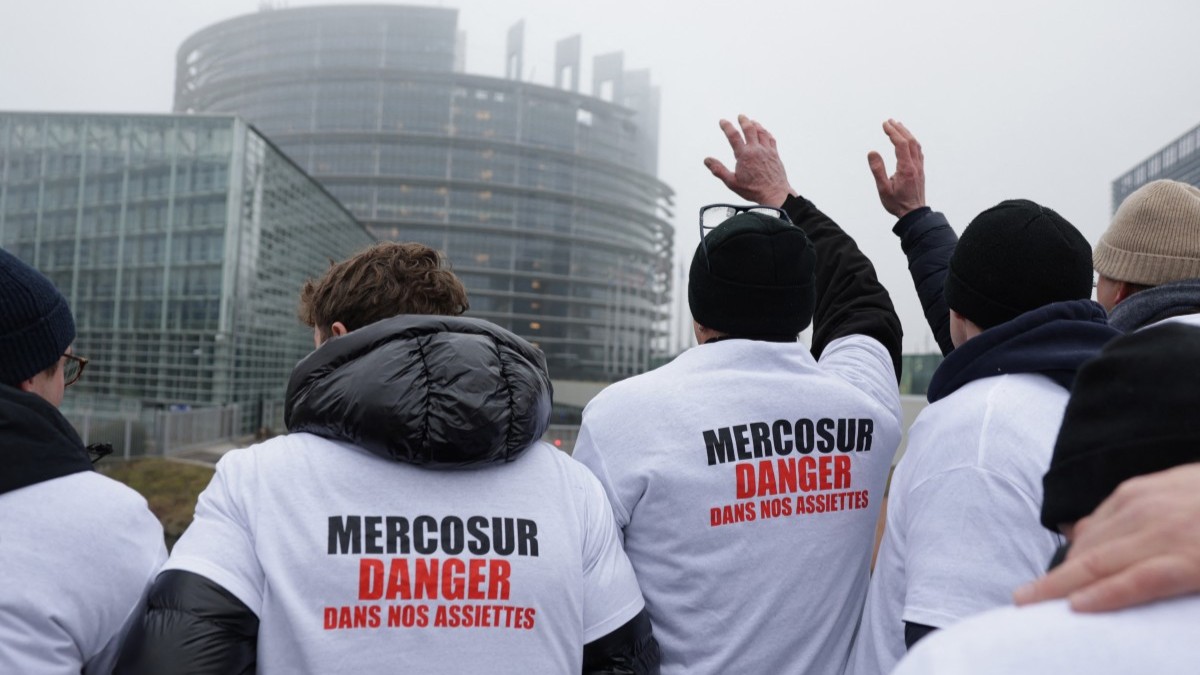
Demonstrators with shirts reading “Mercosur danger in our plates” wave at the EU Parliament building as farmers protest against the Mercosur free trade agreement on the day of a vote on a referral to the courts, in Strasbourg on January 21, 2026.
Roméo Boetzlé / AFP
What happened this week in Strasbourg regarding the agreement between the European Union and Mercosur may ultimately have an effect exactly opposite to that sought by many of the trade deal’s critics.
The European Parliament’s decision to refer the pact to the Court of Justice of the EU, hoped to be a political and legal brake, threatens to become the trigger for an accelerated provisional application, driven directly by the European Commission and endorsed by the Council.
Such a scenario would leave the European Parliament not only without real blocking capacity, but also without room to impose the social, environmental, and agricultural safeguards that have been debated in recent months.
The president of the European Council, António Costa, has been explicit: the Council has already authorised not only the signing, but also the provisional application of the agreement, and has publicly invited the Commission to make use of that prerogative. Faced with Parliament’s gesture, the EU executive power—Council and Commission—s asserting its ability to move forward by relying on the Treaties.
From a legal standpoint, the Commission is not obliged to wait for the European Parliament. Following the signing ceremony held in Paraguay, it is sufficient for one of the Mercosur countries to complete its internal procedures for the agreement to begin provisional application with the European Union. This minimal threshold turns the parliamentary offensive into a tool that is more symbolic than effective.
This is where the boomerang effect emerges. By judicialising the agreement, Parliament sought to buy time and force a political renegotiation. However, what may occur is precisely the opposite: a rapid, technical application, without the additional safeguards that were being discussed to reassure European farmers or strengthen environmental clauses.
The president of the Commission herself, Ursula von der Leyen, has left that door open to this scenario by stressing that “there is a clear interest in ensuring that the benefits of the agreement are applied as soon as possible.” In practice, this means that Brussels could opt for a strictly procedural reading: when Mercosur countries are ready, the EU will be ready as well. Everything else is wet paper—quite literally.
This episode once again lays bare the institutional reality of Europe. The European Parliament displays political muscle, but lacks decisive instruments when the Council and the Commission converge.
From Latin America, pressure is mounting. Paraguay is aiming for an expedited ratification in March, while Brazil, Argentina, and Uruguay expect to complete their procedures within a few months. Paraguayan President Santiago Peña has openly called for a transitional application to bypass the European obstacle. This external urgency strengthens Brussels’ temptation to move forward without waiting for a ruling from the Court of Justice of the EU, which could take between 18 and 24 months.
Meanwhile, in Europe, divisions are deepening. France denounces a “democratic violation,” while Germany insists that nothing will stop the agreement and assumes that its provisional application is likely.