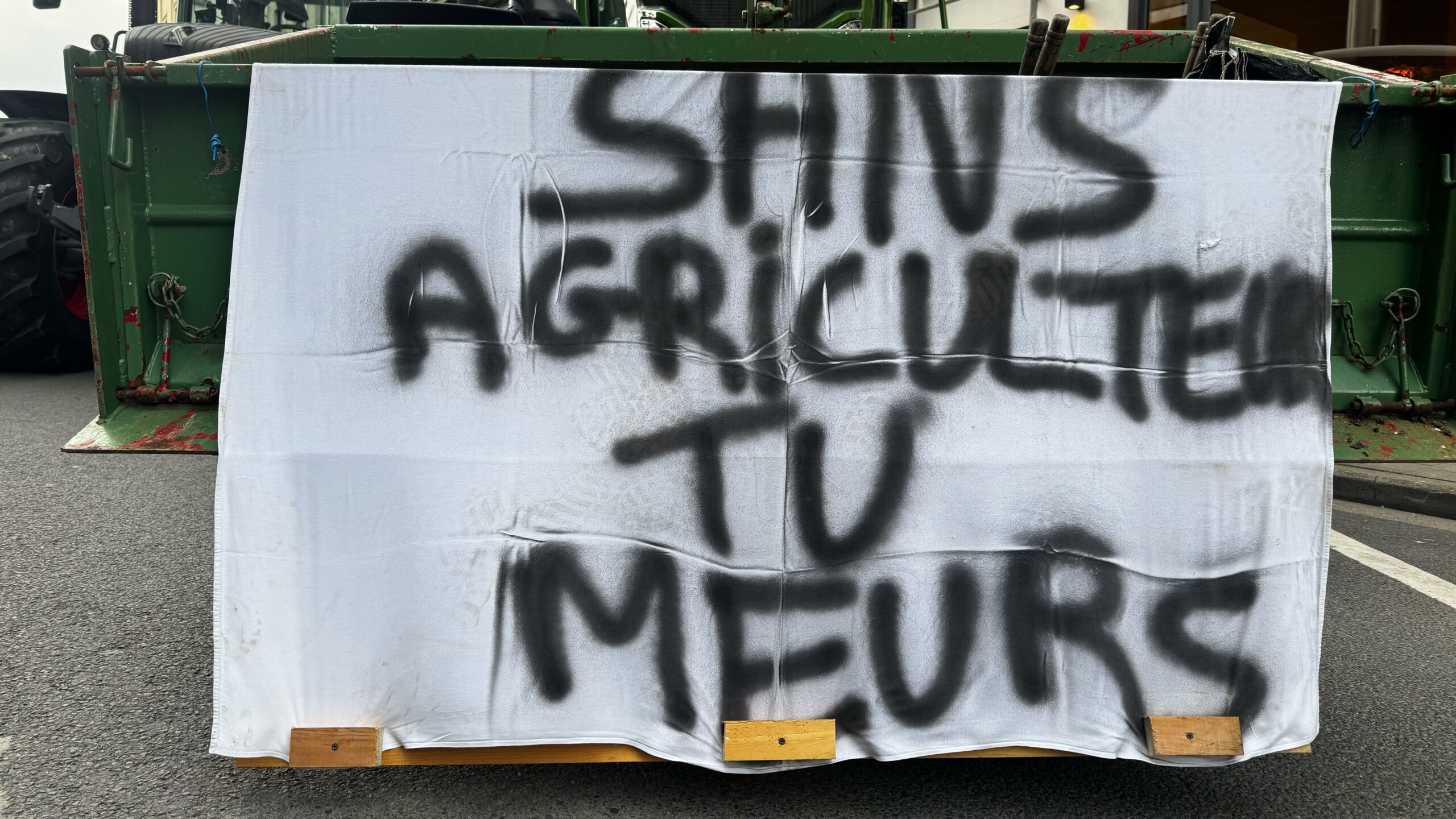
A placard on a tractor that reads “Without agriculture you die” seen during a farmers’ protest in Brussels, Belgium on December 18, 2025
Javier Villamor / europeanconservative.com
Brussels woke up once again this Thursday to the roar of agricultural engines. Coinciding with the opening of the final European Council meeting of the year, thousands of farmers and livestock breeders returned to the EU capital to denounce what they see as the European Union’s systematic neglect of the primary sector—now further exacerbated by political pressure to finalise the Mercosur trade agreement.
The protest found unexpected political backing in the hours preceding the Council’s opening. Hungarian Prime Minister Viktor Orbán openly sided with the demonstrators and delivered a blunt message from Brussels: “The farmers are 100% right,” he said, referring to the growing discontent within Europe’s agricultural sector.
From early morning, convoys of tractors from Belgium, France, and other neighbouring countries clogged the main access routes to the European quarter. The police presence was heavy, with large areas cordoned off around the EU’s main institutions. Throughout the day, moments of tension erupted between protesters and security forces, including the throwing of potatoes and pyrotechnic devices, as well as the sporadic use of water cannons and tear gas to disperse the most confrontational groups.
📢Our writer @JavierVillamor witnessed this just moments ago: Belgian police teargassing the protesting farmers. Is the von der Leyen Commission awake? pic.twitter.com/8YaGWAXycV
— The European Conservative (@EuroConOfficial) December 18, 2025
The Mercosur trade agreement has become the main trigger for the mobilisation. Farmers denounce what they consider unfair competition, particularly in sensitive sectors such as meat, sugar, and cereals, due to the influx of products from countries with lower sanitary and environmental standards.
On this point, Orbán was explicit in outlining Hungary’s opposition to the deal: “The first problem is the package called Mercosur, which would be a free trade agreement with Latin American countries. Therefore, Hungary is among the countries that do not support Mercosur,” he stated. The prime minister also stressed that the internal debate in Hungary had been thorough and technical, and underlined that there is a sufficient blocking minority to prevent ratification: “I see there are enough of us opposing Mercosur to make it impossible for this agreement to be signed.”
The farmers are 100% right:
— Orbán Viktor (@PM_ViktorOrban) December 18, 2025
❌ Green Deal = overregulation
❌ Mercosur agreement = unfair global competition
✅ It's time to support our farmers and protect our families pic.twitter.com/vizwNuleAF
On the ground, protesters echoed that assessment. “Mercosur is not a good rule, it’s not a good law, it’s not something good for us here in European countries,” said one farmer at the demonstration, warning about the impact of plant protection products and genetically modified organisms allowed in third countries but banned in the EU.
Beyond Mercosur, farmers are also pointing directly to EU climate policy as another factor suffocating the sector. Orbán put it bluntly when speaking to the press: “The other problem for farmers is the Green Deal, which means that agricultural work is being over-regulated, to such an extent that it creates serious costs and a competitive disadvantage.”
That argument is widely shared among protesters, who denounce an accumulation of environmental, bureaucratic, and administrative requirements that are not offset by fair prices or genuine protection of the European market. In Belgium, strategic sectors such as sugar beet production have seen cultivated areas shrink dramatically, while production costs continue to rise.
The presence of very young farmers was one of the most striking aspects of the protest. “I’m 17 years old and a third-generation livestock farmer,” said one of them, openly questioning the sector’s viability. “When you look at the price of wheat per ton, the price of milk falling again, and the cost of machinery, the numbers simply don’t add up.”
Some demonstrators also called for a change in consumer habits and a stronger commitment to local produce as part of the solution. “We should consume more of what is produced here and stop looking to distant countries,” they argued.
As tractors encircle the European quarter, inside the European Council, the primary sector barely features on the official agenda. Among farmers, the prevailing feeling is that despite words of support from some national leaders, Brussels continues to offer no concrete answers.
As the political year draws to a close, the image of Europe’s fields mobilised outside the EU institutions repeats itself once again—a warning sign that, according to the protesters, can no longer be ignored without consequences.