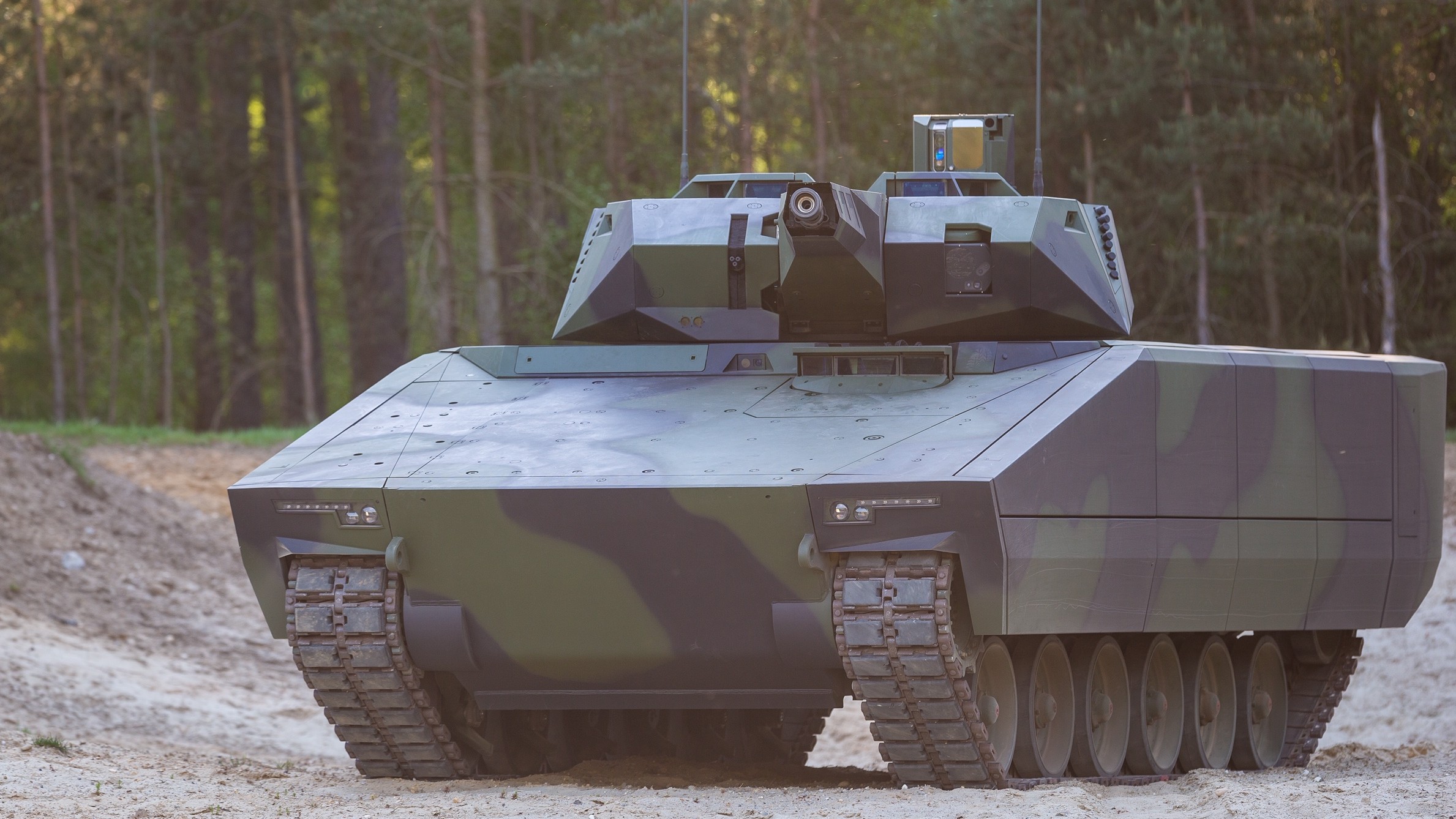
A Rheinmetall Lync Infantry Fighting Vehicle
Rheinmetall MAN – Rheinmetall MAN, CC BY-SA 4.0, https://commons.wikimedia.org/w/index.php?curid=86874026
The European Union took another step toward strengthening its military muscle on June 17th: from now on, Member States will be able to take on debt without restriction—as long as that spending is allocated to defence.
The measure, promoted by the European Commission, is part of a broader package aimed at removing bureaucratic hurdles and accelerating investment in strategic capabilities. It comes at a time marked by the ongoing war in Ukraine and the threat of a possible escalation beyond its borders.
We’re cutting time to get permits for defence companies from years to 60 days – this and more in our Defence Readiness Omnibus.
— Andrius Kubilius (@KubiliusA) June 17, 2025
It’s not a time of war, but also not time of peace – we live in a time of readiness. Our regulations should reflect that.
⬇️https://t.co/ryYHcoZ4nL pic.twitter.com/cYGKhRA1nY
The proposal includes, among other things, the creation of single points of contact in each Member State to issue permits within a maximum of 60 days—a move that will streamline projects that until now could face delays of three to four years. It also introduces incentives for joint purchases, corporate mergers in the sector—i.e., the building of oligopolies—and access to EU funding, even for Ukrainian entities not members of the Union.
This willingness to facilitate and stimulate military spending starkly contrasts with another reality: some countries pushing hardest to bolster European defence are the same ones refusing to increase the EU’s common budget. Germany is the prime example. Under Friedrich Merz’s government, Berlin has rejected Spain’s call to expand the Multiannual Financial Framework (MFF) beyond 1% of Europe’s gross national income. It also opposes extending the post-COVID recovery fund, whose first repayments are due to start in 2028.
It is contradictory to enable greater national debt to fund armies while blocking an increase in the European budget—especially when those same funds could be directed toward similar ends: dual-use technology, military mobility corridors, or the protection of critical infrastructure.
Germany insists it wants a more defence-oriented EU budget, but without increasing its overall size. This is a political paradox that borders on the impossible.
Europe must be ready to defend what it stands for: Our values. Our people.
— European Commission (@EU_Commission) June 17, 2025
We are putting forward ambitious proposals to cut red tape and facilitate access to the €800 billion that EU countries urgently need to ramp up defence investments over the next four years ↓
And not without consequences. The Cohesion Policy and the Common Agricultural Policy (CAP)—cornerstones of intra-European solidarity—could see their resources cut to feed a military effort to which not all Member States contribute equally.