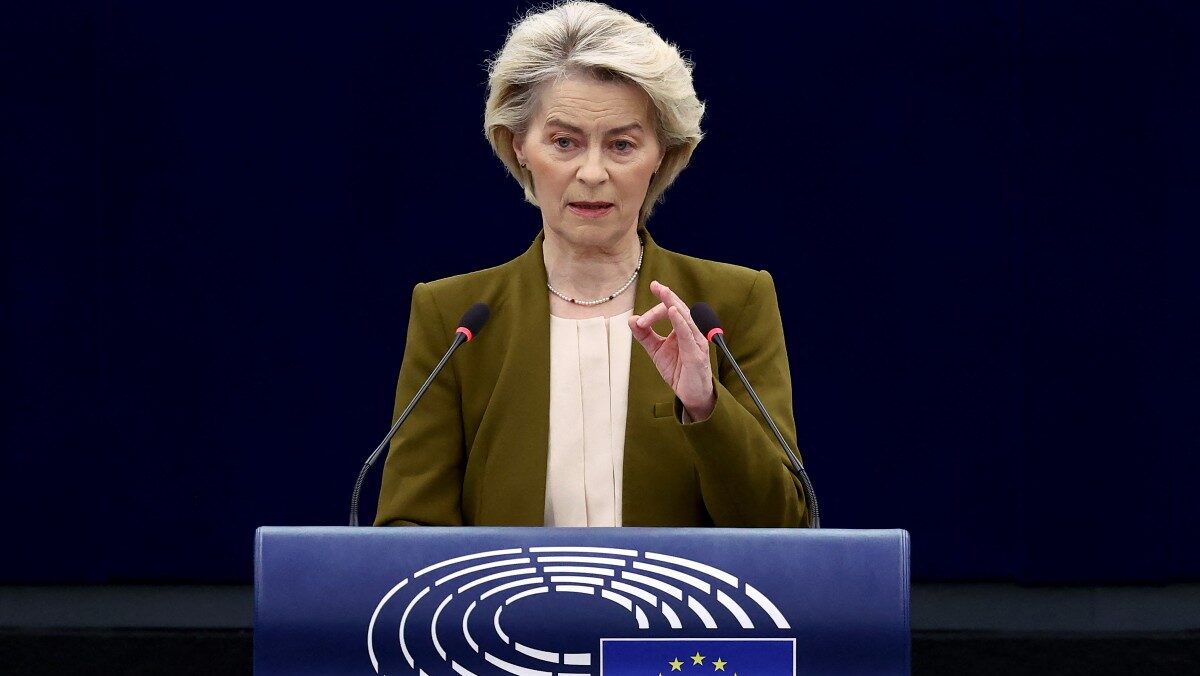
European Commission President Ursula von der Leyen speaks during a debate on the EU engagement towards a just and lasting peace for Ukraine during a plenary session at the European Parliament, in Strasbourg, eastern France, on November 26, 2025.
FREDERICK FLORIN / AFP
The European Union has now crossed the threshold. On Friday, EU countries formally approved the indefinite immobilisation of roughly €210 billion in Russian state assets—breaking with all previous precedent and validating many of Viktor Orbán’s warnings about a dangerous legal and political drift inside the Union. The decision, adopted via written procedure, uses the emergency powers contained in Article 122 of the Treaty, allowing Brussels to bypass unanimity and lock the funds without the need for renewal every six months.
The move is presented as a crucial step for enabling the future use of those assets to finance Ukraine’s reconstruction, although the EU must still persuade Belgium to lift its veto on actually deploying the funds for that purpose. The approval, nonetheless, opens the legal door to a permanent freeze, a transformation of what was conceived as a reversible sanctions regime into a structural mechanism.
European Council President António Costa celebrated the step, insisting that EU leaders had already committed in October to keeping Russian assets immobilised until Moscow ends its war of aggression and compensates Ukraine. “Today we delivered on that commitment,” Costa posted on social media. “Next step: securing Ukraine’s financial needs for 2026–2027.”
Commission President Ursula von der Leyen echoed the message: “We are sending a strong signal to Russia: as long as this brutal war of aggression continues, the costs for Russia will continue to rise.” She added that the decision would make Ukraine “even stronger on the battlefield and at the negotiating table.”
High Representative Kaja Kallas reinforced the line, arguing that the agreement would allow the EU to “keep increasing the pressure on Russia until it takes negotiations seriously.”
Orbán, however, had warned hours before that this written vote would cause “irreparable damage to the Union” and eliminate unanimity “with a single stroke of the pen, clearly unlawfully.” Far from hyperbolic, his assessment now appears anchored in the reality of what has just happened: 25 Member States endorsed the measure, while two opposed it, confirming that unanimity has effectively been circumvented in one of the most consequential sanctions decisions ever taken by the Union.
Today, the Brusselians are crossing the Rubicon. At noon, a written vote will take place that will cause irreparable damage to the Union.
— Orbán Viktor (@PM_ViktorOrban) December 12, 2025
The subject of the vote is the frozen Russian assets, on which the EU member states have so far voted every 6 months and adopted a unanimous…
Until now, the immobilisation of Russian sovereign assets depended on unanimous renewal every six months. That fragile balance allowed countries like Hungary or Slovakia to veto sanctions packages they deemed harmful or excessive, and it prevented Brussels from using those assets as leverage without collective consent. The new arrangement removes those constraints entirely, eliminating the possibility of national vetoes in future renewals and clearing the path for the Commission’s plan to turn the assets into collateral for a multi-billion-euro loan to Ukraine.
Belgium remains the central obstacle. As the country hosting the vast majority of the immobilised funds through Euroclear, its government has repeatedly expressed concern about the legality of using emergency powers to freeze foreign sovereign assets indefinitely. Prime Minister Bart De Wever compared the idea to “entering an embassy, taking out the furniture and selling it,” warning of catastrophic financial and legal exposure. Those concerns have only intensified after the Russian Central Bank filed a lawsuit before a Russian arbitration court against Euroclear, accusing the Belgian institution of causing damages by preventing access to cash and securities belonging to the bank.
The Commission maintains that the economic impact of the war on the EU justifies the use of Article 122, arguing that preserving the Union’s financial stability requires an extraordinary legal basis and swift action outside the normal institutional process—one that also avoids involving the European Parliament. Yet several diplomats acknowledge privately that this interpretation stretches the Treaty further than ever before. Linking an economic emergency clause to a foreign military conflict represents a conceptual leap that many fear could become a permanent tool for bypassing unanimity whenever Brussels deems it politically convenient.
This is the pattern Orbán has denounced: “[T]he rule of law in the European Union is being replaced by the rule of bureaucrats.” The form may be provocation, but the substance is increasingly undeniable. What was once an exceptional measure is being converted into a structural political instrument, without the usual checks, without public debate, and through a written procedure conducted days before the European Council meets in person.
The international repercussions could be severe. Moscow will interpret the indefinite freeze as a form of covert confiscation, with unpredictable consequences for bilateral relations and financial stability. Washington may view it as a unilateral European move in an area that could be central to a future peace negotiation. Inside the EU, the decision widens the divide between advocates of deeper integration and defenders of national sovereignty.
Today’s decision will not end the war, but it will reshape the legal and political framework of the Union for decades. Brussels has now taken a step that carries immense legal, financial and geopolitical risks. And unlike in previous crises, the warnings—including Orbán’s—cannot be dismissed as dramatisation. They reflect a rigorous assessment of the scale of what the Union has decided to do.
The EU has crossed the Rubicon. The question, now more than ever, is whether it fully understands the consequences.