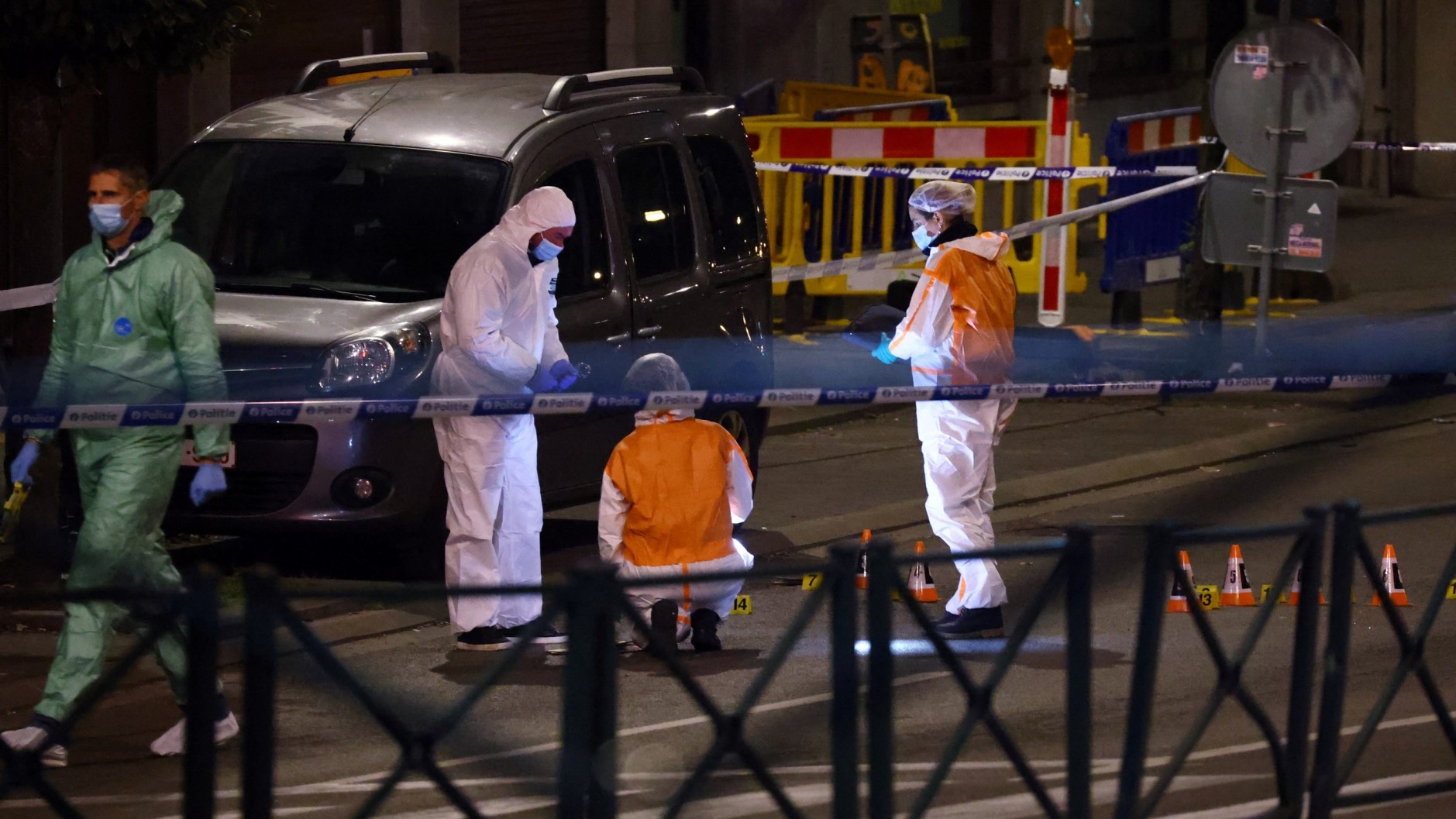
Belgian crime scene investigators search for evidence in a street after two people were killed uring a shooting in Brussels on October 16, 2023.
Kenzo Tribouillard / AFP
“These incidents do not occur where international officials live and work. They happen in the rotten areas of the city, in Anderlecht, in Molenbeek, in places like that,” Alain Hutchinson, Brussels’ commissioner for Europe and international organizations said in a recent interview, downplaying the wave of violence hitting the Belgian capital. He even claimed that in the European quarter, “we have never had this kind of problem” and that expats “have nothing to worry about.”
However, that discourse, intended to reassure the thousands of EU officials living in Brussels, apart from showing complete disregard for ordinary people, clashes head-on with the official data. Far from being confined to a handful of neighborhoods, violence is spreading across the city and has reached levels more akin to a town at war: since January, there have been 57 shootings, 20 of them in just three summer months.
The offensive classism draws a clear line between the lives of European officials and those of ordinary citizens who must learn to live with the increasingly deteriorating security situation in ‘the capital of Europe.’
Brussels prosecutor Julien Moinil warned in mid-August that Brussels is experiencing an “alarming trend” directly linked to drug trafficking. His figures speak for themselves: 6,211 adults and 874 minors have been arraigned this year, triple the number in 2024. Among them, 1,250 were arrested for drug trafficking. Moinil reminded that ten or twenty years of “laxity” cannot be fixed overnight and that, despite the efforts of police and prosecutors, the city lacks the resources to stem the spiral of violence.
The prosecutor himself lives under police protection after receiving death threats—a fact that shows how much Brussels has become a battleground for criminal gangs. Although the homicide clearance rate remains high, the Belgian state is clearly overwhelmed.
The structural lack of personnel in law enforcement exacerbates the problem. In Brussels alone, 810 positions remain vacant out of 6,368, a more than 12% shortfall. The city’s police districts are operating below minimum levels: Anderlecht, Saint-Gilles, and Forest face a 22% deficit; Molenbeek and western Brussels, 11%; and even affluent neighborhoods such as Montgomery or Marlow are not spared.
The national picture is no better. In 2021, the police shortage was estimated at around 2,000 officers; today it stands at 2,566. Interior Minister Annelies Verlinden admits that 1,600 new officers would need to be recruited each year to balance retirements, yet only 815 cadets enrolled in the academy this year. .
The shortage also extends to civilian staff who keep police stations running, with some areas reporting a deficit close to 50%. Unsurprisingly, local police warn that a young officer in Brussels “learns in two years what would take five elsewhere.”
The roots of the crisis lie in the combination of mass immigration, social marginalization, and drugs. The neighborhoods Hutchinson calls “rotten areas” are precisely those most affected by unemployment, the shadow economy, and the presence of illegal immigrants who are rarely deported despite criminal records. Prosecutor Moinil has himself called for faster deportations of foreign offenders to prevent reoffending and to ease the burden on an overstretched justice system.
To this must be added the ability of crime bosses to continue directing their networks from prison, turning each arrest into only a temporary respite rather than a real solution.
Hutchinson’s narrative is not just complacent: it is dangerous. By openly acknowledging the existence of “rotten areas,” the authorities convey the idea that violence is an inevitable evil that merely needs to be contained. But the reality is that Brussels is no longer a safe city, and the 2023 Porte de Namur incident—when a parliamentary assistant was struck by a stray bullet in the city center—shows that no one is truly safe, not even the supposedly protected European officials.