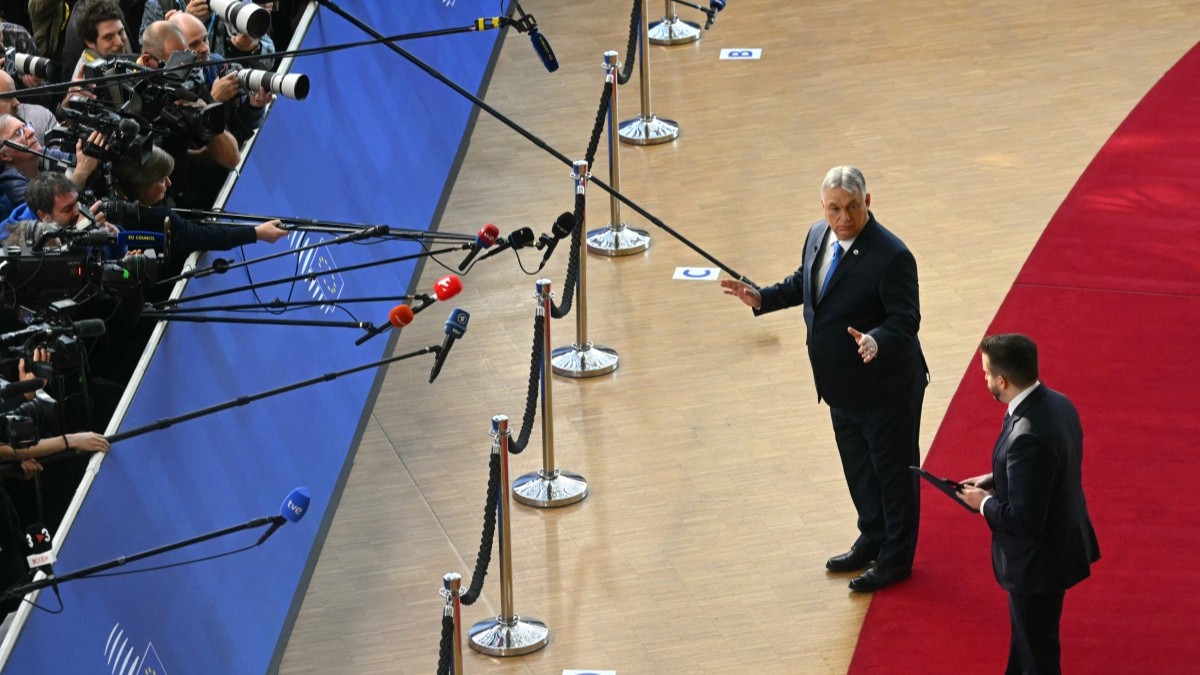
Hungary’s Prime Minister Viktor Orbán speaks to the press as he arrives for an EU Summit at the EU headquarters in Brussels, on March 19, 2026.
NICOLAS TUCAT / AFP
The European Commission confirmed this week the activation of the so-called Rapid Response System (RRS)–not incidentally ahead of the upcoming parliamentary elections in Hungary.
This mechanism was designed within the EU’s policy against disinformation and, in practice, allows the coordination of European institutions, digital platforms, fact-checkers and publicly funded organisations in order to intervene in the flow of information during a sensitive electoral period.
The system, integrated into the Code of Conduct on Disinformation and linked to the regulatory framework of the Digital Services Act, is officially presented as a tool to protect democratic processes from foreign interference.
However, recent reports warn that its real functioning relies on a network of actors closely linked to the Commission itself, raising questions about its neutrality and about the role of Brussels in the internal political debate of member states.
According to an analysis by the Democracy Interference Observatory (DIO), an initiative launched by MCC Brussels, activating the RRS allows selected organisations—including NGOs, fact-checkers and entities that are signatories to the European code to flag content for accelerated moderation on social media, which may result in its demotion, restriction or removal.
The result is a fast-track intervention architecture capable of influencing online political communication in the middle of an electoral period.
‼️🚨 EU INTERFERENCE in Hungary election just became OFFICIAL🚨‼️
— Democracy Interference Observatory (@DIObservatory) March 17, 2026
The EU commission has activated the “rapid response” system which gives EU funded “fact checkers” and NGOs a veto over online speech in Hungary.
This is to combat totally invented “Russian interference”…
The most controversial aspect of the system is the nature of the actors involved.
Among the signatories to the code underpinning the RRS are dozens of organisations that receive direct or indirect funding from the European Union or from national governments, which calls into question their role as independent observers.
Examples cited in the report include Democracy Reporting International, Reporters Without Borders, Alliance4Europe, Debunk EU or Globsec, entities that participate in projects funded by European programmes such as Horizon Europe or by national public budgets.
These organisations also operate within structures coordinated by the Commission itself, such as the European Digital Media Observatory, creating an ecosystem in which actors receiving institutional funding also take part in the mechanisms that determine which content should be flagged or limited during election campaigns.
In practice, the system allows these entities to act as trusted flaggers, with priority access to moderation channels of platforms such as Facebook, Google, TikTok or Microsoft, which are also signatories to the European code.
The Commission has justified the activation of the RRS by citing the risk of disinformation campaigns linked to Russia, an argument that has become common in EU policy in recent years.
🇭🇺 EXCLUSIVE BREAKING: FACEBOOK RESTRICTS ORBÁN POSTS WEEKS BEFORE HUNGARY’S ELECTION
— Mario Nawfal (@MarioNawfal) March 18, 2026
As Hungary heads toward a crucial April election, Facebook is reportedly restricting posts from the country’s Prime Minister.
The move followed a call by an opposition party (Tisza Party)… pic.twitter.com/WXgVOJpQKx
However, the reports supporting these warnings rely largely on anonymous sources or journalistic investigations without publicly verifiable evidence, which has fuelled the debate over whether the threat is being used to legitimize preventive interventions in the information space.
DIO notes that some of these allegations come from reports widely cited in international media but based on unidentified intelligence sources, without clear evidence of an operation capable of altering the electoral result.
Despite this, the narrative of foreign interference has been used to justify the activation of the system even before the campaign has begun.
According to various press reports, platforms that are part of the European code have already started restricting content related to the Hungarian government, reinforcing the perception that the mechanism does not merely monitor, but may directly influence the visibility of certain political messages.
The activation of the Rapid Response System in Hungary confirms a pattern that has been repeated in recent years: in every contentious electoral process, the Commission turns to networks of NGOs, fact-checkers and technology platforms to intervene in the digital environment under the argument of combating disinformation. At its core, this amounts to justifying intervention from Brussels in member states in order to “correct” what is considered contrary to its interests.