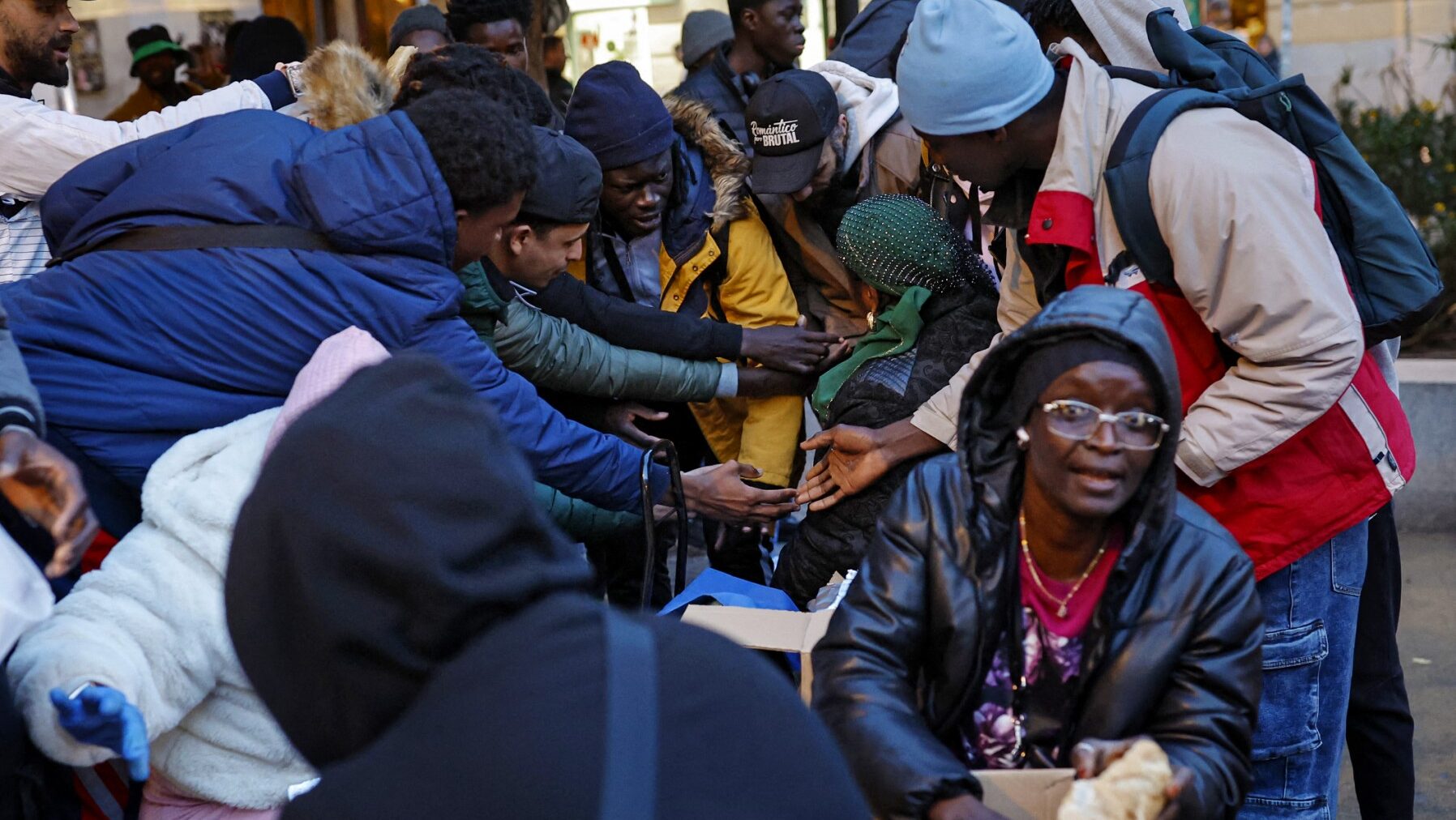
Immigrants receive an iftar meal during the food distribution organized by a group of Senegalese people during Ramadan in Lavapies Square in Madrid, on March 19, 2025.
OSCAR DEL POZO / AFP
The decision by the Spanish government to grant legal status to more than half a million illegal immigrants has triggered an immediate reaction in Brussels and reopened a deeper debate on sovereignty, security, and the coherence of European migration policy.
Although presented in Madrid as an administrative measure aimed at economic growth and social cohesion, the initiative has been met with “serious reservations” by the European Commission, according to EU sources, who warn of potential frictions with the Union’s common framework and with the spirit that currently guides the bloc’s migration policy.
The decree announced at the end of January by Pedro Sánchez’s executive will allow the regularisation of foreigners who entered Spain before December 31, 2025, and who can prove a minimum stay of five months or a prior asylum application. Beneficiaries will receive a one-year residence permit and authorisation to work in any sector.
From the EU’s perspective, the main problem is not only the scale but the automatic effect this decision has on the Union as a whole. Spain is part of the Schengen Area, which means that regularised immigrants will be able to move freely across Europe for up to 90 days in any 180 days. In Brussels, there is concern that this mobility could facilitate de facto residence in other member states without authorisation, putting further strain on already overburdened asylum and control systems.
A senior European official was explicit in stating that the measure “is not in line with the European Union’s current spirit on migration,” especially at a time when the EU is trying to send a deterrent message abroad to curb illegal migration.
The Commission’s reaction comes amid a general tightening of European migration policy. In recent months, the EU has been working on a legislative package aimed at speeding up expulsions, restricting access to asylum, and harmonising procedures at external borders. At least, this is what is set out on paper.
Among the most significant measures are the expansion of the concept of ‘safe third country,’ the creation of a common list of countries of origin considered safe, and a new returns regulation that would allow deportations to third countries with which bilateral agreements exist. All these initiatives point in the same direction: fewer incentives for illegal migration and greater border control.
Within this context, the Spanish regularisation appears in Brussels as a discordant move. The European Commissioner for Internal Affairs and Migration, Magnus Brunner, will address the issue in a specific debate in the European Parliament, pointedly titled “Spain’s large-scale regularisation policy and its impact on Schengen and EU migration policy,” this Tuesday, February 10th. Although Brunner has stressed that this is a national competence, the mere fact that the issue is being brought to the plenary reflects the level of concern.
Institutional unease has been compounded by a strong political and communicative controversy. A series of viral videos featuring MEP Irene Montero, in which she used provocative rhetoric welcoming the “replacement” of the Spanish population, amplified the impact of the decision and projected an ideologised image of Spain’s migration debate.
These statements, disseminated globally, have contributed to the regularisation being perceived not as a technical measure, but as a political gesture loaded with symbolism at a time when many Western democracies are reassessing their migration policies for reasons of security, social cohesion, and democratic legitimacy.