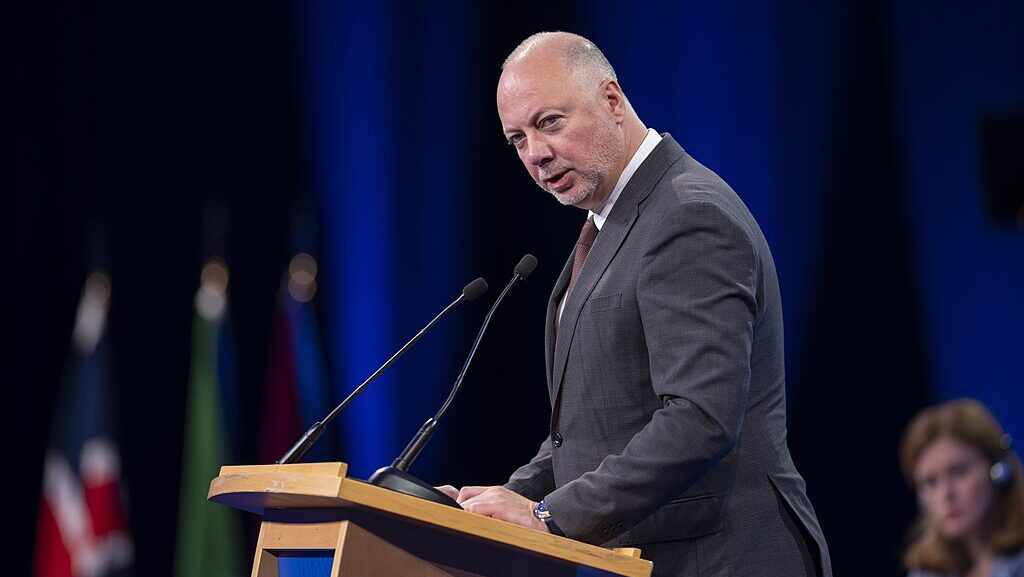
Rozsen Zhelyazkov
Houses of the Oireachtas from Ireland, CC BY 2.0, via Wikimedia Commons
On Thursday, December 11th, Bulgaria’s Prime Minister Rosen Zhelyazkov announced that his government was resigning after less than a year in office, following a wave of anti-corruption protests.
The announcement came just ahead of a parliamentary vote on a no-confidence motion filed by the opposition.
Tens of thousands of people took to the streets across Bulgaria on Wednesday to protest against the government and corruption in the latest in a series of rallies since the end of last month. The demonstrations were triggered by a draft budget for 2026—the first one since the government decided to join the euro zone—which protesters denounced as an attempt to conceal widespread corruption. Although the government withdrew the budget last week, public anger has persisted.
Protesters chanted “Resign” and carried signs reading “I’m fed up!” with caricatures of politicians. They also used lasers to project the words “Resignation,” “Mafia Out,” and “For Fair Elections” onto the parliament building in Sofia.
Last week, Bulgarian President Rumen Radev also expressed his support for the protesters and urged the government to step down to allow for early elections.
On Thursday, Prime Minister Rosen Zhelyazkov stated:
People of all ages, ethnic backgrounds, and religions have spoken out in favour of our resignation. That is why this civic energy must be supported and encouraged.
Bulgaria is scheduled to join the eurozone on January 1st, and this is expected to proceed despite the government’s resignation. However, analysts warn that low public trust in Bulgarian institutions and leaders has been further aggravated by concerns over rising prices as the country prepares to adopt the euro.
The Balkan country has already held seven snap elections since the massive anti-corruption protests of 2020 against the government of three-time prime minister Boyko Borissov.
Lukács Fux is currently a law student at Pázmány Péter Catholic University in Budapest. He served as an intern during the Hungarian Council Presidency and completed a separate internship in the European Parliament.