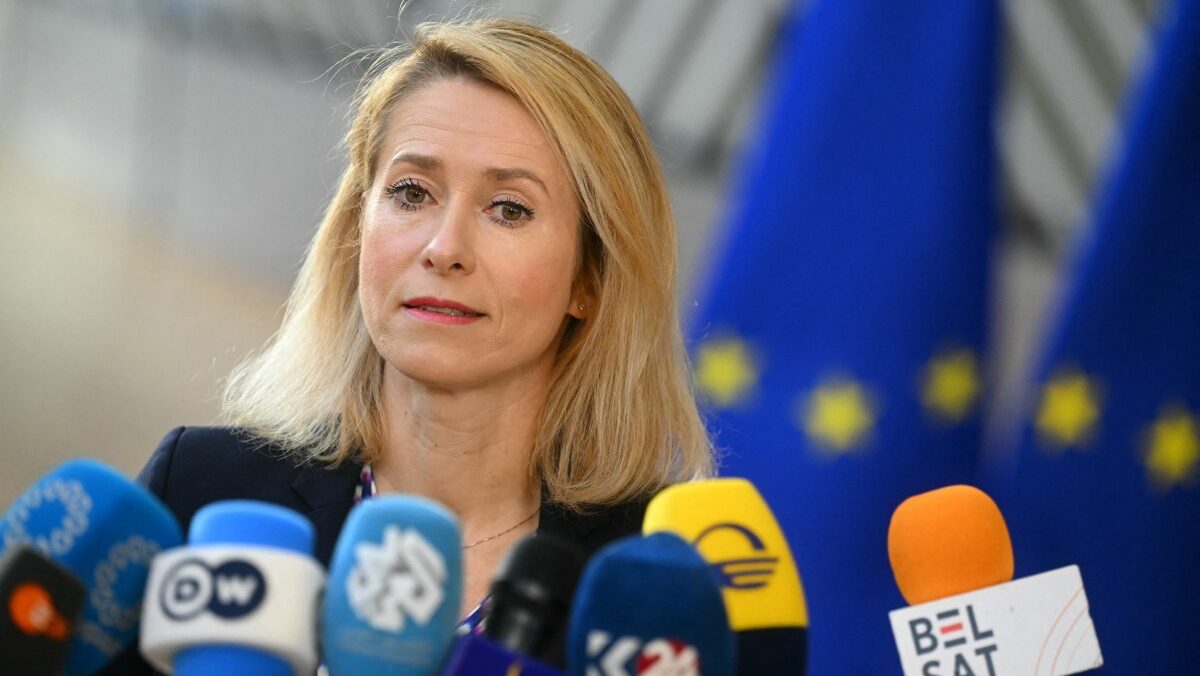
EU High Representative and Vice-President for Foreign Affairs and Security Policy, Kaja Kallas addresses the media as she arrives for a Foreign Affairs Council to discuss the Ukraine war and the situation in the Middle East, in Brussels on March 16, 2026.
NICOLAS TUCAT / AFP
Monday’s meeting of European Union foreign ministers in Brussels comes amid a combination of crises that once again call into question some of the strategic decisions adopted by the EU since 2022.
The war in the Middle East, rising energy costs, and the difficulty of completely isolating Russia have reopened a debate that until recently seemed closed: whether Europe can indefinitely maintain its policy of confrontation with Moscow without bearing an ever greater economic and political cost.
In this context, the remarks of Belgian Prime Minister Bart De Wever have had a particular impact. He is one of the few European leaders who has openly raised the need to negotiate with Russia again and to normalise relations in order to put an end to the energy crisis affecting the continent.
According to the Belgian leader, “In private, many European leaders tell me I am right, but no one dares to say it in public.” De Wever added that “we must end the conflict in Europe’s interest and, at the same time, normalise relations with Russia and regain access to cheap energy. It is pure common sense.”
His words come at a particularly delicate moment, with the war between the United States, Israel, and Iran entering its third week and energy markets reacting upward to the risk of disruptions in oil and gas supplies.
The foreign ministers of the Twenty-Seven are meeting in Brussels with the aim of coordinating the European response to the escalation in the Middle East and assessing the economic impact of the conflict.
The rise in oil and gas prices has revived fears of a new energy crisis, similar to the one experienced after the start of the war in Ukraine.
In preparatory meetings, several EU officials admitted that increasing energy costs once again expose the fragility of the European system following the accelerated abandonment of Russian supply.
The European Commission is studying measures to contain prices, including more state aid, adjustments to the emissions market, and possible reductions in energy levies in an attempt to avoid a new blow to European industry, which is becoming less and less competitive compared with the United States and Asia.
However, in parallel with these technical discussions, room is beginning to open up for political dissent over the origin of this crisis.
The Belgian prime minister’s remarks have caused discomfort in Brussels because they directly challenge the official line maintained by the EU since the start of the war in Ukraine.
“As we are not capable of threatening Putin by sending weapons and we cannot economically strangle Russia without the full support of the United States, there is only one option left: reaching an agreement,” De Wever said in a recent interview.
The Belgian leader also warned that the current strategy depends excessively on Washington and that Europe cannot indefinitely sustain a policy that harms its own economy.
His words have been interpreted by several European diplomats as a reflection of what many governments think in private, especially after the increase in energy prices and fears of new social tensions if the cost of heating and fuel surges again.
This position is particularly striking at the official level because it comes from the country where the capital of the European Union is located and is in line with the stance maintained by some Eastern European countries such as Hungary and Slovakia.
These two countries have long criticised the abandonment of Russian supply, and the Belgian prime minister’s remarks have been interpreted as a sign that this position is beginning to spread.
The closure of the Strait of Hormuz hurts the global economy and helps Russia fund its war.
— Kaja Kallas (@kajakallas) March 16, 2026
It is affecting our partners in the region and is dangerous for global energy supplies.
Today, EU Foreign Ministers will discuss how to better protect shipping in the region, including… pic.twitter.com/iJSVdT7FqA
EU High Representative Kaja Kallas defended the need to maintain European unity and called for “maximum restraint and respect for international law” in the context of the war in the Middle East, avoiding any direct comment on De Wever’s remarks while reaffirming the official line.