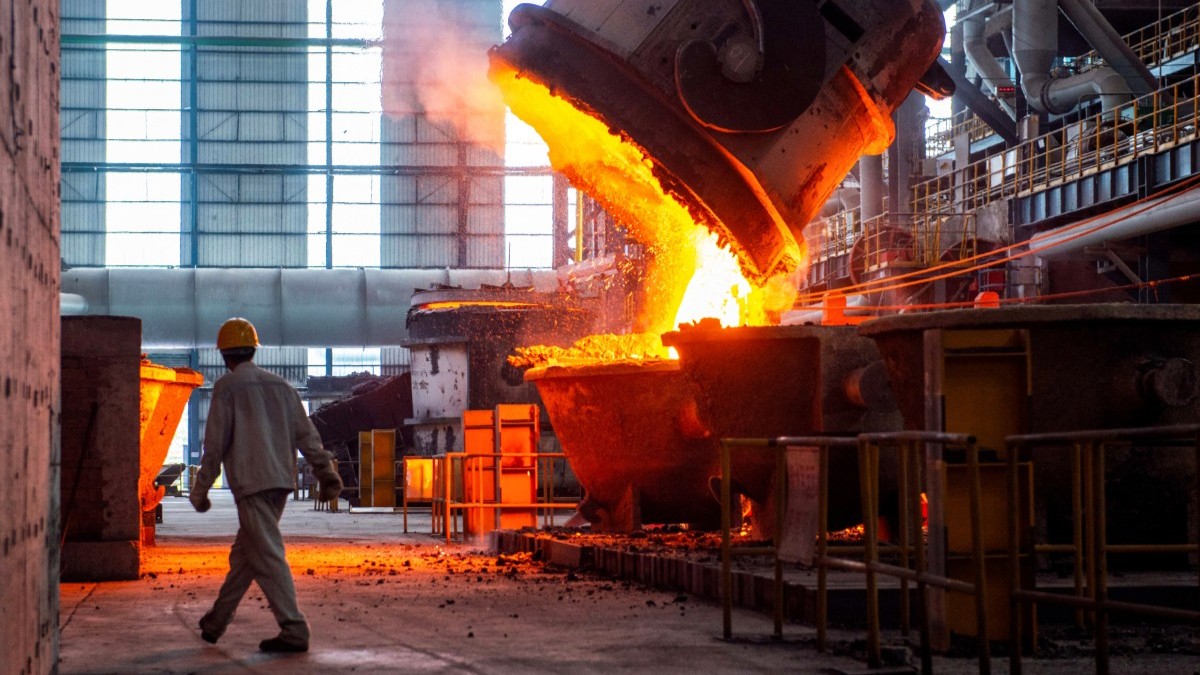
A worker walks past molten steel at a steel factory in Huai’an, in China’s eastern Jiangsu province on July 22, 2025.
AFP
Brussels has done it again. At a time of rising geopolitical and commercial tension, the European Union has chosen to harden its economic confrontation with China by activating the final phase of the Carbon Border Adjustment Mechanism (CBAM).
As of January 1st this year, European importers of emissions-intensive products—such as steel, iron, cement, aluminium, fertilizers, hydrogen, and electricity—must purchase CBAM certificates equivalent to the CO2 embedded in goods entering the EU, with prices linked to the European Emissions Trading System (EU ETS). After a transitional phase focused solely on emissions reporting, the mechanism is now producing tangible economic effects.
Officially presented as a “climate instrument,” the measure is viewed in Beijing—and by a large part of Europe’s productive sector—as a new disguised tariff and yet another form of regulatory protectionism with clear boomerang effects.
The immediate result is a new front of friction with the EU’s main trading partner, precisely as the bloc is still absorbing the cumulative consequences of years of strategic decisions taken under strong pressure from Washington. The precedent of the war in Ukraine, with its devastating impact on energy prices, inflation and European industrial competitiveness, is still too recent to ignore the warning signs.
China was quick to respond to the activation of mechanism. The Chinese Ministry of Commerce said it is “discriminatory” and “unfair,” accusing Brussels of ignoring China’s progress in decarbonisation and of imposing artificially high default benchmarks on Chinese products. Beijing argues that the CBAM violates core principles of the World Trade Organization and the UN Framework Convention on Climate Change.
Beyond diplomatic language, the message is clear: countermeasures are coming. And this is no rhetorical threat. In recent months, China has already raised tariffs on European agri-food exports, such as dairy products and pork and has rolled out an increasingly strict export-control regime on strategic minerals, battery-related technologies and other critical materials.
The consequences are now being felt sharply by European companies operating in China. According to a recent survey by the European Union Chamber of Commerce in China, more than 36% of firms are considering shifting part of their production out of the country to mitigate the impact of Chinese export controls, while 32% are seeking alternative suppliers in third markets.
This is not a carefully planned diversification strategy but a defensive reaction to mounting uncertainty. 40% of surveyed companies report that new licensing procedures have added more than two months to their delivery times; another 34% cite delays of between one and two months. None claim to have avoided disruptions.
The bottlenecks do not end with administrative approval. Even after licences are granted, 42% report additional delays at customs. The impact is direct on supply chains that are critical to European industry, from automotive manufacturing to chemicals and advanced technology.
This deterioration in the trade environment cannot be analysed in isolation. Europe’s policy towards China has hardened in parallel with the strategic escalation driven by the United States, particularly since the return of Donald Trump to an openly confrontational agenda towards both allies and rivals. Tariffs, massive industrial subsidies and pressure to decouple value chains are all part of an economic war in which Europe risks once again becoming collateral damage.
The parallel with the war in Ukraine is uncomfortable but unmistakable. In the name of geopolitical principles largely defined outside Europe, the EU accepted energy sanctions that sent costs soaring, eroded competitiveness and forced even greater dependence on alternative suppliers—many of them American. Today, with China, the script threatens to repeat itself.
Brussels continues to frame CBAM as a technical tool designed to prevent “carbon leakage” and ensure a level playing field. In practice, however, the EU is once again exporting its internal standards to the rest of the world without a realistic assessment of retaliation risks or the impact on its own industrial base.
While Beijing calls—at least rhetorically—for open markets and cooperation in the green transition, the EU establishment appears determined to double down on a regulatory agenda that, far from protecting Europe’s economies, increases their external vulnerability.