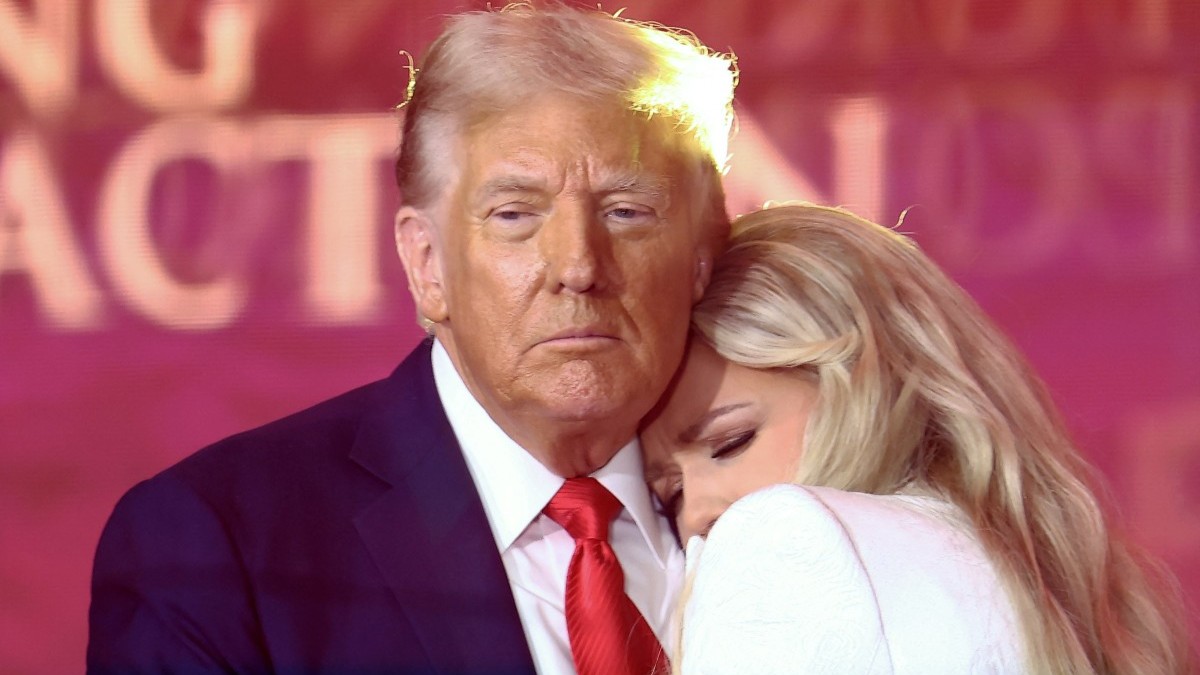
President Trump and Charlie Kirk’s widow Erika Kirk’s embrace during the Charlie Kirk Memorial in Glendale, Arizona on September 21, 2025
Charly Triballeau / AFP
The Arizona Cardinals’ NFL stadium yesterday, Sunday, September 21st, became a political and spiritual cathedral. Nearly 100,000 people filled the stands and the field, with just as many outside, unable to enter, in what is already described as the largest memorial service in recent American history.
The gathering was not a simple farewell to Charlie Kirk, founder of Turning Point USA, assassinated on September 10th. It was an event laden with powerful symbolism that bordered on the official solemnity of a state funeral. With Donald Trump, nearly his entire government, and conservative leaders from across the country present, the atmosphere was dignified and fiery in equal measure: mourning and victory, tears and the promise of continuity.
The event began with two hours of Christian music, with hands raised and collective prayers, as a prelude to what was to come: a reminder that Kirk was not only a political leader, but the architect of a spiritual awakening among America’s youth. “Charlie was a missionary with a noble spirit and a great purpose,” said Trump in his closing speech, in which he proclaimed the young leader “immortal” and embraced him as a martyr of American freedom.
LIVE NOW: Building A Legacy, Remembering Charlie Kirk https://t.co/AAuFzwObpi
— Turning Point USA (@TPUSA) September 21, 2025
But the remarks that have since circled the globe came from Erika Kirk. His widow, her voice breaking, uttered the words that defined the day: “That man. That young man. I forgive him.” The phrase, spoken in reference to her husband’s alleged assassin, unleashed an endless ovation that transformed sorrow into something more profound: an act of reconciliation, almost evangelical, that placed forgiveness at the heart of the message.
Erika was not only forgiving; she also succeeded her husband as CEO of Turning Point USA, promising that the movement would live on: “No assassin will ever stop us.”
Her speech, closer to a homily than a political address, connected with the faith and collective memory of hundreds of thousands of attendees. “On the cross, our Savior said: ‘Father, forgive them, for they know not what they do.’ I do the same,” she added. And then, amid grief, the stadium became a temple. Where many expected rage and a thirst for revenge, mercy appeared.
Vice President JD Vance, a close friend of Kirk’s, underscored the spiritual legacy: “It is better to face a gunman than to live your life afraid to speak the truth.” Marco Rubio spoke of a “renewal” among the youth that Kirk had inspired. And Donald Trump Jr. proclaimed: “If we truly want to honor Charlie, his death cannot be the end. When they killed him, a million Charlies were born to take his place. We are all Charlie.”
The echo of those words resounded in a packed stadium where American flags waved and Bibles were open. As one of Kirk’s closest collaborators reminded, citing Kierkegaard: “The tyrant dies and his power ends. The martyr dies and his power begins.”
The day left one certainty among those present: Kirk, at only 31 years old, had been elevated by his followers to the rank of martyr of conservative and Christian America. What began as a wake turned into an act of collective reaffirmation. For the American right, Charlie Kirk is now not a lost leader but a standard-bearer destined to shape the politics and culture of the country in the years to come.