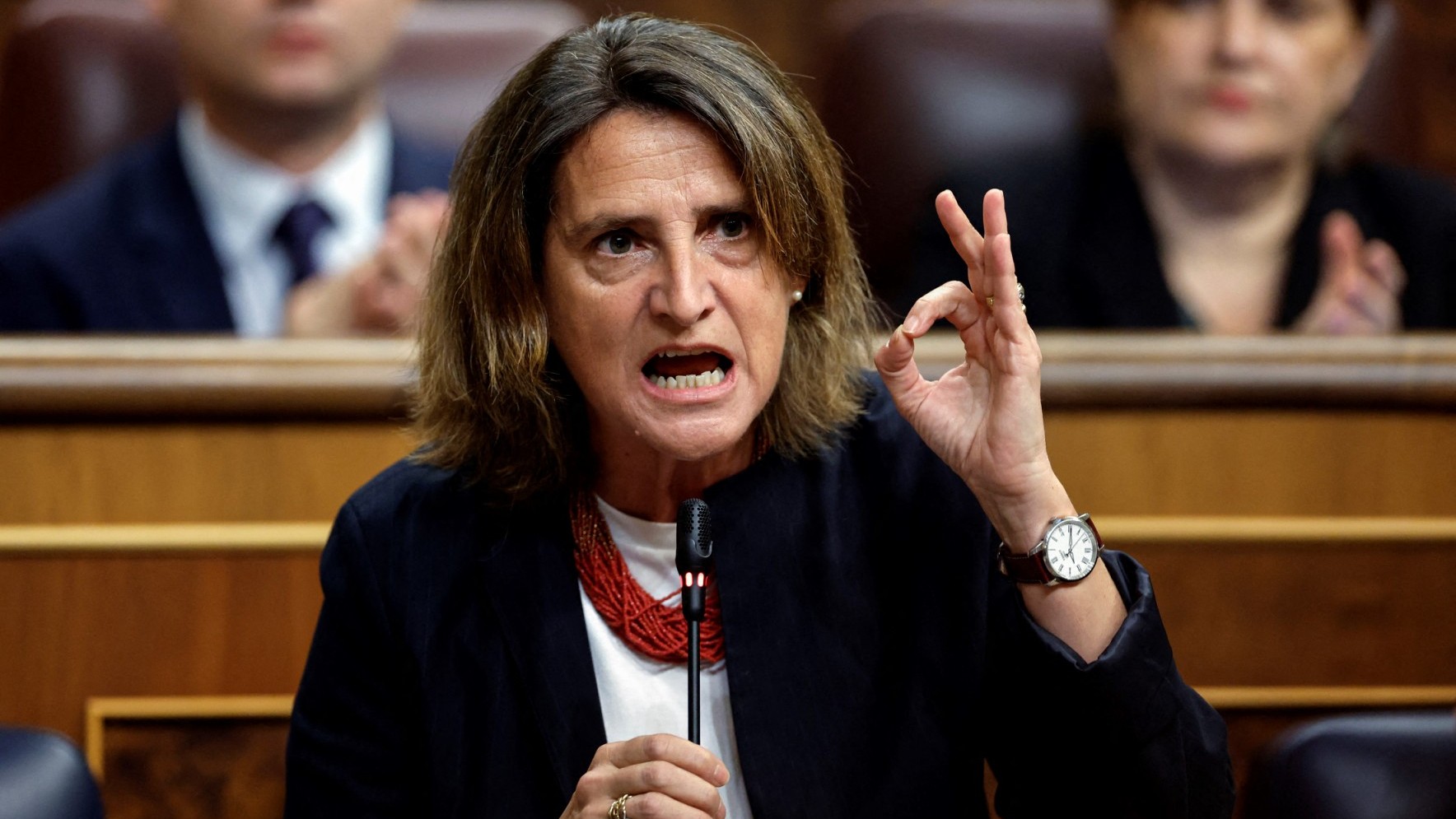
Then Spain’s Deputy Prime Minister Teresa Ribera talks during a plenary session at the Congress of Deputies in Madrid on November 20, 2024.
Oscar del Pozo / AFP
European Commission Vice-President and Competition Commissioner Teresa Ribera (formerly Spain’s deputy PM) has delivered an unusually harsh message to the European People’s Party (EPP), warning in an interview with the EFE news agency that the group’s recent alignment with right-wing parties in several European Parliament votes represents “the seed of the destruction of the European project.”
More than a technical assessment, her remarks are understood as a direct warning to the largest political group in the Parliament, which she holds responsible for undermining Brussels’ traditional policy line.
According to Ribera, the EPP’s shift toward more critical positions on certain regulations marks a departure from the historic logic of broad coalitions that—in her view—has sustained European integration since the post-war era. At the centre of her criticism are votes concerning corporate sustainability, anti-deforestation measures, and parts of the Green Deal, where the EPP supported revising or easing certain provisions. Although these changes were initially presented as administrative simplifications, Ribera claims they are “opening up” the substance of laws considered essential to the EU agenda.
For the Vice-President, these developments reflect a “very worrying” trend toward recovering national prerogatives. She argues that aligning with parties that “advocate the dismantling of the European project” would amount to a step back toward more sovereign, state-centred models—a scenario she describes as an existential threat to the European consensus.
Ribera identifies one of the major dangers as a potential “fragmentation” of the single market if Member States regain broader regulatory powers. She warns that returning to “twenty-seven separate spaces” would weaken the Union’s economic capacity and create uncertainty for companies and consumers.
However, this argument clearly carries a political dimension: for decades, the EU functioned as a framework of economic integration without structural clashes with national sovereignty, until the post-Lisbon Treaty era triggered an accelerated centralisation of competences. Ribera’s warning, therefore, reinforces the message that any step back from this model of integration would put the current EU architecture at risk.
Another part of her message was directed at the United States. According to Ribera, Washington has pressured Brussels to soften its regulation of major digital platforms in exchange for tariff adjustments. The Commissioner argues that accepting such a proposal would place the EU in a “subordinate position” and insists that the bloc must enforce the Digital Markets Act without concessions, which is currently being implemented with ongoing investigations into Apple and Meta.
This discourse aligns with the vision of a Europe strengthening its regulatory sovereignty through increasingly far-reaching and harmonised rules—a trend Ribera sees as essential to compete with both the United States and China, the latter of which she describes as having pursued a long-term strategy in green technologies.
Ribera described the EU’s institutional situation as “extraordinarily delicate” due to external pressures, internal tensions, and growing challenges to the European regulatory framework. For the Commissioner, this context requires “protecting and defending” the EU’s political model and avoiding any step that might be interpreted as a return to national autonomy.
Her conclusion follows the same line: reinforcing Brussels’ regulatory power and preserving the current model of integration against what she considers internal threats—among them, the EPP’s shift toward more critical positions on heavy-handed EU regulation. In other words, defending the cordon sanitaire but expressed in different terms. Nothing new.