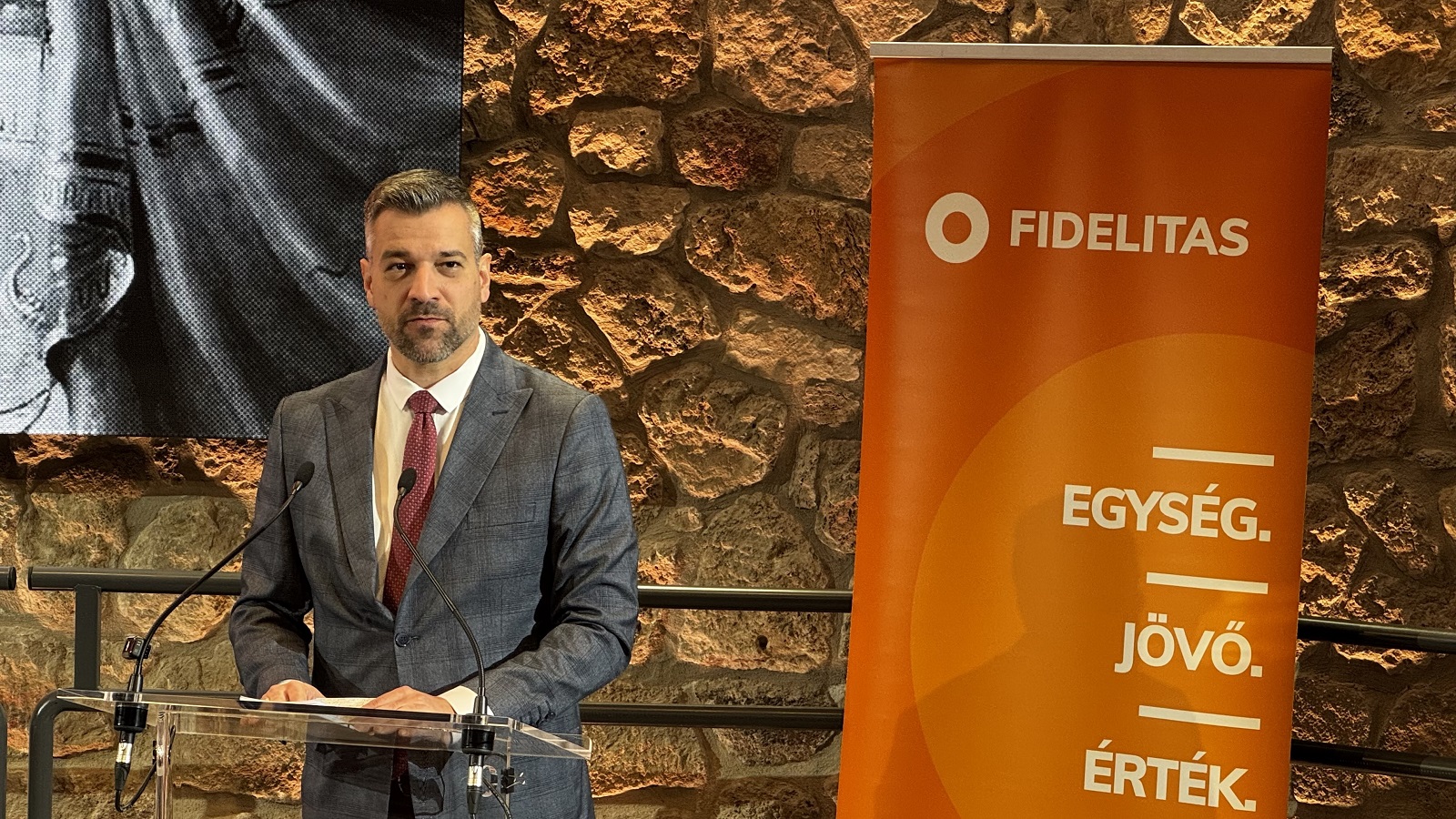
András Laszlo, Fidesz MEP and member of the Patriots group in the European Parliament,
Javier Villamor/TEC
Sunday, March 22 saw The Danube Institute host a meeting organized by Fidelitas in which Hungarian political leaders, international officials, and young European and American activists took part to discuss the future of Europe, the defense of national sovereignty, and the role of the new generation at a moment that several speakers described as particularly delicate for the continent.
The session was opened by the Institute’s Director of Research, Dr. Calum T. M. Nicholson, who began the conference by recalling the transatlantic character of the institution and the purpose for which it was created: to strengthen the links between Hungary and the Anglosphere, but also to promote a broader intellectual debate about Europe’s political direction.
Nicholson, British-Canadian by origin, explained that his experience living in Central Europe had led him to question the way the Anglosphere usually interprets international politics:
In the Anglosphere we tend to see the world in a very binary way, as if everything were black or white, right or wrong. In this region, by contrast, one learns that history, borders and identity are far more complex.
The researcher pointed to the reality of Central Europe itself, where borders changed repeatedly throughout the twentieth century and where, as he noted, “nations do not always end where we think they end”, an idea he used to underline that current debates about sovereignty, migration or identity cannot be understood through simplified frameworks.
After the opening remarks, András László, Fidesz Member of the European Parliament and member of the Patriots group in the European Parliament, took the floor and focused his intervention on the current political context, which he described as a decisive stage for the continent. “Europe today is living through a time of crossroads,” he told the audience:
We are facing at the same time the consequences of war, migratory pressure, energy problems and a loss of competitiveness that is weakening our economies.
According to the MEP, these crises cannot be understood separately, but as the result of a political model that has gradually moved decision-making away from citizens.
“The central question is who decides about our future. More and more often it is not the nations, but structures that move power further away from the people. Sovereignty is not the problem; its erosion is. Borders are not a danger; their disappearance is,” he argued.
László maintained that the solution is not to dismantle Europe, but to return the leading role to the states and the political communities that built it, and warned that the younger generation will be the one that has to bear the consequences of current decisions, especially on issues such as the war in Ukraine, energy policy, and immigration.
Fidelitas International Director Anna Lakó introduced the part of the meeting dedicated to the debate among young participants, with delegations from several European countries as well as from the United States.
Lakó stressed that the aim of the forum was to strengthen cooperation between conservative youth organizations and to show that a new generation is ready to take part in politics:
Today is not only about listening to speeches, but about taking responsibility. Europe is going through a decisive moment and our generation will have to decide whether it preserves what we have inherited or allows it to be lost.
She thanked the presence of American youth organizations and highlighted the importance of transatlantic cooperation.
The second part of the event featured several young participants, who presented their views on the political situation on both sides of the Atlantic and on the challenges that, in their opinion, will shape the coming years in Europe and in the United States.
One of the most commented interventions was that of a Hungarian student, who summed up the tone of the debate by saying that the current generation is facing a particularly complex historical moment.
“Europe is in a very difficult phase, probably the most important of its recent history, because everything has become political: the economy, culture, security and even everyday life. And when everything becomes political, what is at stake is the very future of our nations,” she said during the discussion.
Participants agreed that the new conservative generations see the current situation as a phase of redefinition of the European project, marked by debates about sovereignty, identity and democratic legitimacy, but also by growing cooperation between political movements that until a few years ago acted separately.
The Budapest meeting is part of a series of forums promoted by Fidelitas and the Danube Institute aimed at strengthening international networks among young political leaders and academics, at a time when, according to several speakers, debates about borders, war, the economy and institutional power are likely to return to the center of European politics in the coming years.