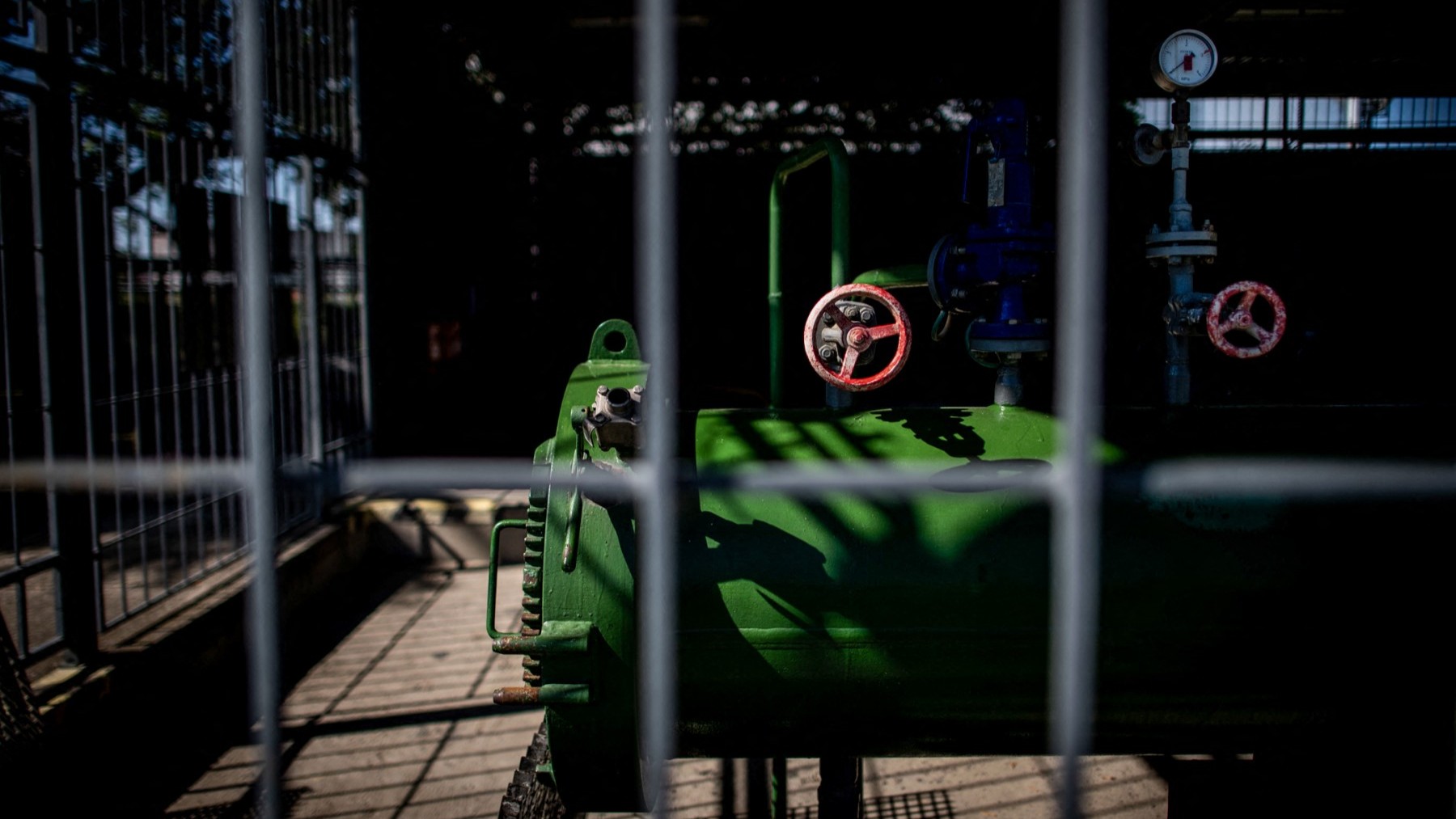
This picture taken on May 19, 2022 shows an endpoint of the oil pipeline Druzhba in Slovak refinery Slovnaft in Bratislava, Slovakia.
VLADIMIR SIMICEK / AFP
The European Commission has convened an extraordinary meeting of the Oil Coordination Group for next Wednesday, following the disruption of supply through the Druzhba pipeline and the decision by Hungary and Slovakia to suspend diesel shipments to Ukraine.
The origin of the conflict dates back to January 27, when an alleged Russian drone attack on Ukrainian territory put out of service the section of the Druzhba pipeline that supplies Hungary and Slovakia.
Both countries rely heavily on Russian crude transported through this route to feed their refineries. Budapest and Bratislava accuse Kyiv of deliberately delaying repairs for political reasons and responded by suspending their diesel exports to Ukraine.
The measure further aggravates Ukraine’s already fragile energy situation in the middle of winter, marked by blackouts and heating problems after months of attacks on its power grid.
Brussels reacted by convening an ad hoc meeting to assess the impact of the disruption and explore alternative supply options.
However, from the outset it stressed that it does not intend to “exert pressure on Ukraine” to speed up repairs, a nuance that reflects the political sensitivity of the moment.
Following the closure of Druzhba, Hungary asked the Commission to facilitate the transport of Russian oil by sea through the Adriatic pipeline managed by the Croatian company JANAF. Zagreb refused to allow the transit of Russian crude, although it assured it was willing to supply oil from other sources.
Croatian authorities maintain that JANAF’s capacity—up to 15 million tonnes per year—is sufficient to cover the needs of Hungary and Slovakia. Technically, there are no significant obstacles and transport tariffs account for barely 1% of the total cost.
The real core of the conflict is economic. Russian oil remains approximately 30% cheaper than the alternatives available on the international market. For Budapest and Bratislava, replacing it would mean higher costs, inflationary pressure and loss of competitiveness.
The Commission insists that neither Hungary nor Slovakia faces an immediate risk to their security of supply thanks to their strategic reserves. At the same time, it has expressed concern about Ukraine’s energy situation. This balancing act has caused discontent in Budapest.
Hungarian Foreign Minister Péter Szijjártó called on Brussels to act “as the European Commission and not as the Commission of Ukraine,” demanding that the commitments of the Association Agreement and the existing rules on Russian crude imports be respected while the pipeline remains out of service.
In January 2026, the EU adopted legislation requiring Member States to phase out Russian fossil fuels by 2027. Hungary and Slovakia have challenged the law, arguing a lack of viable alternatives and disproportionate costs. From Kyiv, for its part, both governments are accused of prolonging their energy dependence on Moscow.
It is striking that a country seeking to join the EU maintains a confrontation with two of its members and attempts to dictate their energy agenda, which is key to economic development. It is even more disconcerting that Brussels appears to side with the third party in the dispute.