Tara Winstead on Pexels
Europe is entering an elections year laden with political, institutional, and strategic tension. This is not merely a succession of trips to the ballot box, but an open struggle for control over the internal balances of power within the European Union.
In a context shaped by war in the East, economic erosion, growing public disaffection, and the advance of a centralising agenda from Brussels, every national or regional election takes on a significance that goes well beyond the borders of the country concerned.
A genuine change of course remains unlikely for now. But holding ground—preventing the consolidation of a federalist majority willing to hollow out national sovereignty—has become the minimum objective for those who defend a Europe of states rather than a technocratic superstate. From that perspective, some elections are clearly more decisive than others.
Among all the scheduled contests, Hungary’s parliamentary elections, set for April 12th, stand out as the most consequential of the year.
This is not only due to the symbolic weight of Viktor Orbán as a reference point for Europe’s sovereigntist bloc, but also because of Hungary’s practical role as a bulwark against the EU’s federal drift.
Hungary is currently one of the main obstacles to Brussels’ push for Treaty reform aimed at abolishing the right of veto in key policy areas. That veto remains the last effective brake on far-reaching decisions—from fiscal policy to sanctions, enlargement, or transfers of competences—that the Commission and major Member States are promoting with increasing openness.
It is no coincidence that, faced with the inability to impose certain changes through formal channels, EU institutions are increasingly resorting to legal shortcuts, strained interpretations, or “provisional” mechanisms that bypass state control. For Brussels, Hungary remaining outside the disciplined mainstream is an anomaly to be corrected. For Europe’s institutional balance, it remains a safeguard.
Beyond Hungary, other elections in the Union will also have a direct impact on the composition of the Council of the European Union, the bloc’s true centre of political power. Each national government that shifts towards more conservative or Eurosceptic positions introduces friction, slows down automatic consensus, and complicates the dynamics of mutual pressure and leverage that have characterised recent years.
Parliamentary elections in Slovenia (March 22) and Cyprus (May 24) are relevant in this regard. In both cases, gains by conservative forces or by parties critical of accelerated integration could reinforce an informal bloc of countries willing, at the very least, to debate and resist the Commission’s priorities rather than accept them unquestioningly.
A similar dynamic applies to legislative elections in Sweden (September 13) and Denmark (expected in the autumn). Although both countries belong to Europe’s northern core, a shift in their internal political balance could temper their traditional alignment with Brussels’ more interventionist positions.
Regional elections in Germany—Baden-Württemberg, Rhineland-Palatinate, Saxony-Anhalt, Berlin, and Mecklenburg-Western Pomerania—should not be underestimated. Germany remains the Union’s political and economic engine, and any weakening of its internal consensus translates into reduced leadership capacity at the European level. The advance of conservative or status-quo-critical forces in the eastern Länder, in particular, adds pressure to an already eroded federal government.
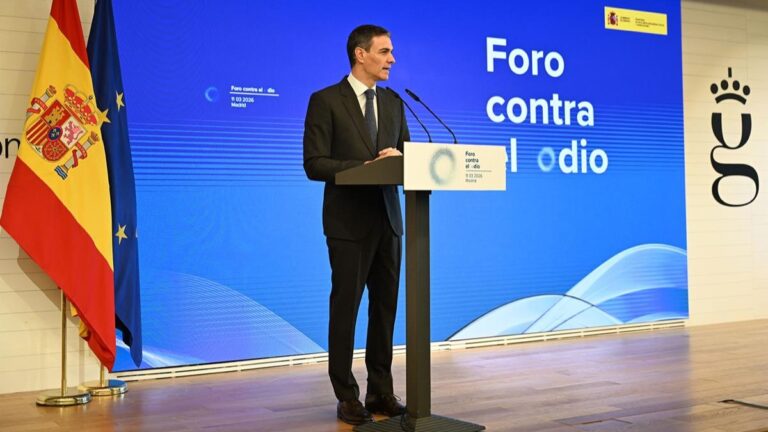
In Spain, although general elections are not expected until 2027 despite the Socialist government’s ongoing crises, regional contests in Aragon, Castile and León, and Andalusia will serve as a political barometer. Not so much for their immediate impact in Brussels, but for their ability to condition the stability of a central government that remains a key ally of the Commission in advancing its ideological and regulatory agenda. Pedro Sánchez is a crucial partner for Ursula von der Leyen—and vice versa.
All of this is unfolding under the normalisation of preventive intervention. The so-called Democracy Shield opens the door for Brussels to act whenever it deems an electoral outcome “undesirable” or believes it poses “systemic risks.” The ambiguity of the concept is precisely its greatest danger.
The result is a political climate of “all or nothing,” in which elections cease to be a normalised democratic contest and instead become existential battles. All available instruments will be used—indeed, are already being used: media pressure, judicialization, financial conditionality, and the moral stigmatisation of political opponents.