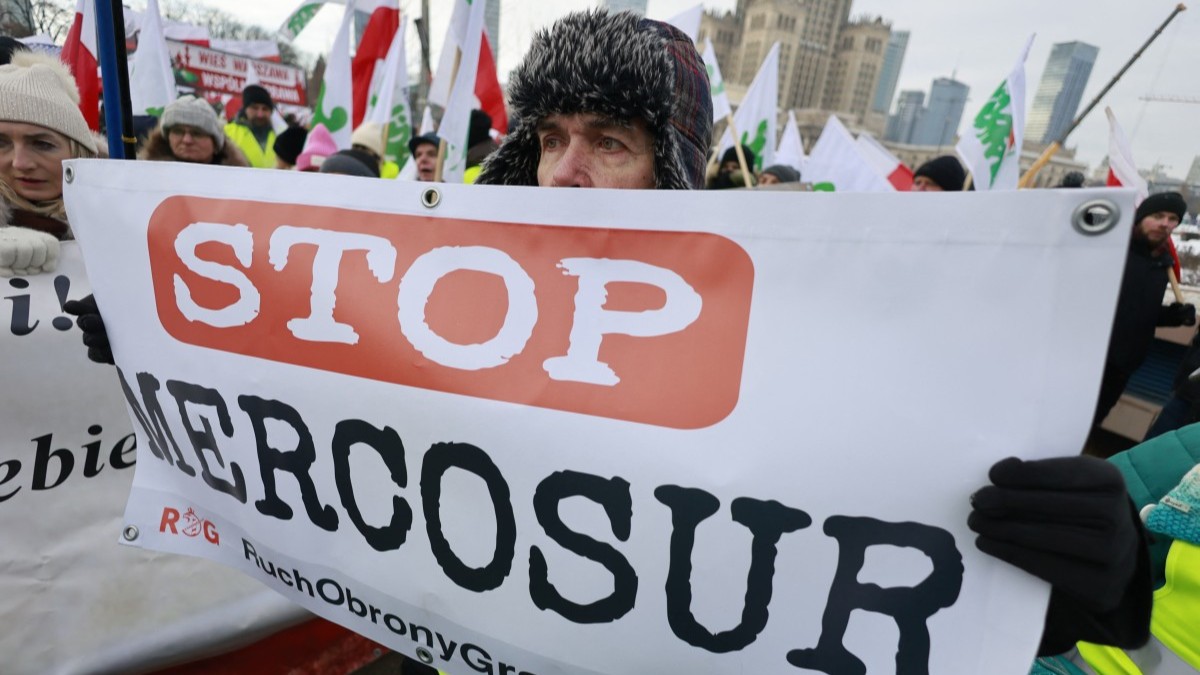
A Polish farmer at a protest against the EU-Mercosur agreement in Warsaw, Poland on January 9, 2026
Wojtek Radwanski / AFP
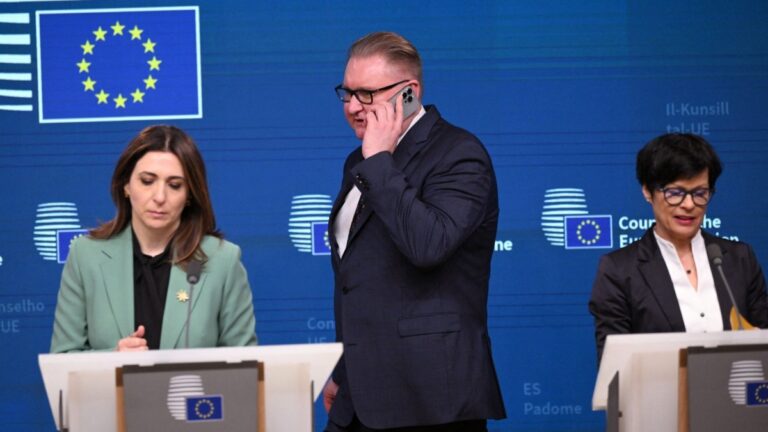
The decision has been taken, and there is no turning back. Backed by a qualified majority of member states, the European Union approved this Friday the free trade agreement with Mercosur, bringing to a close more than 25 years of negotiations and explicitly disregarding the warnings of the European agricultural sector and the outright opposition of key countries such as France.
Brussels has chosen to sacrifice the farming sector in the name of a commercial and geopolitical strategy designed behind closed doors, detached from the productive and social reality of vast rural areas across Europe. A blow that is hard to explain—and even harder to justify—for farmers and livestock producers who are already operating at the limit.
With this green light from the Council, the President of the European Commission, Ursula von der Leyen, will travel on Monday to Asunción to sign an agreement that will bind the EU to Argentina, Brazil, Uruguay, and Paraguay, creating on paper the largest free trade area in the world. In practice, the deal opens the European market to agri-food products produced under standards far below those required within the Union.
For months, Europe’s primary sector has warned about the consequences of the agreement: a massive influx of meat, rice, honey, soy, or sugar at prices impossible to match; the use of pesticides and substances banned in Europe; and additional pressure on margins already squeezed by regulation, energy costs, and EU bureaucracy.
Farmers’ protests in France, Belgium, Spain and Poland have failed to alter the course. Neither have warnings about the loss of food sovereignty nor the real risk of family farms disappearing. The implicit message from Brussels is clear: agriculture is nothing more than an adjustment variable.
The Commission has attempted to dress up the decision with safeguard clauses, automatic investigations in the event of market distortions, or promises of advance payments under the Common Agricultural Policy.
But the sector itself considers these measures insufficient, slow, and, in practice, ineffective in the face of a large-scale import shock.
France’s rejection—supported by other countries such as Poland, Ireland and Hungary—shows that this is not a marginal or ideological objection, but a structural concern shared by major agricultural producers. However, the qualified majority system has allowed the Commission to push ahead even without the backing of one of the EU’s leading farming powers.
The real problem is that this sets a deeply troubling precedent for the future. When strategic interests defined in Brussels collide with key sectors of member states, the latter can simply be ignored.
Supporters of the agreement insist on its strategic value: diversifying alliances in the face of pressure from the United States, competing with China, and strengthening the EU’s international credibility. These arguments may make sense in macroeconomic or diplomatic terms, but they fail to answer a fundamental question: who pays the price?
The answer is clear. European farmers aro subjected to strict rules in the name of climate, health, or sustainability, while products that do not meet those same standards are allowed to enter. Rural areas are already battered by depopulation and the lack of generational renewal. And, in the medium term, consumers do, as local production disappears in favor of long, opaque supply chains controlled by large corporations.