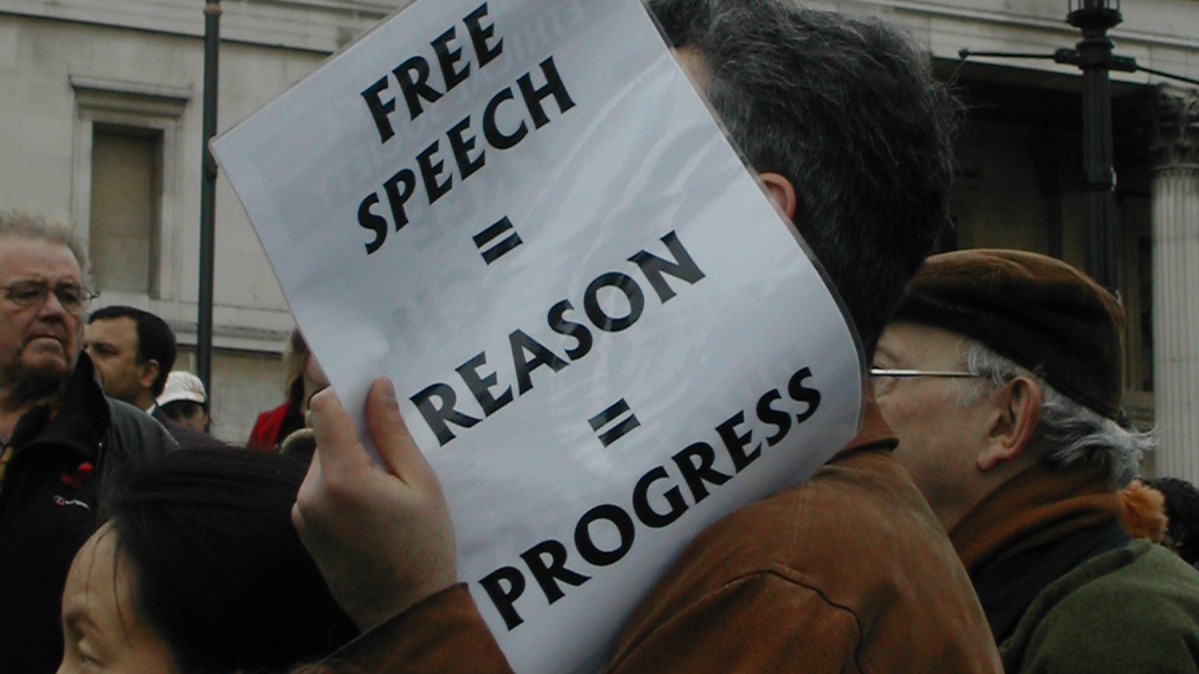
By Simon Gibbs from London, United Kingdom – Free speech = reason = progressUploaded by Cirt, CC BY 2.0, https://commons.wikimedia.org/w/index.php?curid=22571007
The European Commission presented on Wednesday, November 12th, in a joint press conference by Irish Commissioner Michael McGrath and Vice President Henna Virkunnen, the new “European Democracy Shield”, a legislative package that promises to strengthen the Union’s “democratic resilience.” But beyond the rhetoric of defense against disinformation and hybrid attacks, what emerges is the design of a genuine Orwellian state: a centralized system of information surveillance under the pretext of “protecting democracy.”
As McGrath and Virkunnen explained, the plan revolves around three pillars: “protecting the information space,” “strengthening democratic institutions,” and “enhancing social resilience.” In practice, however, this means giving Brussels the power to monitor media outlets, social networks, and national electoral processes, under the argument of preventing “foreign manipulation.”
The creation of the European Centre for Democratic Resilience will be the key element. This new body will serve—according to the EU itself—“to detect, deter, and respond to threats of disinformation and manipulation.” In other words, a European digital surveillance agency that will coordinate member states actions, track online content, and define what information is deemed “reliable.”
Vice President Virkunnen’s language was unequivocal: “European democracy is under attack and we must protect it.” Yet it was never clarified who would decide what constitutes an attack or what counts as “fake news.” In a context where political criticism can easily be labeled “disinformation,” the risk of censorship is evident.
Another major point was the intention to intensify investigations into large digital platforms—Meta, X, TikTok—within the framework of the Digital Services Act and the Artificial Intelligence Act. These regulations will impose an obligation to label or remove AI-generated content and deepfakes, especially during electoral campaigns.
Although the measure is presented as a guarantee of transparency, it opens the door to political supervision of digital communication, concentrating within the Commission the power to decide what can or cannot circulate on social networks. It is a centralized model of control over public discourse, inspired by national “disinformation monitoring” agencies already operating in France and Sweden.
In his statement, McGrath insisted that the Shield “does not seek to limit freedom, but to protect it.” However, the legislative proposal shows a clearly interventionist approach: the creation of pan-European networks of “independent” fact-checkers, crisis protocols to remove “harmful” content, and a legal framework that would allow the temporary suspension of certain messages during election campaigns. It is the same old totalitarian agenda, now disguised as the supposed defense of democracy.
Thus, what is emerging is a technocratically managed democracy, in which Brussels acts as the moral and informational arbiter of the continent. Instead of strengthening national sovereignty and the plurality of voices, the EU has chosen to shield itself against criticism, wrapping its discourse in concepts such as “resilience,” “information security,” and “citizens’ trust.”
The new Shield fits into a broader trend: the institutional bunkerization of the European Union, which is moving toward an increasingly closed and self-referential structure. After the failure of its “unity” narrative during the pandemic and facing the rise of Eurosceptic movements, Brussels is reinforcing its mechanisms of social control under the guise of security.
Under the pretext of combating Russian bots or fake news, the Commission seeks to build a system that erodes fundamental freedoms—freedom of the press, of thought, and of expression—essential pillars of the democratic Europe it claims to defend.