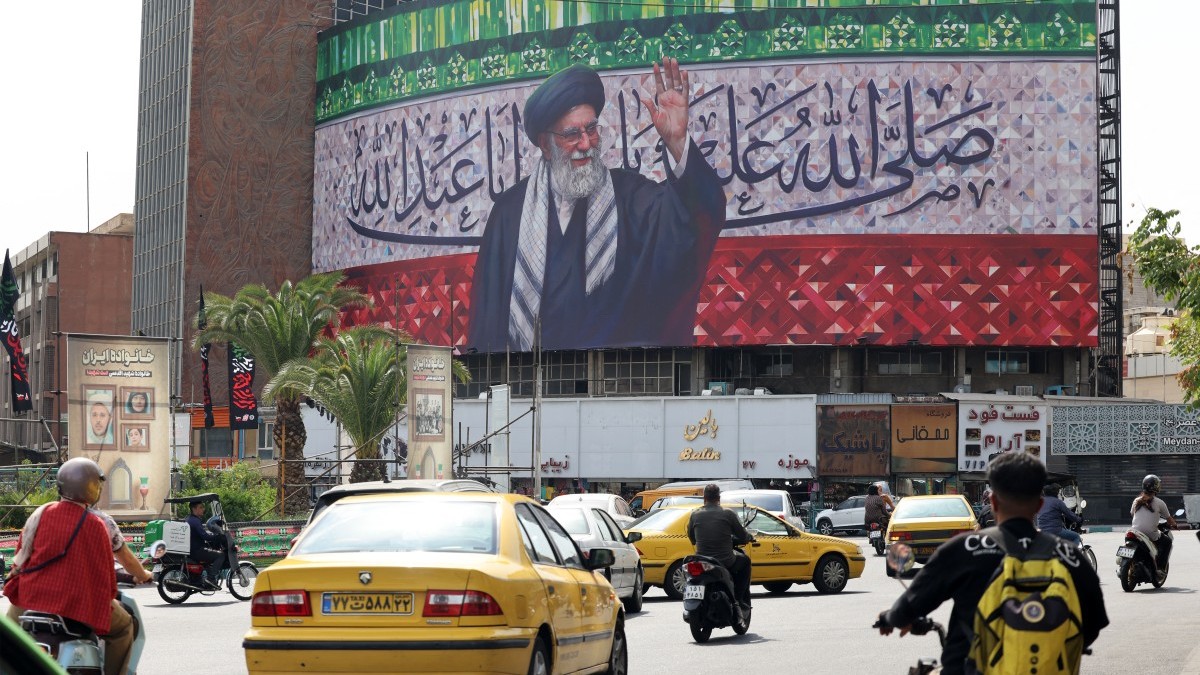
Motorists drive their vehicles past a billboard depicting Iran’s Supreme Leader Ayatollah Ali Khamenei displayed in the centre of Tehran’s Valiasr Square on July 13, 2025.
Atta Kenare / AFP
Iran held another round of talks on Tuesday, August 26th with European powers in Geneva, seeking to avert the threat of sweeping UN sanctions being reinstated under the expiring 2015 nuclear deal.
The negotiations brought together Iranian Deputy Foreign Ministers Majid Takht-Ravanchi and Kazem Gharibabadi with British, French and German Germany officials, as well as the Deputy High Representative of the European Union for Foreign Affairs. The session followed a previous round of talks on July 24th in Istanbul.
“The main focus of the discussions was Europe’s threat to trigger the snapback mechanism as well as certain issues related to the extension of UN Security Council Resolution 2231,” according to Iranian officials.
Gharibabadi later wrote on X: “Dr. Takht-Ravanchi and I held another meeting with the political directors of the three European countries in Geneva. Both sides outlined their views regarding UN Security Council Resolution 2231. Iran remains committed to diplomacy and to seeking a mutually beneficial diplomatic solution. It is time for the three European countries and the UN Security Council to make the right choice and give diplomacy the time and space it needs.”
At a regular press conference in Tehran earlier, foreign ministry spokesman Esmaeil Baqaei emphasized that “our focus is on preventing actions or incidents that may be costly for the country,” adding that Tehran was “negotiating with all our might.”
The talks were arranged after a phone conversation last Friday between Foreign Minister Abbas Araghchi and his European counterparts, along with the EU’s foreign policy chief, during which it was agreed that discussions should continue at the deputy foreign minister level.
The European trio have threatened to activate the deal’s “snapback mechanism” by the end of August. If triggered, the mechanism would reinstate all UN sanctions lifted under the accord unless Iran curbs its uranium enrichment and restores cooperation with International Atomic Energy Agency inspectors.
Baqaei argued that the European powers “do not have the legal and moral” grounds to pursue such action. “We will not allow this issue to become a tool of psychological warfare,” he told reporters.
Although the window for activating the mechanism closes in October, after which sanctions would be permanently lifted, the Europeans have floated the idea of extending the deadline. Iran has firmly rejected their authority to do so, with Araghchi stating Tehran is working closely with China and Russia to block the move.
The conflict derailed Iran’s earlier rounds of nuclear negotiations with Washington, which had included five sessions aimed at reaching a new agreement. A ceasefire between Iran and Israel has held since June 24th, but with sanctions looming, officials on both sides of the Geneva table now say diplomacy has entered its final stretch.