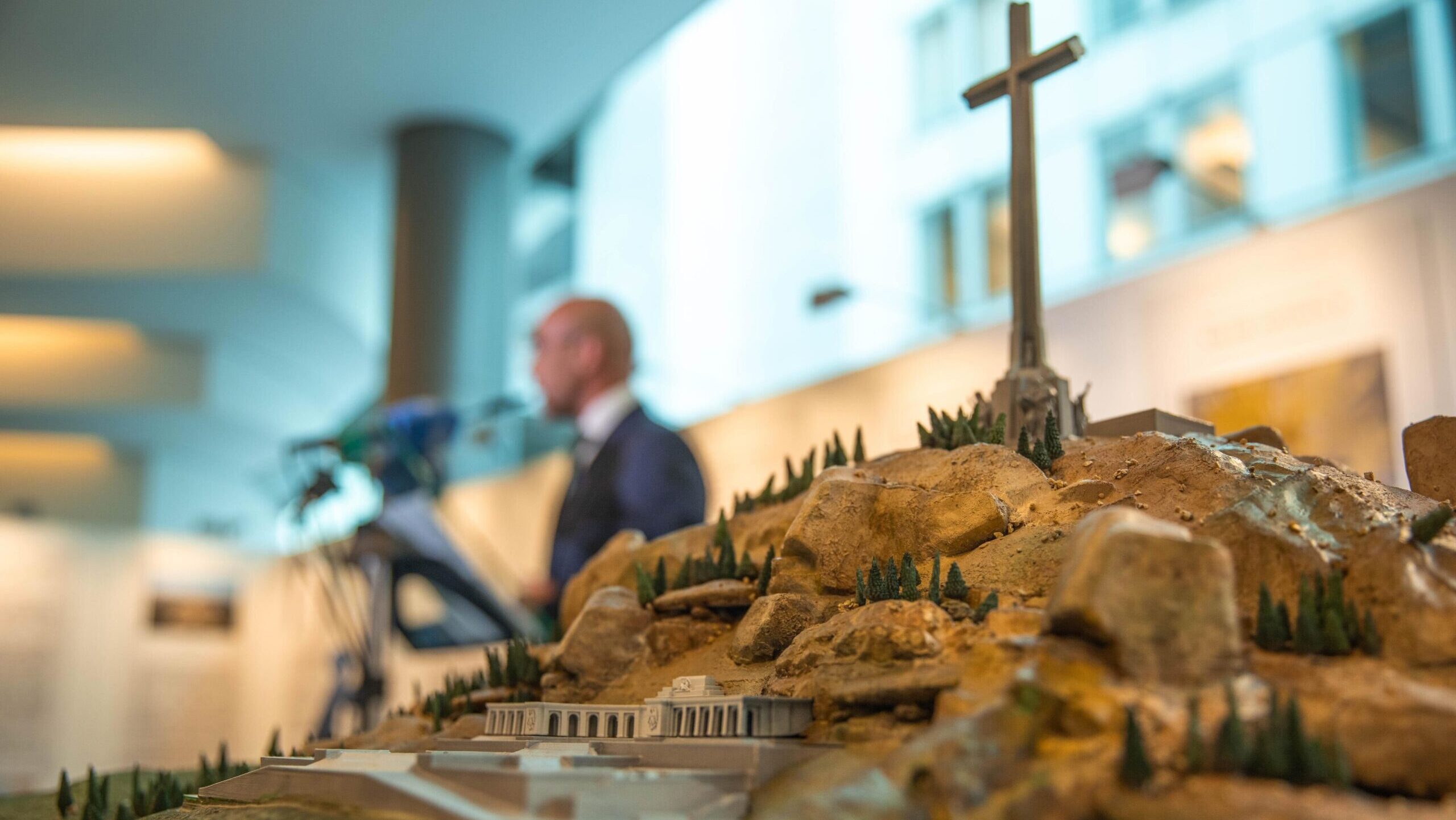
Model of Valley of the Fallen, Jorge Buxadé (VOX) in background.
VOX
The European Parliament in Brussels has hosted an exhibition promoted by the Patriots for Europe group and the VOX delegation with a clear aim: to present the historical, artistic, and spiritual value of the Valley of the Fallen as an essential part of Europe’s cultural heritage. More than a simple display of images, the event became a powerful affirmation of the soul of Europe—rooted in Christianity and in an unmanipulated, truthful memory of the past.
The exhibition featured a carefully curated selection of photographs taken over the years, capturing the ever-changing light on the stone, the contrast between the monument’s immense cross and the humble natural surroundings, and the architectural harmony of the site. Through these images, viewers were invited to look beyond ideological prejudice and rediscover a place conceived not to divide, but to unite.
The Valley of the Fallen, built as a resting place for combatants from both sides of the Spanish Civil War, stands today as one of the greatest symbols of reconciliation in the 20th century. Its basilica carved into rock, the monumental cross that crowns it, the constant presence of Benedictine monks, and the boys’ choir that singsGregorian chants daily all testify to a living spirituality untouched by fashion or political decrees.
Throughout the event, several experts highlighted the monument’s universal value, drawing comparisons to other emblematic works of Western culture. It was recalled that artists from across the political spectrum—including socialists and Basque nationalists—took part in its construction, and that the often-repeated claim of 20,000 forced laborers is part of an ideologically driven narrative that distorts the documented reality.
Speakers also warned against ongoing attempts to strip the Valley of its spiritual dimension—whether by transforming it into a secular museum or by expelling the monastic community that still prays there. Such actions, they argued, would amount to a modern form of iconoclasm: not the destruction of stone, but of meaning.
MEP Jorge Buxadé closed the event with a forceful defense of European identity: “Europe was not born in the Treaty of Rome, but in Subiaco, when Saint Benedict wrote his rule. The Valley of the Fallen—carved into rock, with its Benedictine abbey and its choir—continues that spiritual legacy which united Europe after the fall of the Roman Empire.” In contrast to “the Europe that sanctions, cancels, and tears down crosses,” Buxadé called for “a Europe of nations, of freedom, and of the Christian humanism that made our civilization possible.”
The exhibition made it clear that the defense of the Valley of the Fallen is not only a Spanish issue—it is a European commitment to historical truth, artistic beauty, and the Christian roots that forged the continent’s spiritual unity. In a Parliament that often ignores or disdains its heritage, this event served as a timely reminder of what Europe once was—and what it can still be, if it dares to remember.