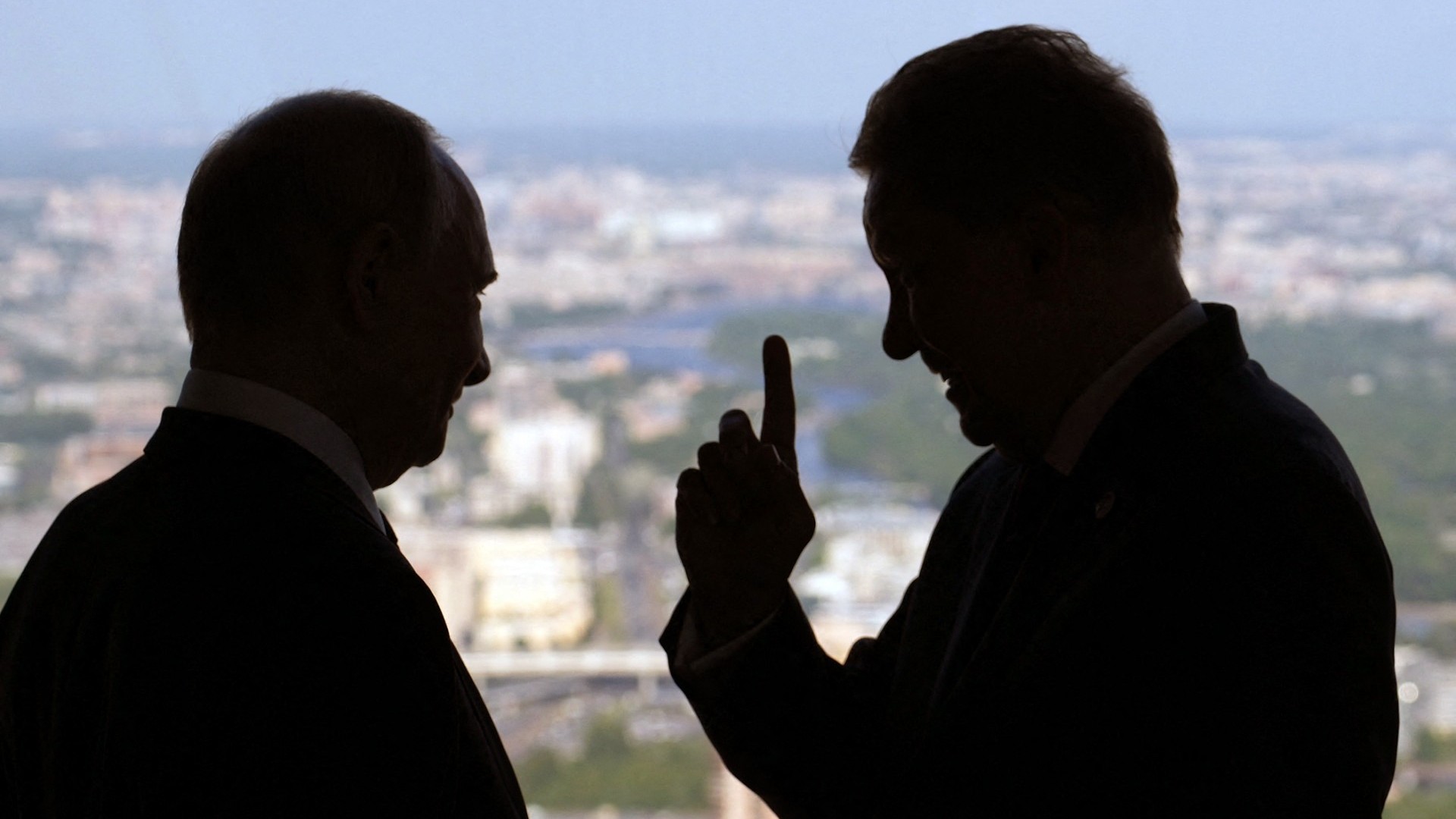
Russia’s President Vladimir Putin (L) speaks with Russia’s energy giant Gazprom CEO Alexei Miller as they visit the Lakhta Centre skyscraper, the headquarters of Russian gas monopoly Gazprom in Saint Petersburg on June 5, 2024.
Alexandre Zholobov / SPUTNIK / POOL / AFP
Brussels tirelessly repeats that the war in Ukraine is a fight for freedom and democracy. However, three and a half years after the Russian invasion, countries in the European Union continue to transfer around €1 billion a month to Moscow for imports of gas and oil.
According to The Sunday Times, in August 2025 alone, European payments to Russia for energy reached £965 million (€1.1 billion), adding up to more than €16.8 billion over the past twelve months. The Centre for Research on Energy and Clean Air (CREA) confirms the figure: in July this year, EU member states spent €1.3 billion on Russian fossil fuels, €930 million of which was gas.
Brussels often speaks of a 90% reduction in Russian hydrocarbon purchases compared to 2021. But what remains is still enough to keep the Kremlin’s coffers filled. The underlying explanation is not technical but political: the European Union has become the perfect consumer, trapped in its own climate dogma. The exploitation of gas fields in the Mediterranean, coal in Poland, or hydrocarbons in Hungary has been limited for ideological reasons. And the halt to nuclear energy has increased external dependence.
Since March 2022, seventeen EU member states have paid more to Russia for energy than they have provided to Ukraine in aid. France, for example, has transferred €16 billion to Moscow compared to €17 billion in aid to Kyiv. Spain has spent €10 billion compared to the €6 billion allocated to the war. Belgium has spent €14 billion against barely €5 billion in aid.
According to an analysis by The Guardian, in the third year of the war, EU member states have purchased €21.9 billion worth of Russian fossil fuels, a figure higher than their direct financial aid to Kyiv. Bruegel, one of the most influential economic think tanks in Brussels, estimates that after the 2022 embargo, imports fell from $16 billion a month to about €1 billion a month, a level that persists to this day.
Not all payments are direct. Much of the Russian fuel enters Europe after being refined in India or Turkey. The United Kingdom, which banned the import of Russian crude oil in 2022, has ended up buying more than €3 billion worth of refined fuels derived from Russian oil, according to CREA. Germany, which boasted of “independence” from Russian gas after the Nord Stream sabotage, still imports indirectly through France.
The Institute for Energy Economics and Financial Analysis (IEEFA) calculates that since 2022, the EU has spent around €380 billion on gas imports via pipeline, of which €83 billion was from to Russia. These flows prove that even when volumes decrease, money continues to reach Moscow.
The reality is that Russia has kept its volume of energy exports almost intact thanks to Europe, China, India, and Turkey. The Kremlin obtains less profit per barrel, but compensates with quantity and with Europe’s inability to cut supply. Instead of diversifying and exploiting its own resources, Brussels has preferred to remain faithful to the climate dogma, sacrificing energy security on the altar of ideology.
The result is that while speeches hail “strategic independence,” the EU’s monthly payments sustain the very war machine it claims to want to defeat.