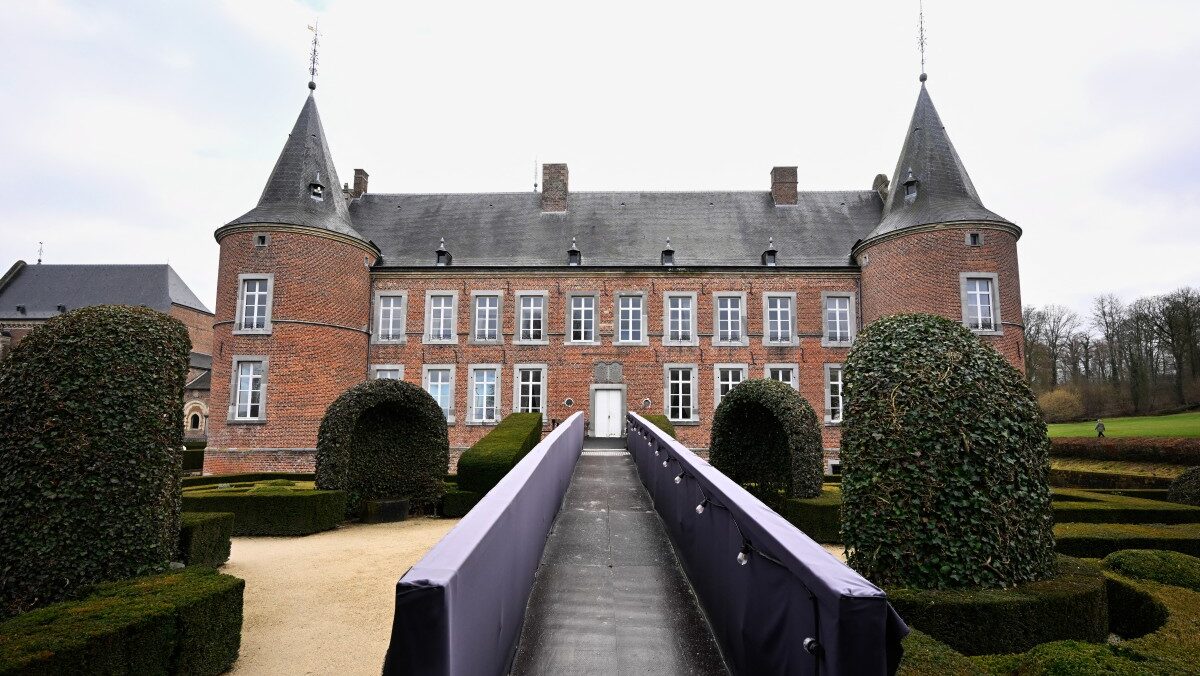
Alden Biesen Castle in Rijkhoven on February 2, 2026.
JOHN THYS / AFP
On February 12, the heads of state and government of the European Union will gather at Alden Biesen Castle in Belgium, convened by the president of the European Council, António Costa.
Presented as an informal retreat, the meeting will focus on strengthening the single market, reducing strategic dependencies, and enhancing Europe’s competitiveness in an increasingly hostile geoeconomic environment.
Yet, behind the official agenda, another decisive issue is emerging: growing political pressure to accelerate Ukraine’s integration into the EU, even if that means compressing timelines and reinterpreting the accession criteria that have structured the enlargement process for decades.
Costa justified the meeting by stating that “in the current geopolitical environment, strengthening our Single Market is more than ever an urgent strategic imperative.” In the first session, Mario Draghi will outline the impact of the shifting geoeconomic context on European competitiveness; in the second, Enrico Letta (author of the 2024 report “Much More than a Market” on the single market) will present proposals to complete the internal market and facilitate the expansion of European companies.
Discussions will focus on critical raw materials, technological autonomy, protection against unfair competition, and the creation of a ‘28th regime’ to harmonise business rules.
But the debate on competitiveness cannot be separated from the debate on enlargement. And this is precisely where consensus begins to fracture.
From Brussels, signals are multiplying that Ukraine’s accession has become a political priority for 2027—or even earlier. In parallel with peace talks promoted by Washington in Abu Dhabi and the gradual rapprochement between Moscow and Beijing, the EU is seeking to demonstrate that it remains a relevant actor on the strategic chessboard.
The Commission has explored formulas for “partial accession” or accelerated sectoral integration for Kyiv. In practical terms, this would mean advancing access to the single market or to specific EU programmes without Ukraine fully meeting the classic Copenhagen criteria: institutional stability, a consolidated rule of law, a functioning market economy and the capacity to adopt the acquis communautaire.
The official argument is geopolitical: strengthening Ukraine means strengthening European security. The implicit argument is political: sending a strategic signal to Russia and preventing war fatigue from eroding Western commitment.
However, several member states privately warn that a rushed enlargement could destabilise both the EU budget and the Union’s internal institutional balance. Ukraine is a large country with a dominant agricultural sector that would significantly reshape the Common Agricultural Policy, alongside massive reconstruction needs that would strain cohesion funds.
The current tension intensified following Ursula von der Leyen’s speech this Wednesday before the European Parliament in Strasbourg. The President of the Commission once again insisted that the Union must “tear down the barriers” preventing it from becoming a true “global giant.”
Beyond the economic rhetoric, the message was clear: if the 27 cannot reach unanimous agreement, “enhanced cooperation” among those willing to move forward must be explored. In other words, advancing without everyone. The national veto—a cornerstone of the balance between sovereignty and supranational governance—increasingly appears as an obstacle to be overcome.
In the name of competitiveness and strategic autonomy, the door thus opens to a two-speed Europe, where a core group pushes ahead with deep reforms—including enlargement—while others remain on the decision-making periphery.
The economic background is far from trivial. Europe faces simultaneous pressures: trade tensions with the United States and China, dependence on critical raw materials, regulatory fragmentation and difficulties for companies seeking large-scale access to capital. The proposal for a ‘28th regime’ for businesses or a Savings and Investment Union addresses genuine structural challenges.
But the central question remains whether the EU can tackle these reforms while simultaneously redefining its institutional architecture and accelerating a historic enlargement that could add up to nine countries within a span of just three years, according to current plans.
Some leaders fear that, rather than strengthening the single market, a rushed integration of Ukraine without deep internal reform could multiply existing asymmetries. Others argue that enlargement itself is the necessary catalyst to force those reforms.