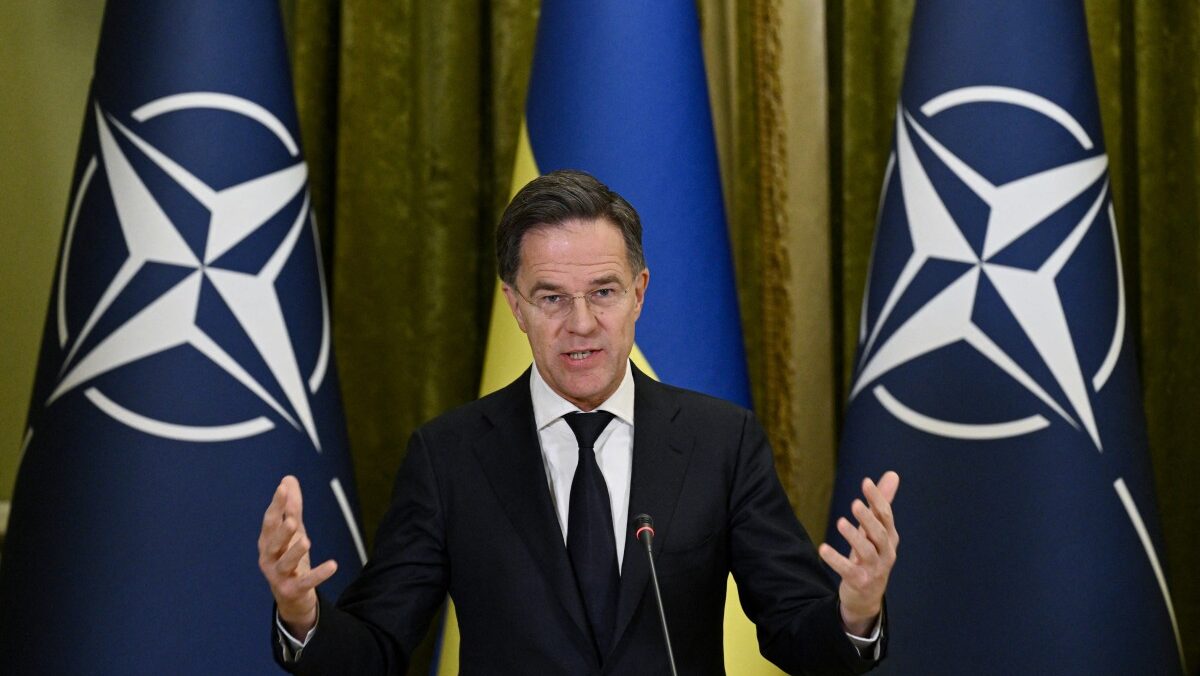
Mark Rutte
Genya SAVILOV / AFP
For years, officials in Brussels and across Europe operated on a shared assumption: that Russia would not be in a position to directly challenge NATO before 2029. That date became a strategic comfort zone—time to rearm, coordinate, and reassure domestic publics. That certainty is now eroding rapidly.
According to The Wall Street Journal, a growing number of European political and military leaders now believe Moscow could test NATO—and the European Union—much sooner than previously expected. Such a move would not necessarily take the form of a full-scale invasion, but a limited, rapid, and carefully calibrated incursion designed to exploit Europe’s hesitation and internal divisions.
This shift in thinking accelerated after the release of a recent wargame simulating a Russian operation against Lithuania. The results were sobering. In one scenario, an initial force of just 15,000 troops was sufficient to sever the land corridor linking the Baltic states to the rest of NATO.
More troubling than the military details was the political dimension of the exercise. It highlighted how indecision, legal ambiguity, and slow decision-making could allow Russia to achieve strategic objectives within days—without triggering a clear and unified allied response.
The scenario also assumed limited U.S. involvement from the outset. With Washington increasingly focused on domestic priorities and global competition elsewhere, European planners no longer assume immediate American leadership in a regional crisis.
Lithuania, Latvia, and Estonia have long warned of their geographic vulnerability. Their overland connection to the rest of the alliance is narrow—and easy to disrupt. The wargame confirmed that this weakness is not theoretical, but operational and immediate.
At the same time, European officials point to Russia’s shift toward a war-economy model, with industrial output and recruitment levels exceeding the needs of the war in Ukraine alone. The concern in European capitals is not that Russia could win a prolonged war against NATO, but that it could launch a rapid and ambiguous operation that tests the alliance’s credibility.
One of the clearest conclusions from the exercise was that deterrence depends as much on political will as on military capability. If Moscow believes that Berlin, Paris, or Brussels will hesitate, seek de-escalation, or argue over procedures before acting, the threshold for provocation drops sharply.
That debate is no longer confined to simulations or tabletop exercises. While some NATO commanders continue to cite 2029 as the benchmark for a serious Russian threat, a growing number of officials warn that reliance on that timeline may be dangerously complacent. A crisis could come sooner, before Europe has fully rebuilt its defences or resolved its strategic ambiguities.
Skeptics point to Russia’s heavy losses in Ukraine and its difficulty achieving decisive breakthroughs there. They also stress that Europe, taken as a whole, outweighs Russia in both population and economic power.
But the concern is not about a total war. As several analysts involved in the wargame argue, Russia would only need to demonstrate that NATO’s Article 5 is not automatic—that it can be delayed, diluted, or politically neutralised. A limited operation, framed in “humanitarian” or hybrid terms, could be sufficient to make that point.
The lesson of the wargame is clear. Europe’s main vulnerability lies less in its weapons than in its political indecision. While Russia looks for openings, Europe continues to debate timelines, procedures, and red lines—often at the expense of speed and clarity.