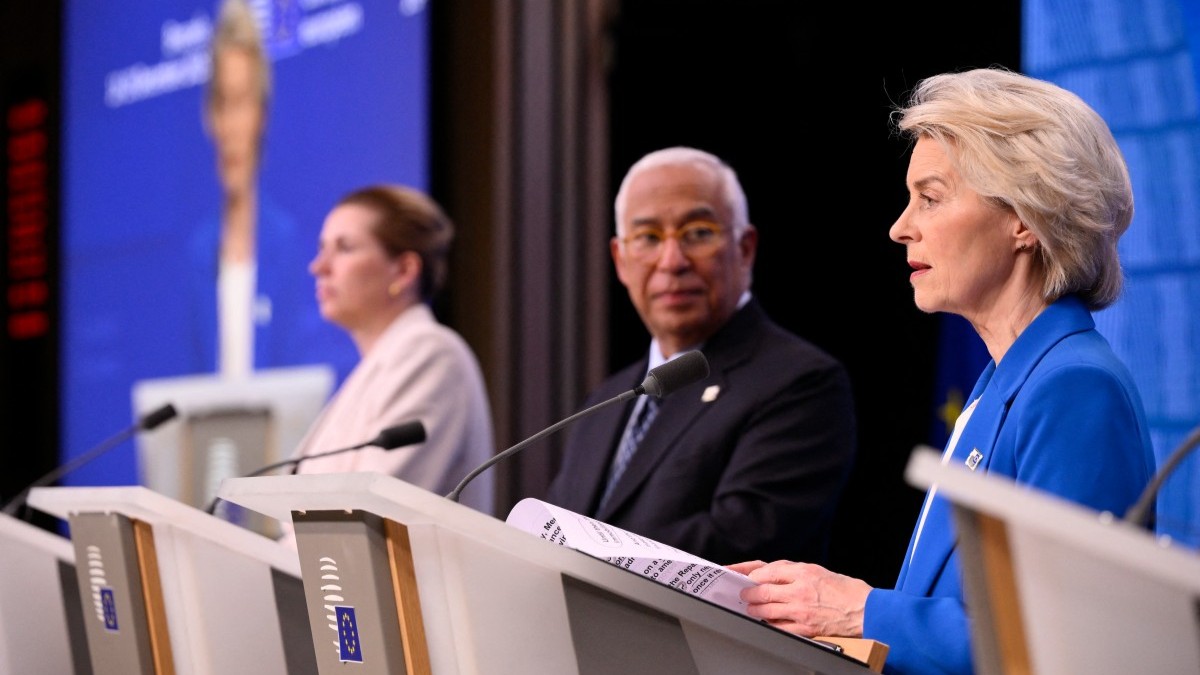
European Commission President Ursula von der Leyen (R) speaks as European Council President António Costa (C) and Denmark’s Prime Minister Mette Frederiksen listen during a press conference after the European Council meeting in Brussels, Belgium on December 19, 2025.
John Thys / AFP
The European Union has once again postponed a decision that for months has fuelled headlines and prompted warnings. After a marathon summit in Brussels, heads of state and government have (for now) set aside the idea of using frozen Russian assets to finance Ukraine.
Instead, they have approved a new loan of up to €90 billion backed by European common debt, that is, by eurobonds. More debt for Europe’s taxpayers as a whole, and no real breach of the limits Brussels claims it is willing to cross.
Despite the rhetorical escalation against Russia and the constant calls for a “war economy,” the EU’s hardliners were forced to back down on their proposal to take a dangerous step: the effective confiscation of Russian state assets, valued at around €210 billion and largely held at Euroclear in Belgium. The plan, backed by the European Commission and Berlin, has run aground on the legal, financial, and political risks that several member states refuse to assume.
European leaders have thus revived a ‘Plan B’ that until a few weeks ago seemed unlikely: jointly borrowing to grant Kyiv a two-year loan guaranteed by the EU budget. This formula allows everyone to save face. Brussels can claim that support for Ukraine is “guaranteed,” while avoiding a decision that could set a far-reaching precedent for Europe’s legal certainty and for the credibility of the euro as a reserve currency.
But the underlying message is hard to ignore. The EU maintains a dialectical escalation with Russia that, when the decisive moment arrives, proves to be essentially political. It serves to align narratives, justify historic increases in military spending, and mobilise public opinion through fear. Yet when it comes to bearing the real consequences of that confrontation—including the risk of financial retaliation or international litigation—consensus evaporates.
The key figure at this summit has been Belgian Prime Minister Bart De Wever, who once again blocked the use of Russian assets. Belgium, where most of those funds are held, has demanded unlimited guarantees against possible retaliation from Moscow—a condition unacceptable to the rest of the bloc. His stance, unpopular in some Brussels circles but supported at home, has ultimately prevailed.
Italy, under the leadership of Giorgia Meloni, has also opted for pragmatism: halting both the Russian assets plan and other initiatives driven by Berlin, such as the Mercosur agreement, once again postponed. Not to mentions French President Emmanuel Macron suggesting that Europe should “re-engage in a full-fledged dialogue with Russia, in full transparency with Ukraine, [possibly] in the coming weeks.”
In this context, leaders such as Viktor Orbán emerge strengthened. The Hungarian prime minister, together with his Slovak and the Czech counterparts, decided not to veto the joint loan scheme, after they secured an opt-out. The text of the final agreement states that “any mobilisation of resources of the Union’s budget as a guarantee for this loan will not have an impact on the financial obligations of the Czech Republic, Hungary and Slovakia.”
The outcomes of the summit once again highlighted the Union’s political fractures. Orbán has again presented himself as a leader anchored in political and economic reality, in contrast to what he sees as Brussels’ strategic idealism. His message—critical of escalation and sceptical about the effectiveness of sanctions—gains traction every time the EU resorts to provisional solutions to avoid irreversible decisions.
The new loan will allow Ukraine to buy time and avert a short-term liquidity crisis. But for Europe, the balance sheet is less reassuring. The normalisation of common debt as a permanent emergency tool is further entrenched, despite long-standing objections from northern countries. And the gap between confrontational rhetoric and the real willingness to take risks is once again laid bare.