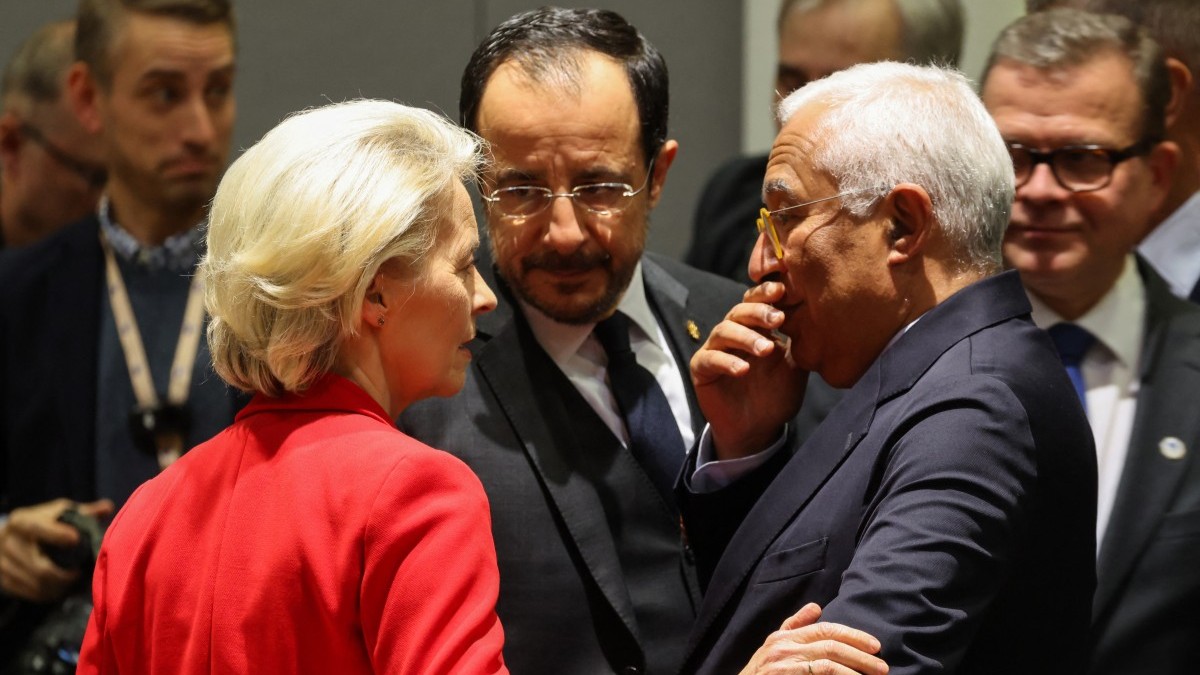
European Commission President Ursula von der Leyen (L), Cyprus’ President Nikos Christodoulides (C), and European Council President António Costa converse ahead of a meeting of the European Council at the European headquarters in Brussels, on January 22, 2026.
Ludovic Marin / AFP
The words spoken by Kaja Kallas upon her arrival at last Thursday’s extraordinary European Council, convened by Council president António Costa, sounded grave, almost solemn: the relationship with the United States has suffered a “hard blow,” and that deterioration “benefits Russia and China.” The diagnosis, in abstract terms, is correct. The problem is that, once again, Brussels appears incapable of translating that diagnosis into a coherent political strategy.
After a week of explicit threats from Washington—tariffs, territorial pressure over Greenland, and language unbefitting of allies—the European Union has chosen the most familiar path: declare unity, celebrate de-escalation, and carry on exactly as before.
Kallas acknowledges that something has broken. She admits that transatlantic relations “are no longer the same as before” and that U.S. unpredictability forces the preparation of alternative scenarios. However, in the same intervention, she rules out any profound rethinking by assuring that the EU is not willing to “throw away 80 years of good relations.” The message is clear: whatever happens, Europe will not alter its strategic dependence on the United States.
The word for this year has been unpredictability.
— Kaja Kallas (@kajakallas) January 22, 2026
This is what we are living through.
But right now, it is important to focus back our efforts on stopping the war in Ukraine.
Russia is increasing its attacks on civilians and civilian infrastructure in Ukraine, amid a… pic.twitter.com/ijUIPdmcuk
That stance reveals the main problem of European foreign policy: it confuses stability with inertia. Pointing out that tensions benefit Russia and China may be true, but avoiding any structural change in the relationship with Washington guarantees that those tensions will recur. There is no deterrence when the adversary—or even the ally—knows there will be no consequences.
In addition, Kallas’s relevance can also be questioned. As Slovak Prime Minister Robert Fico aptly pointed out in a recent tweet, “If the U.S. Secretary of State, Marco Rubio, repeatedly refuses to meet with Kaja Kallas, let alone have a constructive disagreement with her, what purpose does her service actually serve?”
Thursday’s extraordinary European Council was presented as a key meeting to redefine the relationship with the United States. In practice, it was an exercise in damage control. There were no new decisions, no credible red lines were announced, and no real pressure instruments were activated. Everything was reduced to Brussels’ favorite buzzword: unity.
That unity, however, is purely declarative. While some Member States argued for firmer responses, others opted for restraint and waiting. The result was a minimal consensus that avoids immediate conflict but leaves the power asymmetry intact. Europe reacts; Washington sets the pace.
The Greenland crisis is not a marginal episode. It is a test of how far the United States is willing to use trade and strategic pressure, even against formal allies. That the EU celebrates as a success the mere fact that those threats have been “paused” reveals a dangerously low bar.
Even more worrying is the speed with which, once the shock has passed, European institutions behave as if nothing had happened. The sovereignty of a European territory was subjected to direct pressure, and yet the debate was closed without drawing any lasting conclusions.
In this context, the statements by Roberta Metsola are particularly clarifying. The President of the European Parliament was quick to encourage the resumption of the ratification of the trade agreement with the United States, a clearly unbalanced pact that locks in 15% tariffs on European products while opening the EU market to U.S. industrial goods duty-free.
Arrival and doorstep by Roberta #METSOLA @EP_President , President of the European Parliament, at the informal meeting of the members of the European Council #EUCO taking place on 22 January 2026 in #Brussels. https://t.co/K2PUOtIpYG
— EU Council Newsroom (@EUCouncilTVNews) January 22, 2026
Presenting that agreement as a “normalization” after de-escalation represents a troubling inversion of priorities. Europe accepts unfavorable conditions as the price of calm, reinforcing the idea that pressure works.
As long as Brussels continues to respond to every crisis with declarations of unity and no real changes, it will remain predictable, reactive, and vulnerable. Greenland was not the end of anything, but a foretaste. And the sense of relief felt after the European Council is not a sign of strength, but of resignation.