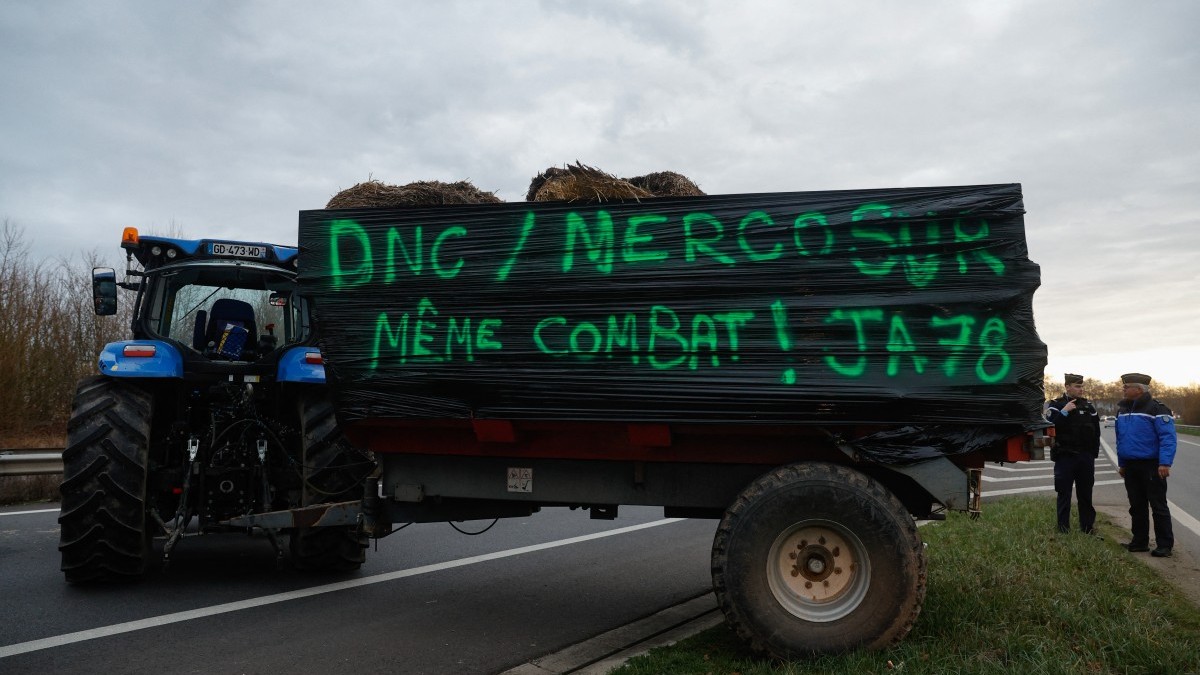
A sign on a tractor at a farmers’ protest outside Paris reads “DNC / Mercosur, same battle” on December 16, 2025, as part of nationwide action by farmers to protest against the government’s mandatory culling protocol for cattle affected by lumpy skin disease (dermatose nodulaire contagieuse).
Geoffroy Van Der Hasselt / AFP
On Tuesday, the European Parliament validated the safeguard clauses of the trade agreement between the European Union and Mercosur, officially presented as a shield to protect European farmers from sudden surges in imports of sensitive products.
However, these measures do not stem from a strategic conviction to defend Europe’s primary sector but rather from the resistance from certain member states—with France at the forefront—facing growing domestic pressure from their livestock and agricultural sectors (combined with an electoral strategy pursued by President Emmanuel Macron himself).
By a large majority, the European Parliament approved a tightening of the conditions that would trigger the safeguards. Compared to the 10% threshold initially proposed by the European Commission and accepted by national governments, MEPs set a 5% limit both for increases in imports and for price drops relative to the average of the previous three years. In addition, they halved investigation timeframes, with the aim of allowing measures to be applied more swiftly in cases of “significant damage” to European producers.
On paper, the mechanism is more robust. It will allow the temporary suspension of tariff preferences for products such as beef, poultry, dairy, sugar, or ethanol, and even introduces a principle of reciprocity to act when imported products fail to meet equivalent environmental, sanitary, or animal welfare standards—an element the farming sector considers one of the key tools to prevent unfair competition, as seen with third countries such as Morocco.
The problem lies less in the content of the safeguards than in the timing and the reasons behind their adoption. These concessions come after years of negotiations on the EU–Mercosur agreement, at a point when the text is virtually finalised, and Brussels is desperately trying to prevent the deal from collapsing at the last hurdle. The immediate objective is to circumvent the veto of countries such as France and Italy and enable European Commission President Ursula von der Leyen to travel to Brazil for the final signing. It is no coincidence that Paris has explicitly conditioned its support on the adoption of “solid and operational” safeguard clauses, against a backdrop of recurring agricultural protests and mounting unrest in rural France.
This episode lays bare a structural contradiction in European trade policy. For years, the Commission and many national governments defended the Mercosur agreement by downplaying its impact on the primary sector, relying on future compensation and on the supposed adaptability of European farming. Only when domestic pressure became politically unbearable—tractors on the streets, mobilised farmers’ unions and electoral risk—did the urgency to shield producers emerge.
It is worth stressing that much of this tension could have been avoided if the now-celebrated safeguards had been incorporated from the outset of the negotiations. Had that been the case, the European Union would have projected a more coherent and firm position, imposing its conditions with greater authority and reducing both internal frictions among member states and external tensions with Mercosur partners. Instead, Brussels opted for a reactive strategy, improvising protection mechanisms at the last minute to extinguish political fires.
The protagonists of the process implicitly acknowledge this reality. Parliament’s rapporteur, Gabriel Mato, stressed after the vote that what matters most is having a regulation that allows the EU to “continue moving forward while protecting the agricultural sector,” recognising that farmers’ concerns “had and continue to have” a solid basis. Even more explicit was the chair of the International Trade Committee, Bernd Lange, who warned that the agreement would “die” if it is not signed in the coming days—a statement that illustrates the extent to which the EU is now negotiating under pressure.
The approved safeguards may serve as a safety net and offer partial relief to a sector that feels systematically sacrificed in the name of free trade and grand geopolitical balances. But they do not address the underlying problem: the lack of a genuine, sustained, and coherent political will to defend Europe’s primary sector as a strategic pillar rather than as a bargaining chip.