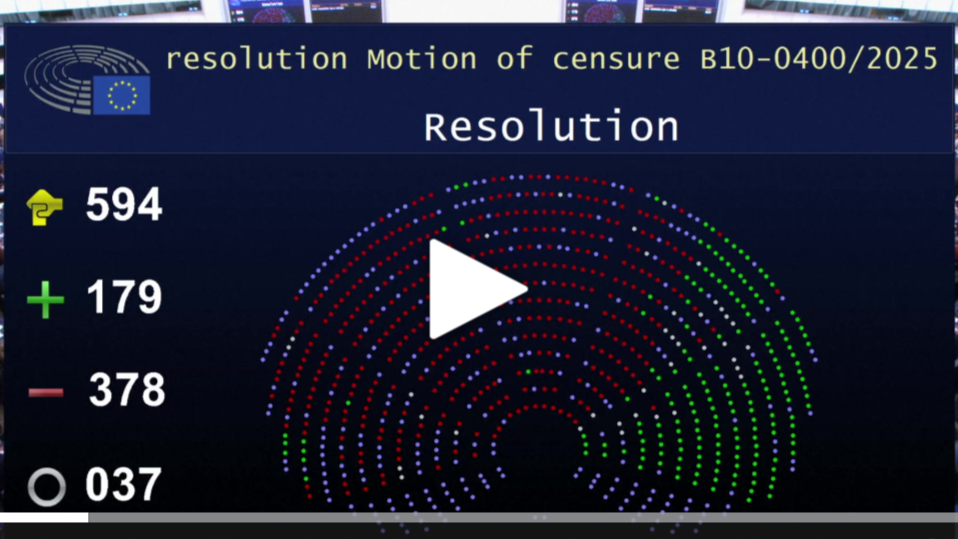
The MEPs’ vote on the PfE’s motion of censure on the Commission on October 9, 2025.
Screenshot of the livestream by the Multimedia Centre / European Parliament
The European Parliament on Thursday, October 9th, rejected two motions of no confidence tabled against the President of the European Commission, Ursula von der Leyen. The initiatives, promoted by the groups Patriots for Europe and The Left, highlighted the growing discontent with the Commission’s management, although, as predicted, neither achieved the absolute majority required to pass.
The Patriots’ motion, which focused on issues of economic competitiveness, transparency, national sovereignty, and freedom of expression, obtained 179 votes in favour, 378 against, and 34 abstentions. Meanwhile, the motion presented by The Left received 133 votes in favour, 383 against, and 37 abstentions.
The text submitted by Patriots for Europe argued that the Commission has failed to defend European interests and has acted beyond its competencies.
Among the main criticisms were the implementation of the European Green Deal, considered harmful to industrial and agricultural competitiveness; the management of illegal immigration, described as ineffective; and the policies that, according to the signatories, “threaten freedom of expression” through digital censorship practices.
The group also denounced the signing of the Mercosur trade agreement, which they accuse of opening the European market to products that do not meet EU environmental or health standards, and the recent EU–US trade framework, negotiated “without a Council mandate and with little transparency.”
The motion presented by The Left—supported by some members of the Greens—focused its criticism on the Commission’s foreign policy, particularly its response to the war in Gaza, and its alleged “lack of commitment” to social rights and the Green Deal.
The text accused the Commission of “failing to defend international law” and called for the suspension of the EU–Israel Association Agreement, as well as sanctions and an arms embargo. It also denounced the Commission’s “inability” to address the housing crisis and growing social inequality in Europe.
The results reveal a growing political fragmentation within the European Parliament. The motion from the Patriots—more focused on economic management and national sovereignty—managed to attract broader support than that of the left, reflecting the advance of sovereigntist and Eurosceptic forces in the current political cycle.