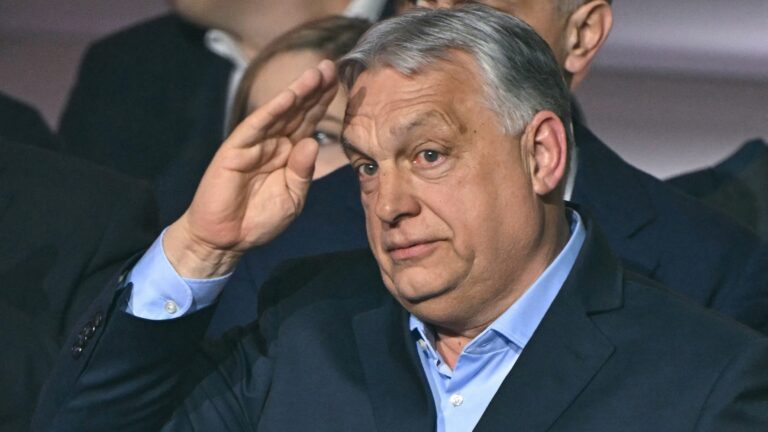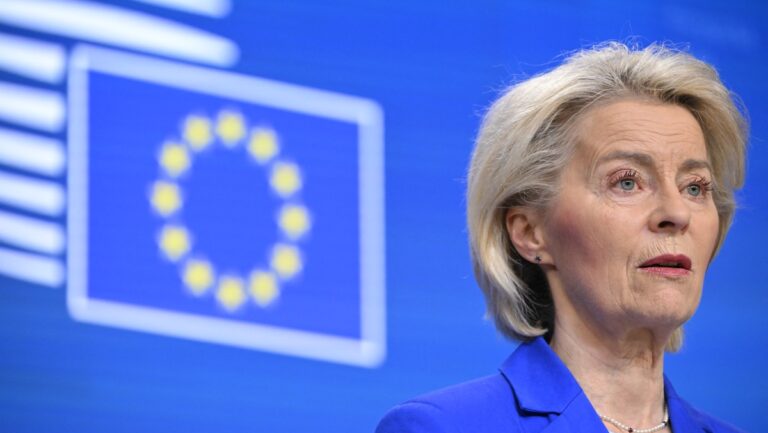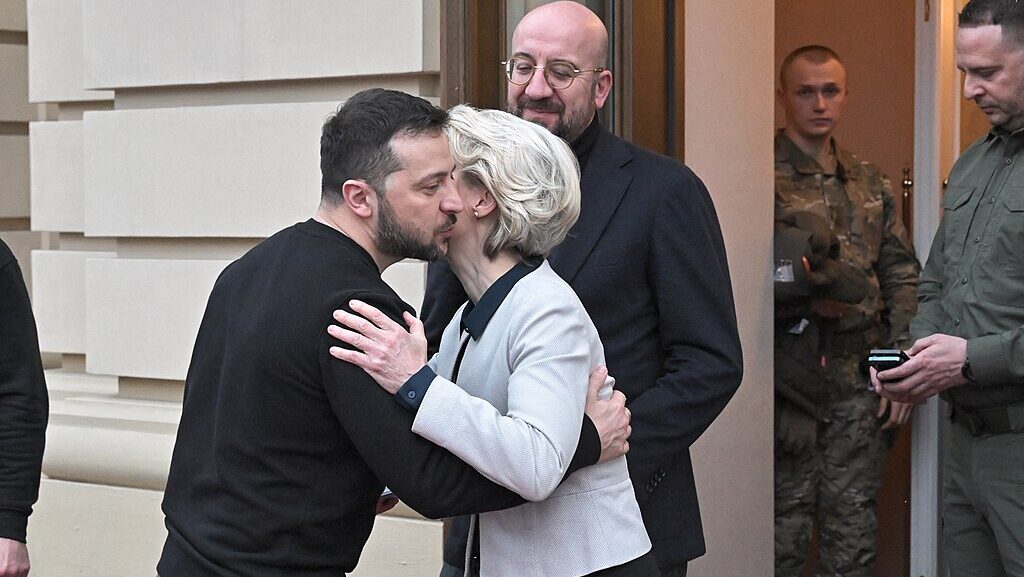
Volodymyr Zelensky, Ursula von der Leyen, and Charles Michel
© European Union, 2026, CC BY 4.0, via Wikimedia Commons
Brussels is considering an unprecedented plan to draw Ukraine into the European Union as early as 2027 through a form of partial, phased-in membership, prompting fierce accusations from Hungary that the bloc is seeking to sidestep national vetoes and interfere in domestic politics.
According to multiple EU and Ukrainian officials who spoke to Politico, the proposal would allow Kyiv to take a seat at the EU table before completing the full slate of accession reforms.
Supporters argue this would anchor Ukraine firmly in Europe after four years of war with Russia while giving it time to overhaul its judiciary, democratic institutions, and political system.
Ukrainian President Volodymyr Zelensky has pressed for a fixed accession date, arguing that EU membership amounts to a security guarantee. Russia is likely to try to “stop our movement into the EU, that is why we say name the date,” he said last week.
The plan amounts to lowering the bar for membership and bending EU rules for political convenience.
However, Germany has openly opposed the creation of multiple tiers of membership. Chancellor Friedrich Merz called accession by 2027 “out of the question,” while Bavarian prime minister Markus Söder warned that such haste would overwhelm the EU and threaten its cohesion.
Nowhere is resistance stronger than in Hungary, whose conservative government has argued that admitting Ukraine into the EU would mean great economic harm for the EU, as well as dragging the 27-member bloc into war with Russia.
Prime Minister Viktor Orbán has made opposition to Ukraine’s fast-tracked accession a central election issue ahead of April’s Hungarian parliamentary election:
There is enormous pressure in Hungary from Brussels to give up certain national goals: not to stay out of the war, give a large part of its money to Ukraine, accept the proposals that Brussels makes, accept migrants, give up its child-protection laws. … The stake of the election is whether we are able to stay on a national path that serves our own interests … or we elect a governor-style government that carries out instructions from Brussels.
This April, Hungary faces a decisive election.
— Orbán Viktor (@PM_ViktorOrban) February 9, 2026
The options are:
1️⃣ A patriotic government serving Hungarian national interests.
OR
2️⃣ A Brusselian puppet government serving foreign interests.
🇭🇺 There is no middle ground. Hungary must choose sovereignty! pic.twitter.com/NWRt9vZ3TQ
EU diplomats acknowledge that Hungary is the principal obstacle, as enlargement requires unanimous approval. Some are openly discussing ways around Budapest, including using Article 7 of the EU treaty, which allows for the suspension of a member state’s voting rights.
Hungarian officials accuse the EU of openly plotting to neutralise Budapest’s veto.
Balázs Orbán, the prime minister’s political director, wrote on X:
Brussels and Kyiv are openly planning to push Ukraine into the EU by 2027—while openly counting on the removal of Hungary’s veto by removing the patriotic government led by Viktor Orbán. Hungarians rejected Ukraine’s EU accession because it would bring massive costs, agricultural damage, and war risks. Brussels knows this—and wants Hungary out of the way.
This is outrageous. Brussels and Kyiv are openly planning to push Ukraine into the EU by 2027 — while openly counting on the removal of Hungary’s veto by removing the patriotic government led by 🇭🇺@PM_ViktorOrban.
— Balázs Orbán (@BalazsOrban_HU) February 10, 2026
Hungarians rejected Ukraine’s EU accession because it would… https://t.co/hYJ5JXMO4m
Foreign Minister Péter Szijjártó said the “Brussels–Kyiv coalition” is seeking a change of government in Hungary.
The outrage is understandable: using rule-of-law mechanisms, such as Article 7, to punish a country for exercising a legitimate veto on foreign policy would be an abuse of power and a blow to democratic norms within the European Union.
Public opinion appears to back Hungary’s concern: a January survey by the Hungarian think tank Századvég found that 75% of Europeans oppose Ukraine joining the EU before meeting established criteria, with fears centred on agriculture, food safety, security risks and the redistribution of EU funds.
Yet EU officials argue that extraordinary circumstances justify extraordinary measures, and some even hope U.S. President Donald Trump could pressure Budapest into lifting its veto as part of a broader peace deal with Russia.