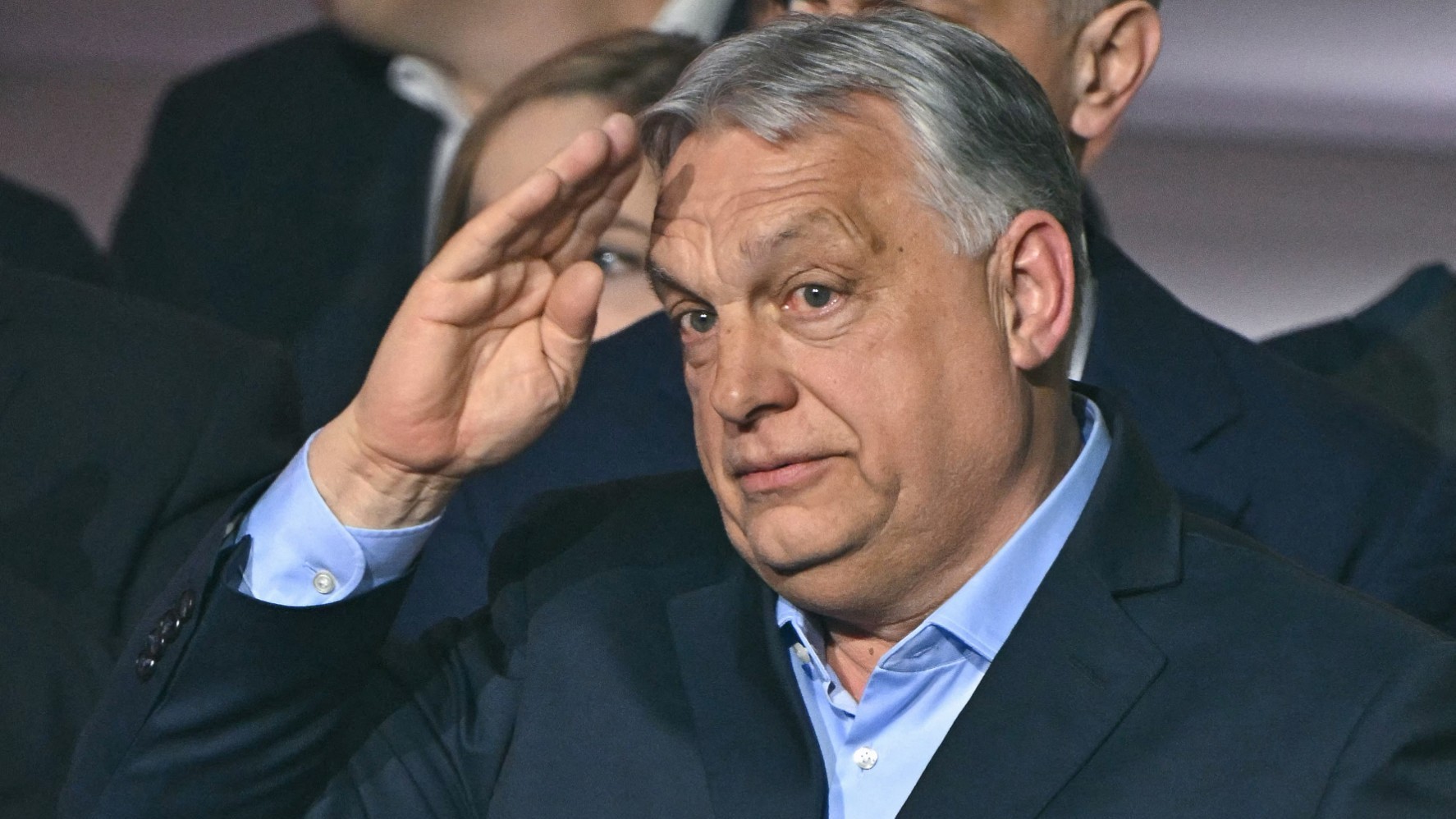
Hungary’s Prime Minister Viktor Orbán salutes to supporters at Fidesz’s election night event in Budapest on April 12, 2026.
ATTILA KISBENEDEK / AFP
What happens when an institution celebrates too openly the disappearance of the only brake it had?
Brussels itself provided the answer this week. Following Viktor Orbán’s electoral defeat, European ministers and diplomats acknowledged to Politico that the European Union will now be able to move more quickly on dossiers that had been blocked for years: more money for Ukraine, new sanctions against Russia, possible measures against Israel, and an acceleration of Ukraine’s accession process to the EU.
The tone of those statements is an unmistakable symptom of the ‘political illness’ afflicting Brussels.
Estonian Foreign Minister Margus Tsahkna went so far as to say that, for years, it had been “depressing” to meet because everything ended up blocked by Hungary. Now, he said, there is a “more hopeful” atmosphere. Politico described that reaction as “the great unblocking.” But the wording contains an indirect admission: for years, a single national government was able to prevent Brussels from acting as though an automatic foreign policy already existed. And that is precisely what the veto is for.
The veto was not a design flaw. It was the condition that made it possible to build the European Union without entirely stripping the member states of their sovereignty. In foreign policy, enlargement, or sanctions, the Treaties require unanimity because these are existential matters: war, borders, money, alliances, and international recognition. The system is based on the simple idea that no country should be forced to accept decisions it considers contrary to its strategic interests.
Hungary used that instrument aggressively, sometimes awkwardly, and often in isolation. It blocked aid packages for Ukraine, delayed sanctions, slowed the opening of negotiations with Kyiv, and challenged common positions on the Middle East. That turned Orbán into the perfect villain within the Brussels ecosystem. But it also forced the Union to negotiate, qualify and, at times, concede.
Because behind the rhetoric about “obstruction” there was another, less visible reality: several governments shared some of Hungary’s doubts, although they preferred to let Budapest bear the political cost. In other words, the Hungarian veto did not only block; it also revealed divisions that Brussels preferred to present as non-existent. European unanimity tends to exist, above all, after eliminating those who disagree.
The case of Israel demonstrates it. Even without Orbán at the table, the proposal by Spain, Belgium, and Slovenia to suspend the association agreement with Israel failed because Germany and Italy opposed it. Suddenly, it became obvious to everyone that the problem was not Hungary, but that the Union remains a collection of divergent national interests, even if the Commission and part of the diplomatic apparatus try to speak as if a European state already existed.
Orbán understood before many others that in Brussels, power does not depend only on being right, but on having the ability to stop processes. That is why he turned the veto into his main political instrument. He did not always win. Sometimes he ended up giving way after negotiations or financial pressure, but he forced the Union to acknowledge that it still cannot act as a fully sovereign power.
It is striking that the open celebration of his departure essentially confirms that he was right. If the absence of a single leader allows €90 billion loans, new sanctions, enlargements, and diplomatic changes to be suddenly unblocked, then the problem was not Orbán. The problem was that there was still someone with enough power to say no.