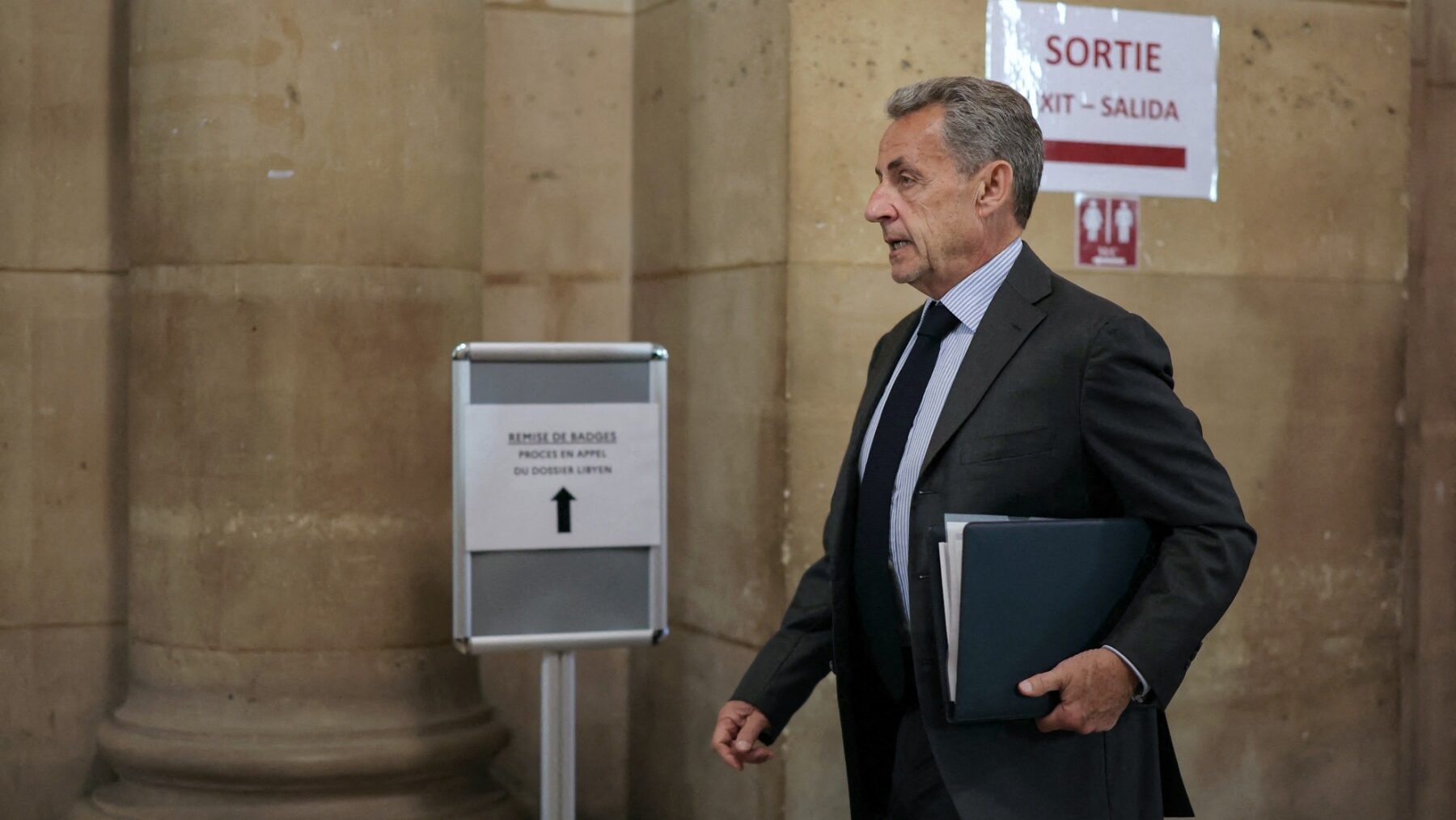
France’s former president Nicolas Sarkozy arrives for a hearing in his appeal trial over charges he had sought Libyan financing for his 2007 election in exchange for helping improve Tripoli’s image after deadly bombing, at the Palais de Justice courthouse in Paris on May 6, 2026.
THOMAS SAMSON / AFP
Former President Nicolas Sarkozy is currently back in French court for the appeal hearing regarding his conviction in a highly contentious case concerning the financing of his presidential campaign by Libyan funds. The latest developments in the trial are weighing heavily on the statesman and implicitly reveal his terrible responsibility for the destabilisation of an entire region under severe strain, with dramatic geopolitical consequences for which the world is still paying the price.
Sarkozy’s appeal trial in the case of suspected Libyan funding of his 2007 presidential campaign is one of the most sensitive political and legal cases of the Fifth Republic. Commencing in March 2026, this second trial aims to review a landmark conviction handed down in 2025 for criminal conspiracy in connection with an alleged corruption scheme involving Muammar Gaddafi’s regime.
At the heart of the appeal, Sarkozy’s defence strategy is based on an attempt to sever the link between the Libyan financial flows and his election campaign. During the hearings, his lawyers presented new financial tables purporting to demonstrate that the millions of euros paid by intermediaries never benefited the campaign but were instead partly embezzled or returned to the Libyan regime in the form of kickbacks.
However, these arguments met with considerable scepticism from the court, due to inconsistencies, unexplained sums, and discrepancies between the documents produced and the established facts.
Furthermore, a new development further undermines the defence: the distancing of his former right-hand man, Claude Guéant, whose statements and correspondence contradict the former president’s version of events regarding certain contacts with Libyan dignitaries. The man who had until then been presented as a loyalist among loyalists has clearly chosen to distance himself from his friend and mentor.
These contradictions lend credence to the hypothesis, already accepted at the first instance, of a ‘corruption pact’ forged as early as 2005 between Sarkozy’s entourage and the Gaddafi regime.
The closing arguments of the civil parties marked a turning point in this appeal trial. Lawyers representing the families of the victims of the 1989 UTA DC-10 bombing denounced a strategy of systematic denial on the part of the defendants. The attack on a UTA aircraft on 19 September 1989 resulted in the deaths of all 170 passengers and crew members. The French judicial inquiry subsequently implicated officials from Muammar Gaddafi’s Libyan regime, some of whom were convicted in absentia in 1999. Today, the victims’ families are civil parties in the case brought against Sarkozy: they denounce what they see as complacent relations between French officials and the Libyan regime from the 2000s onwards, believing that these political and financial ties may have contributed to downplaying, or even erasing, the memory of and demands for justice regarding this attack. The families are calling for “the rot of corruption to be cleansed.”
Some have described it as a “show trial” and accused Nicolas Sarkozy of “denying the facts to the point of absurdity.” The civil parties have emphasised that this case is not merely a financial dispute but an attack on the public interest and the integrity of the state, which has compromised itself through murky dealings with the Libyan regime. The clandestine meetings with Libyan officials, including Abdallah Senoussi, the regime’s number two, sentenced to life imprisonment for ordering the 1989 bombing, as well as the complex financial networks involving intermediaries and shell companies, illustrate the existence of a parallel system of decision-making and financing. According to the victims’ lawyer, Vincent Ollivier, Gaddafi’s visit to Paris in 2007 was no coincidence. At the time, the dictator “paraded through Paris with the arrogance of a kingmaker and the confidence of someone who knew he was owed something,” the lawyer believes.
Beyond the legal framework, the case forms part of a broader analysis of Sarkozy’s role in North African geopolitical dynamics. As president, he was one of the key architects of the military intervention in Libya in 2011, which led to the fall of the Gaddafi regime. While this intervention was initially presented as a humanitarian and democratic response, its long-term consequences are now widely debated. It led to the fragmentation of the Libyan state and the proliferation of armed militias, creating chronic instability and spreading insecurity throughout the Sahel. Against this backdrop, suspicions of prior financial dealings between Sarkozy’s entourage and the Libyan regime cast doubt on the true motives behind this intervention, raising suspicion that it may have served to erase all traces of the close ties maintained between the Gaddafi regime and Sarkozy. Personal political interests are said to have dramatically influenced major strategic decisions.
The outcome of the trial remains uncertain. But Sarkozy’s legacy—still held in high esteem by a section of the French Right—remains permanently tarnished by this scandalous episode.