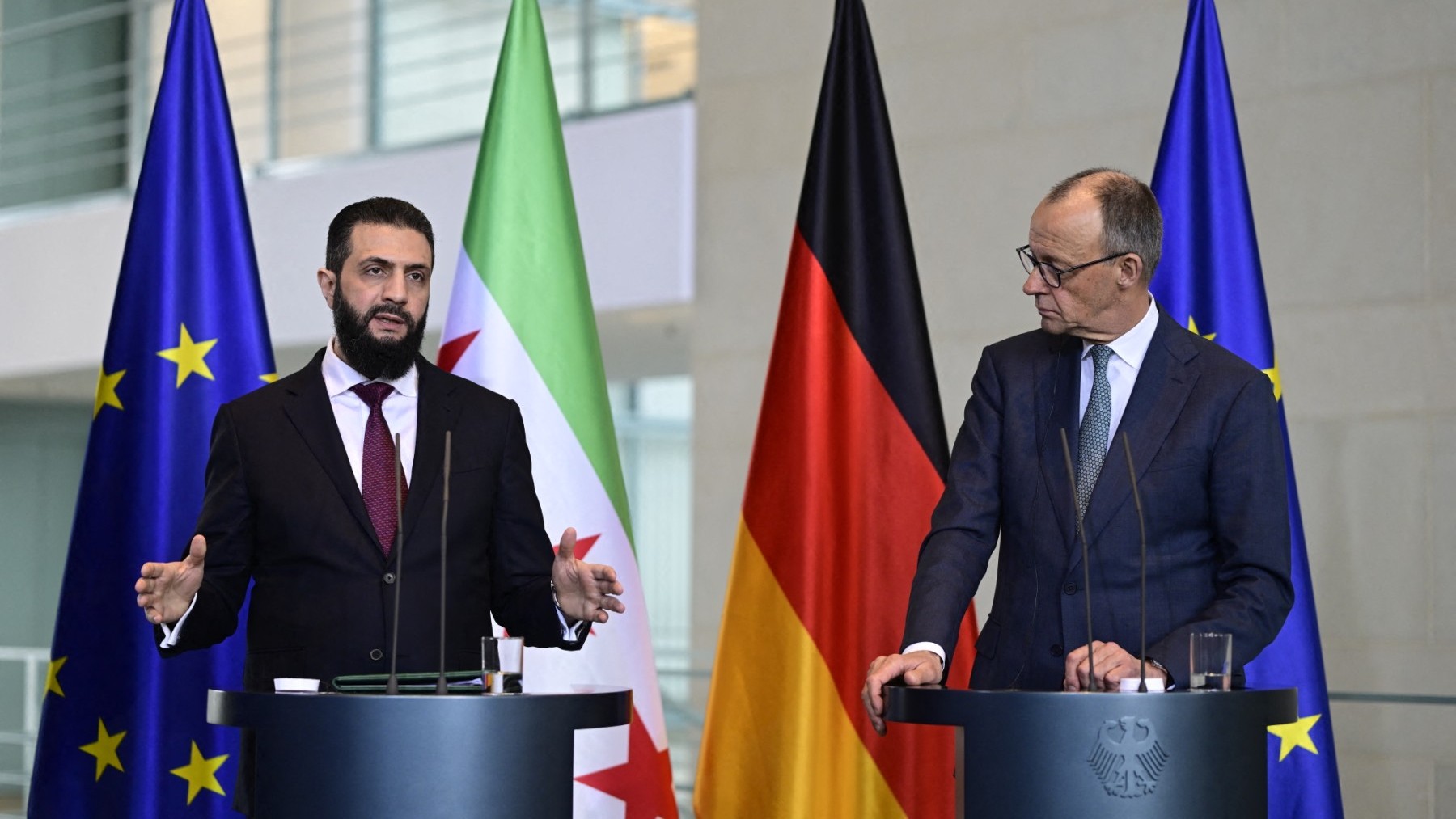
German Chancellor Friedrich Merz (R) and Syrian President Ahmed al-Sharaa address a joint press conference after talks at the Chancellery in Berlin on March 30, 2026.
JOHN MACDOUGALL / AFP
The deportation of Syrian citizens from Germany has been virtually paralyzed despite the political announcements made by Berlin in recent months. A key reason is that Damascus has stopped issuing replacement travel documents for Syrian nationals facing deportation.
According to recently published information, since the end of January no German federal state has received the type of documentation required to carry out forced returns of individuals lacking valid passports or complete identity documents.These replacement documents are an essential requirement in deportation procedures. Without them, authorities may face serious legal and operational difficulties in carrying out returns even when a final deportation order exists.
German federal authorities have not officially confirmed the blockage, although they have not denied it either.
The issue currently affects around 11,000 Syrian citizens who are under an immediate legal obligation to leave Germany, according to data from the German Federal Police.
The Interior Minister of the federal state of Hesse, Roman Poseck, called for direct talks with Damascus to unlock the situation. He noted that Syrian cooperation is necessary not only to conduct deportations but also to encourage voluntary returns.
The situation is particularly significant because it comes only months after the political transition in Syria following the fall of Bashar al-Assad’s regime and the beginning of international contacts with Syria’s new authorities.
In Germany, the debate over deportations to Syria had gained political weight in recent months. Friedrich Merz’s government turned migration tightening into one of its central messages, and the CDU-SPD coalition explicitly included the reactivation of deportations to Syria in its agreement, beginning with criminals and individuals considered dangerous.
The current chancellor did not take long to betray his voters by denying that migration policy would change less than 24 hours after winning the election.
At the end of last year, Federal Interior Minister Alexander Dobrindt also announced plans to work on a specific return agreement with Damascus. However, progress has been limited.
Since the effective end of the Syrian civil war, only four deportation flights have taken off from Germany, and all exclusively involved serious criminals.
At the same time, political rapprochement between Europe and Syria continues to advance. Brussels has begun lifting certain sanctions, opened new diplomatic channels, and is studying financial mechanisms and reconstruction programs that could mobilize tens of billions of euros in the coming years.
This appeasing behavior, without receiving anything in return, is becoming increasingly controversial in Brussels corridors. While the European Union seeks migration cooperation and regional stabilization, Syria retains a particularly effective instrument of pressure: administrative control over the documentation of its own citizens.
The episode recalls a dynamic already familiar in European migration policy. For years, Turkey used its strategic position as a negotiating tool with Brussels. Morocco also turned border management into a form of diplomatic leverage on several occasions.
Now the Syrian case once again highlights a reality that many still refuse to acknowledge: European migration control depends to a large extent on the cooperation of third countries.