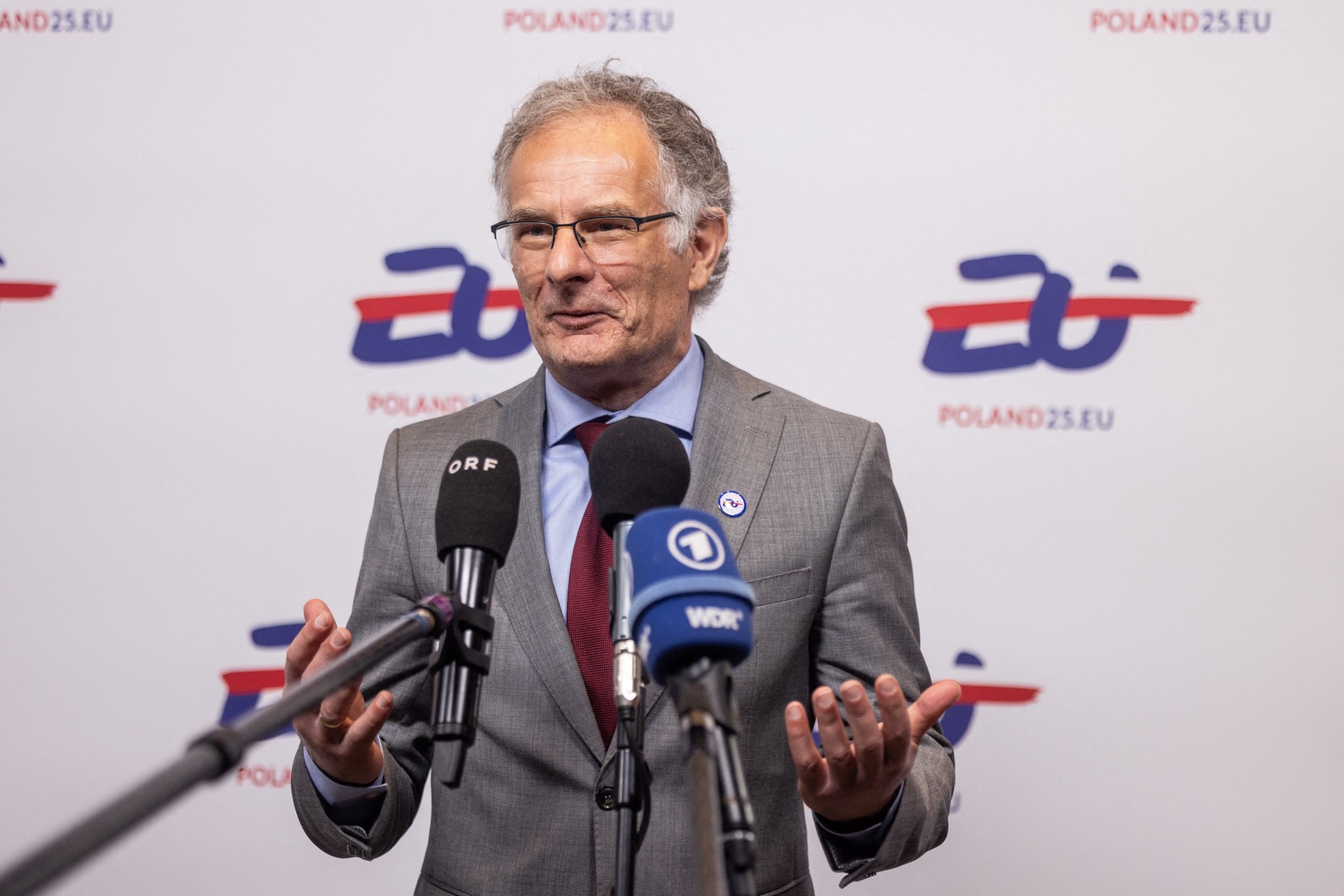
Austria’s Minister of Finance Markus Marterbauer delivers a doorstep statement before the Informal Meeting of EU Ministers for Economic and Financial Affairs and Central Bank Governors (ECOFIN) in Warsaw, Poland, on April 11, 2025.
WOJTEK RADWANSKI / AFP
A major political dispute has opened in Austria after it was revealed that the country has quietly overseen transports of close to €20 billion to Kyiv over the past four years.
The sum was unveiled in response to a parliamentary question from Austria’s right-wing populist FPÖ, following Hungary’s interception in March of an armoured cash convoy carrying tens of millions of dollars and gold from Austria to Ukraine. Hungary has since returned the seized assets in a less-than-transparent move, following the electoral defeat of the ruling Fidesz party.
Party officials subsequently asked the Austrian Ministry of Finance a number of questions regarding similar transportations, including “What total amount of cash, precious metals, or other valuables has been transported from Austria to Ukraine via this route since 2022?” Since cash and precious metal transports in commercial traffic must be declared to customs in the EU, precise figures are available.
According to the official response from the Ministry of Finance, led by Markus Marterbauer (SPÖ, Social Democratic Party of Austria), 1,011 such transportations have been registered, with 553 taking place in 2025 alone. The value of these combined well exceeds €18 billion.
It is unclear what financial institutions were behind these shipments, and whether Austrian taxpayer money was involved. As the OTS publication said the parliamentary response of the finance minister revealed “a failure of oversight.”
And FPÖ MP Christian Hafenecker stressed “we’re not talking about play money here.” He expressed displeasure at Marterbauer’s comments, which he said amounted to the minister admitting that “we know nothing, we’re not investigating anything, we haven’t collected any information.”
That’s not an answer, that’s dereliction of duty.
His party is demanding full transparency regarding the transports, which would no doubt unveil even more explosive details than have already been disclosed.
Polling conducted earlier this year suggests that a clear majority of Austrians oppose additional aid to Ukraine, arguing that funds should instead be prioritised for domestic use.