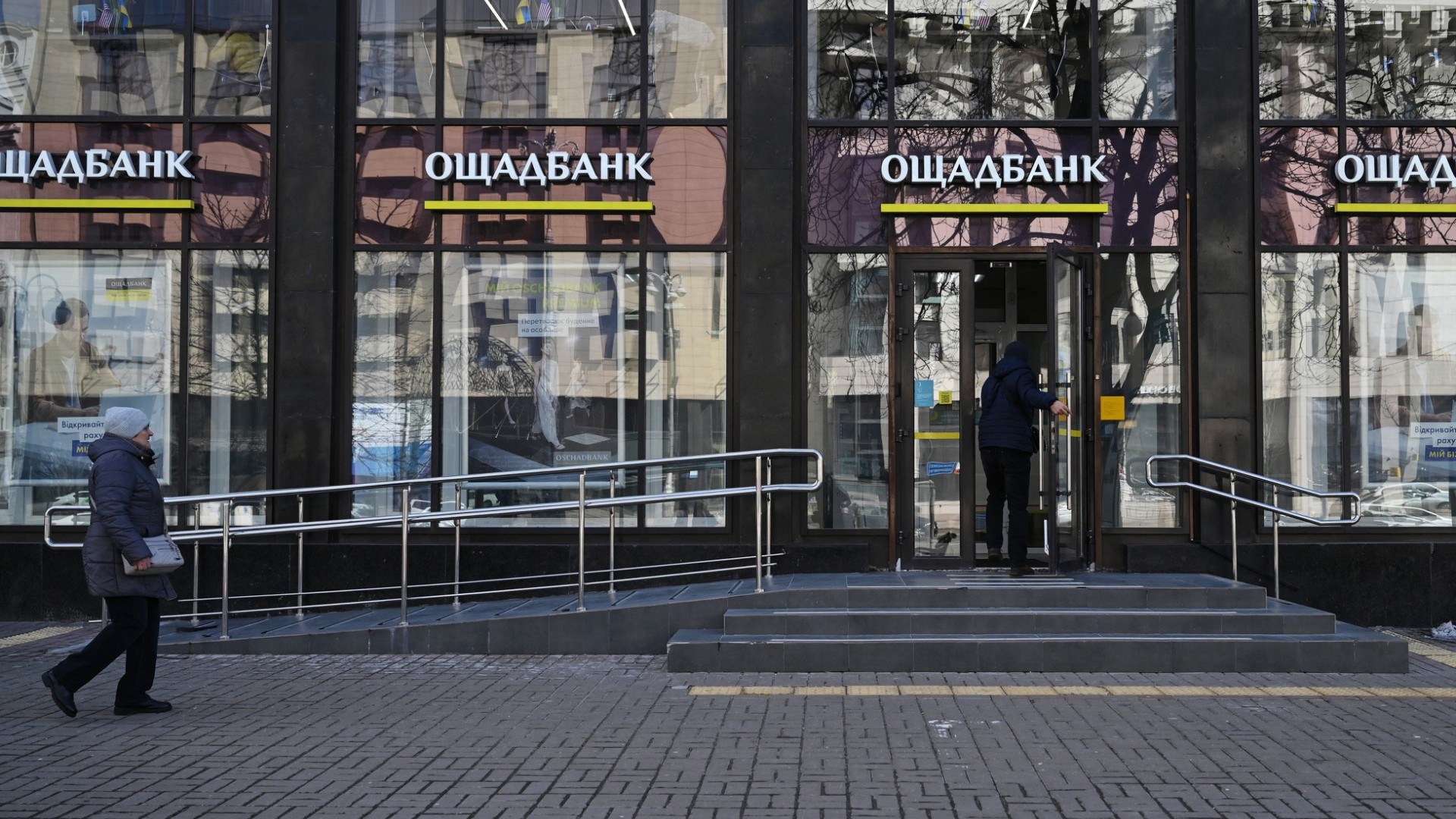
A man enters an office of the State Savings Bank of Ukraine, or Oschadbank, in Kyiv on March 6, 2026.
GENYA SAVILOV / AFP
On Wednesday, May 6th, the Hungarian law firm that specialises in economic criminal law and which represents the Ukrainian savings bank Oschadbank, issued a statement, saying the Central Investigation Department of the Criminal Directorate of the Hungarian National Tax And Customs Administration (NAV) handed over to the Ukrainian party 40 million U.S. dollars, 35 million euros and 9 kilograms of gold bars worth 1,526,265 U.S. dollars, belonging to Oschadbank. The procedure reportedly lasted for hours on Wednesday and took place at the Záhony border crossing. During the handover, Yurii Katsion, Chairman of the Board of Directors of Oschadbank, and Ukraine’s ambassador to Hungary, Sándor Fegyir were present.
Hungarian liberal, pro-Tisza news website Telex quoted one of the lawyers representing the Ukrainian nationals who had escorted the so-called gold convoy carrying the sizeable amount of cash and gold across Hungary as saying that the authorities did not give any reasons as to why they were releasing the shipment that was seized two months ago.
As we reported at the time, the Hungarian Counter-Terrorism Centre’s personnel intercepted an armoured cash convoy carrying tens of millions of dollars, euros and gold across Hungary on March 5, and detained the Ukrainian nationals escorting the two armoured vehicles. The operation was carried out in cooperation with Hungary’s tax authority. The Hungarian authorities said they were acting on suspicion of money laundering, and later expelled the Ukrainians involved, including a former general of Ukraine’s SBU Security Service, and a former major of Ukraine’s Air Force. The transport operation was also reportedly assisted by individuals with military experience, Hungary’s customs authority said at the time. On March 10, a government decree was issued stating that “the legal title of the property seized in the Ukrainian money transport cars could not be clarified at the scene.”
Unsurprisingly, the narratives surrounding what happened diverged dramatically from day one, with Kyiv, Brussels, and the pro-Ukrainian media protesting with one voice, and framing what happened as politically motivated and unlawful. All these actors dismissed as absurd or entirely ignored the elements of the story that indicated the shipments were not “routine” and perfectly legal as claimed. Zelensky went as far as to say the seizing of the cash and gold was “banditry,” and that “Orbán simply stole the money.” According to the detained Ukrainians’ lawyers, the recipient of the assets, as well as Ukrainian savings bank Oschadbank, and Raiffeisen, which sent the cash and the gold, there was nothing unusual in the shipment that the money transporters reportedly wanted to send from Austria to Ukraine.
And yet, it was not the Hungarian authorities and the government only that questioned why enormous amounts of cash and gold are being transported across borders rather than moved through standard financial systems.
Austrian journalist Richard Schmitt wondered why “cash packages worth €40 million and $35 million, along with gold bars worth €1.36 million, being transported by car from [Austrian] Raiffeisen Bank in Vienna to Kyiv,” also noting that the vehicles were intercepted on Hungary’s M5 motorway, which runs from Budapest toward Serbia, raising further questions about the intended destination. Ukrainian blogger Anatoly Shariy suggested the shipment might involve politically sensitive funds, claiming the seized amount was, “to put it mildly, not exactly ordinary,” and said the assets may have belonged to Zelensky’s “associates from Europe.”
The controversy also drew reactions in Austria. The opposition right-wing Freedom Party of Austria (FPÖ) demanded a full investigation into the shipment and its possible connections to Austria, with FPÖ secretary-general Christian Hafenecker questioning whether similar cash transports had originated in Austria and whether the funds might include Austrian taxpayers’ money destined for Ukraine.
On April 8th, NAV issued a press statement on status of the investigation, in response to “several false pieces of information” published in the press regarding “the case known as the Ukrainian golden convoy.” They confirmed that NAV was “conducting criminal proceedings on suspicion of money laundering in connection with the large amount of Ukrainian cash and gold bars passing through Hungary.”
NAV said its financial investigators established, among other things, that the armoured cash-transport vehicles contained only freshly printed banknotes (euros and dollars), which had not previously been put into circulation. The investigation established that the euros were printed by the Italian central bank, and that in addition to the Ukrainian Oschadbank, a Polish and a Gibraltar bank were also behind the shipments. The statement also said it had “submitted a proposal to the Prosecutor General’s Office, which is supervising the legality of the investigation, to issue a European Investigation Order to the Republic of Austria and the Republic of Poland.”
During the investigation, NAV said, several pieces of evidence emerged indicating that the background to the Ukrainian cash transport passing through Hungary is “unclear”, and the origin and use of the 40 million dollars and 35 million euros in cash and 9 kilograms of gold bars transported in the armoured car “may also constitute a crime.” NAV released a video recording to back up that claim. In the recording, the former Ukrainian intelligence major general, “who is reportedly supervising the money transfers, is allegedly forging documents in the restroom of a gas station during the transfer, while his colleagues are talking about corruption money,” NAV said.
Then came April 12th, the day of the Hungarian general election that ended with the defeat of ruling Fidesz. Soon after that, Volodymyr Zelensky said he wanted to hold talks with the incoming prime minister, Péter Magyar, about the seized cash shipment as soon as possible. And in less than a month, the assets were unceremoniously returned by the same Tax Authority that had clearly said, four days before the elections, that the origin and the destination of the seized shipment raised serious concerns and an investigation on suspicion of money laundering was ongoing.
It is also absurd that it was not even NAV that announced the return of the shipment but the Ukrainian president himself. On Wednesday, Zelensky said the handing back of the assets was “an important step” in Ukrainian-Hungarian relations.
An important step in relations with Hungary – today, the funds and valuables of Oschadbank that were seized by Hungarian special services in March of this year were returned. At the time, the Hungarian side unlawfully detained Ukrainian cash-in-transit officers. We brought our…
— Volodymyr Zelenskyy / Володимир Зеленський (@ZelenskyyUa) May 6, 2026
The Hungarian Tax Authority clearly understood the signs of the times. But they did not dare communicate their decision to Hungary’s citizens.