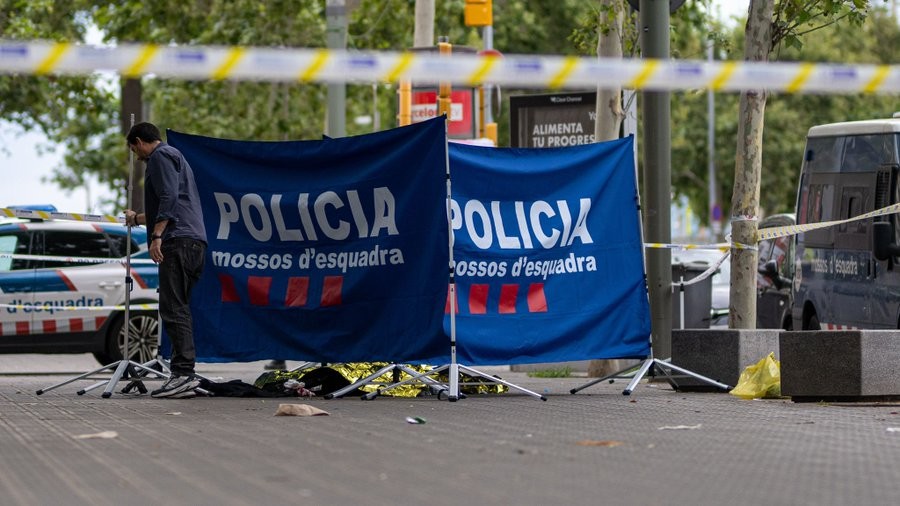
Crime scene cordoned off iby the regional police in Barcelona on May 4, 2026
@AlertaMundoNews on X, May 4, 202
Barcelona and its metropolitan area saw an unusual sequence of knife violence this weekend: four stabbings in just 24 hours, two of them fatal.
The most serious incident occurred on Saturday morning. A woman was killed in broad daylight in one of the quietest residential areas of the municipality. It did not take place in a deprived environment, but in a high-income area close to international schools.
Emergency services were unable to save the victim’s life. The Mossos d’Esquadra (regional police) arrested the suspect shortly afterwards in Barcelona, still in possession of a large knife. The investigation remains under secrecy and police are keeping all hypotheses open.
Some witnesses claimed to have heard Islamic religious proclamations during the attack. The Mossos have not confirmed this and, for now, are avoiding any interpretation of the motive. Even if true, police sources stress, it would not necessarily imply a terrorist attack.
The impact of the incident led the Esplugues city council to declare two days of official mourning and organize a town hall meeting. The message was one of condemnation of violence and a call for caution regarding unverified information.
This attitude reflects the usual institutional response. Yet, what happened was not an isolated incident.
🚨🇪🇺 Ursula says Europe is SAFE, best place to raise kids
— Global Dissident (@GlobalDiss) May 3, 2026
🇪🇸 Meanwhile Barcelona: Man stabbed multiple times in broad daylight at Plaça de Catalunya, fighting for his life
FIFTH attack in under 24hpic.twitter.com/qgvC97dCKO
The night before, in L’Hospitalet de Llobregat, a fight between two groups left two people injured by a knife, one of them seriously. Hours later, in the early hours of Sunday, a man died after being stabbed on Calle de la Cera, in the Raval district, near the Port of Barcelona.
Police arrested a minor as the alleged perpetrator. Some reports point to a prior robbery as the trigger, although this has not been confirmed.
The fourth incident took place in the Fórum area, where another minor was stabbed by a group that has not yet been identified. He survived. The attackers have not been apprehended so far.
Four attacks. Two dead. In a single day. The figure is punctual, the context is not.
For years, Barcelona has combined a relative decline in overall crime with an increase in visible episodes of violence in public spaces. Fewer crimes overall, but with greater impact when they occur. And above all, a greater likelihood that a minor conflict will escalate rapidly.
At this point, knives play a central role.
The Mossos d’Esquadra have long warned about the proliferation of knives and blades on the streets, particularly in nightlife areas, transport hubs and certain neighborhoods in the metropolitan area, with the number of confiscated weapons steadily increasing in recent years. The presence of knives does not always translate into more homicides, but it does create an environment where potential violence grows.
And it is not only about how many crimes are committed, but how they are committed.
The institutional response tends to rely on two pillars: caution in public messaging and increased policing. Both have limits. The first does not reduce the perception of a lack of safety when incidents cluster in time. In fact, it often worsens it. The second addresses the symptom, not necessarily the cause.
Meanwhile, political tension is rising. VOX, the Popular Party (PP) and other groups have linked the events to public safety and municipal management. The city council, for its part, insists on avoiding premature conclusions and on not amplifying the alarm.
Between these two narratives, a familiar gap opens up in Europe: the one separating isolated data from everyday experience.
Barcelona is not a city out of control in statistical terms. But it is a city where knife violence appears frequently enough to alter the perception of safety. And that perception, in urban politics, carries as much weight as the numbers.
The weekend leaves two dead. But above all, it revives a question: whether this is normal—or whether situations once considered unthinkable are becoming normalized.