The European Parliament held a new debate in Strasbourg on Wednesday on security and energy, shaped by the war between Iran and the United States–Israel and the closure of the Strait of Hormuz. In just 60 days of conflict, Europe’s fossil fuel import bill has increased by more than €27 billion.
That is the starting point. The institutional context, however, has not changed.
From the European Commission to the majority of parliamentary groups, the dominant line remains the same as in previous crises: more energy integration, more electrification, and an acceleration of the Green Deal as a structural response.
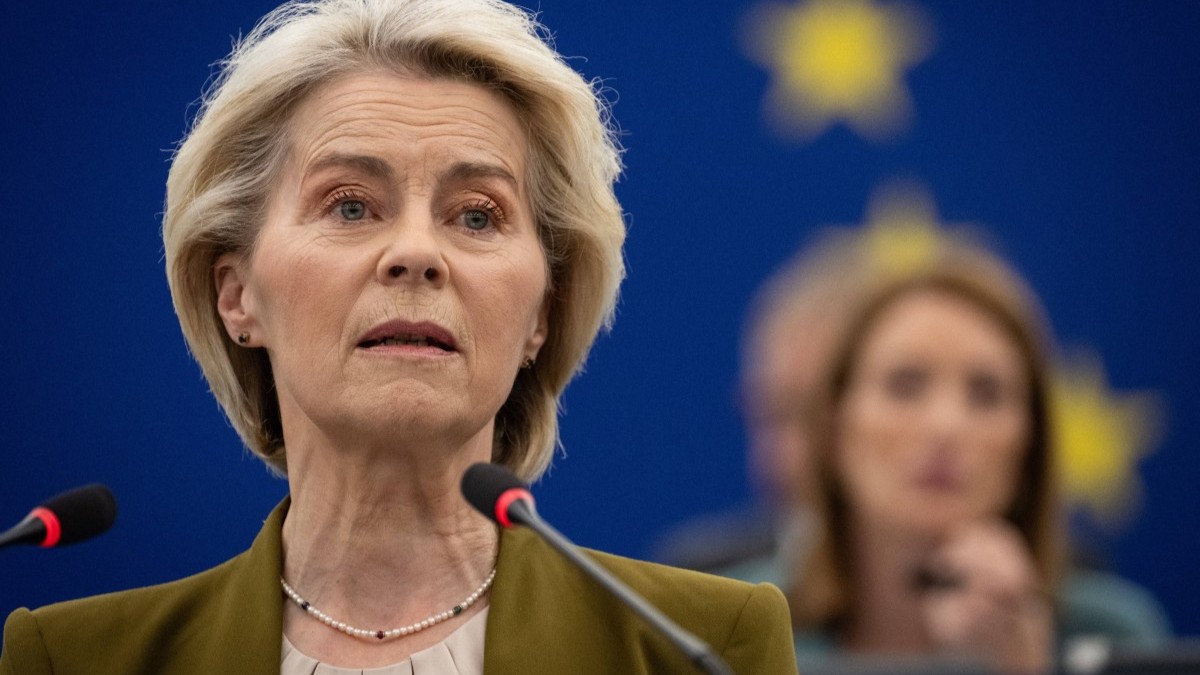
Ursula von der Leyen put it bluntly: Europe’s vulnerability stems from its dependence on imported fossil fuels, and the only way forward is to “reduce that dependency and accelerate clean energy, from renewables to nuclear.”
The thesis is well known. What matters now is that the debate is no longer about whether the energy transition should happen, but about the speed and conditions under which it is being imposed.
This is where the current political divide emerges.
From the socialist and liberal bloc, the Gulf crisis is seen as proof that the Green Deal must not only be maintained but intensified. “The only way to break dependency is to accelerate the transition,” several MEPs insisted, directly linking energy prices to Europe’s exposure to external oil and gas.
On the other side of the chamber, however, the argument shifts.
Manfred Weber, leader of the EPP, introduced a relevant nuance: support for the transition, but with pragmatism in its execution. He defended renewables and nuclear as the basis of energy sovereignty, while implicitly acknowledging that the current model is not delivering sufficient stability in a context of geopolitical crisis. A significant shift within the EPP, which had been one of the strongest advocates of Europe’s energy trajectory.
Beyond the EPP, conservative and sovereigntist groups were more direct. Their criticism is not so much about the transition itself, but about its design. They argue that Europe has replaced one dependency—Russian gas—with another emerging one: critical raw materials and supply chains controlled by third countries, particularly China. This is the structural shift in the debate.
Europe, which built its strategic narrative around “energy autonomy,” now faces an operational contradiction: decarbonising without securing control over the inputs required to do so.
While the Commission insists on electrification, efficiency and grid expansion, part of the chamber is raising a more immediate issue: how to sustain industry and consumption amid rising prices. The disruption in Hormuz—even though the EU imports only a limited share of its oil through that route—has shown that the problem is not direct supply, but the global price effect.
The result is tangible: more expensive fertilisers, inflationary pressure, and declining industrial competitiveness.
At this point, sovereigntist criticism gains traction. Several MEPs defended the temporary use of domestic resources—gas, coal or nuclear—to cushion the shock. Not as a strategic alternative, but as a realistic transitional tool.
The majority response was negative or evasive.
The prevailing logic remains to avoid any measure that could be interpreted as a step back from climate objectives, even in the midst of an acute energy crisis. This helps explain why proposals such as price caps, windfall taxes or regulatory flexibility appear in the debate, but without clear operational consensus.
Parliament appeared not so much debating technical solutions as ideological frameworks. The discussion quickly shifted toward positions of principle: the Green Deal as a structural solution versus the Green Deal as a source of vulnerability. Between these two poles, space for intermediate policies is limited.
The Strasbourg session thus leaves a familiar picture: the EU is capable of diagnosing its energy vulnerability, but still unable to agree on how to manage it in operational terms.