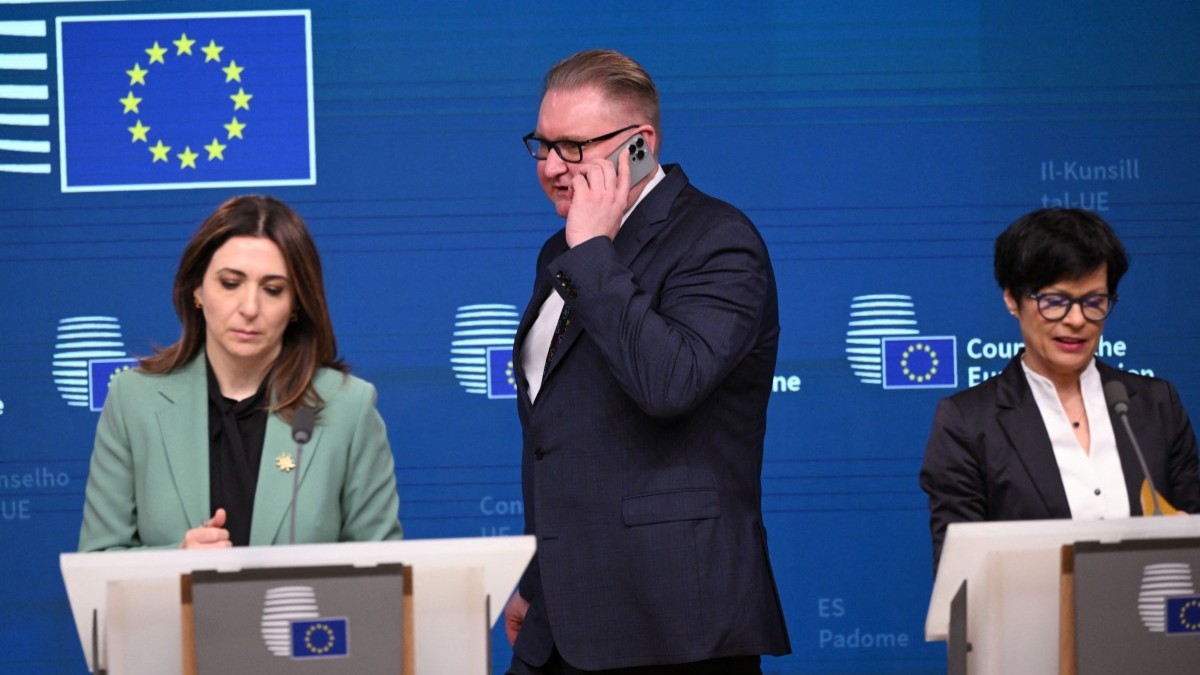
Ukraine’s Deputy Prime Minister Taras Kachka (C) arrives for a press conference with Cyprus deputy Minister for European Affairs Marilena Raouna (L) and EU Commissioner for Enlargement Marta Kos (R) ahead of a General Affairs Council at the European Council in Brussels on March 17, 2026.
NICOLAS TUCAT / AFP
The European Union has reactivated its enlargement process with the start of technical work on an accession treaty with Montenegro. António Costa described it as a “milestone,” and it is so in a historical sense. For the first time in more than a decade, Brussels is activating a real timeline for a new member’s entry.
Montenegro has followed the classic path. It applied for membership in 2008, has been negotiating since 2012, and has progressed slowly but steadily. It has now met the key rule-of-law criteria—Chapters 23 and 24—allowing the rest of the negotiations to begin closing. In Brussels, 2026 is already being openly discussed as the target date to conclude the process, with possible accession around 2028.
Congratulations to Montenegro – today we took a big step towards your accession to the European Union.
— António Costa (@eucopresident) April 22, 2026
The decision to establish the Working Party to draft the new Accession Treaty is a key milestone.
For the first time since 2013, the EU starts the clock for the next…
This progress restores credibility to a system that had been blocked for years. But at the same time, it makes clear that not all candidates are advancing under the same conditions.
The enlargement map is now uneven. Montenegro is clearly leading. Albania is moving forward at a solid pace. Serbia and North Macedonia remain stuck due to internal political problems and mutual vetoes. Bosnia is still in a preliminary phase. Turkey remains frozen.
At the same time, Ukraine and Moldova have emerged at an unprecedented speed.
Ukraine applied for membership in February 2022. By June it was already a candidate. By the end of 2023, negotiations were approved, and in 2024 they formally began. In just two years, it has covered ground that has taken others more than a decade.
Brussels justifies this through context: war, security, and the need to anchor Ukraine within the European bloc against Russia. It is a political decision, not just a technical one.
The Commission insists the process remains merit-based. Formally, the rules have not changed but, in practice, the reality is different.
Ukraine has become a strategic priority. Its accession is no longer framed solely as an enlargement file, but as part of Europe’s security architecture. That explains the acceleration.
Kyiv has made progress on reforms and completed the technical screening of its legislation, but its speed cannot be understood without that geopolitical context. No other candidate has enjoyed this level of political backing in such a short time.
In the Western Balkans, the message is perceived differently. Countries that have spent years meeting requirements now see Ukraine advancing faster. The sense of grievance is evident, even if rarely expressed openly.
Sources within the European Council say this has been raised repeatedly during the first two years of the war in Ukraine. One thing is to support a country at war; another is to bend your own rules when it suits you.
Enlargement is no longer perceived as a strictly merit-based process and is increasingly seen as a hierarchy of priorities. Those with strategic relevance move first. This has an immediate effect: it erodes reform incentives in countries that have been waiting for more than a decade. What is the point of reforms if, when it suits Brussels, they ultimately do not matter?
Despite everything, the political push behind Ukraine has clear limits. The war complicates the implementation of reforms, and the EU itself is not ready to absorb a country of that size without major adjustments to its budget, agricultural policy, or institutional system.
That is why several member states support Kyiv politically but reject any real fast-tracked accession. Geopolitical logic pushes forward, but the Union’s internal logic holds back. Montenegro’s progress confirms that the classic model still works. Ukraine’s case shows that the model is no longer sufficient to explain reality.