The European Union has decided to use Monday’s meeting in Brussels of the Global Alliance for the Implementation of the Two-State Solution to attempt to reclaim political initiative in the Middle East.
The official message rests on three pillars: de-escalation between Israel and Lebanon, strengthening the Palestinian Authority as a legitimate interlocutor, and relaunching a “credible” path toward a two-state solution. The problem is that behind this diplomatic architecture, the EU continues to arrive late, divided, and with far less leverage than it was claiming just a few months ago.
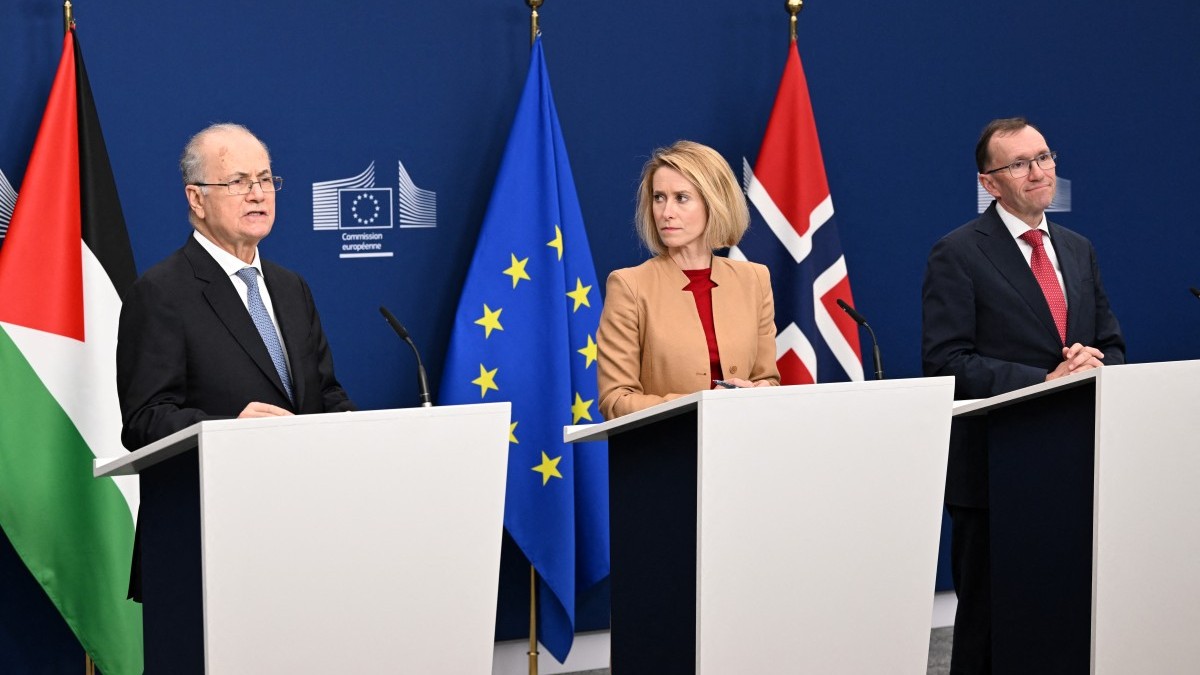
Today’s meeting, co-chaired by High Representative Kaja Kallas and Belgian Foreign Minister Maxime Prévot, brought together more than 60 countries and placed Palestinian Prime Minister Mohammad Mustafa centre stage.
Brussels wants to make clear that it still regards the Palestinian Authority as the political and administrative partner for any future arrangement in Gaza and the West Bank, even as its internal legitimacy erodes and its actual capacity on the ground grows increasingly limited.
Mustafa spoke in Brussels of “one state, one government, one law, and one goal” while also calling for a unified security structure and Israeli withdrawal from Gaza. That is the European bet: sustaining an institutional Palestinian interlocutor even as the situation on the ground fragments in precisely the opposite direction.
On the Lebanese front, the European line also tries to combine balance with distance. Brussels has condemned Hezbollah’s attacks but at the same time has sharpened its tone against the Israeli response.
The European External Action Service has described that response as “disproportionate” or “heavy-handed,” called on Israel to cease its operations in Lebanon, and insisted on respect for Lebanese sovereignty and territorial integrity.
Ursula von der Leyen, for her part, welcomed the ten-day ceasefire announced last week between Israel and Lebanon and again stressed that Europe’s priority is to consolidate the pause and open space for more lasting negotiations.
But that is only the common facade. Deep divisions persist within the EU over how hard to push Israel and how far to translate rhetoric into real political or economic costs.
Spain, Ireland, Belgium, and Slovenia have spent months pushing a harder line, with greater conditionality and a stronger willingness to link the relationship with Israel to compliance with international law. At the other end, countries such as Germany and Austria remain reluctant to take any step that could be read as a strategic break with Jerusalem. Between the two blocs sits an intermediate group—including France, the Netherlands, and several Nordic partners—willing to toughen the language but not necessarily to take on an open confrontation.
The most visible test of that fracture will come on Tuesday, April 21st, at the Foreign Affairs Council. Pedro Sánchez wants to formally put before ministers a request to suspend the EU-Israel Association Agreement. He signalled as much on April 10th in Barcelona, when he stated that the Union should suspend it because Israel is “trampling on” and violating several of its articles, particularly those relating to international law and humanitarian law.
In fact, the very room for manoeuvre is constrained by that political arithmetic. Suspending the agreement with Israel looks unlikely today, precisely because of resistance from several member states. Other, more limited measures—such as sanctions against violent settlers in the West Bank—could have a better chance of advancing, since in that area, the EU has mechanisms less exposed to an outright veto. But the difference does lie in the details: correcting at the margins is one thing; genuinely altering the structural relationship with Israel is quite another.
The distance from the United States comes into sharp focus here. Washington continues to monopolise hard power: it brokered the ceasefire between Israel and Lebanon and last week hosted direct talks between Israeli and Lebanese representatives under the leadership of Marco Rubio. The White House juggles coercion, security and tactical timing. The EU, by contrast, is trying to occupy the space of process, international legality, and Palestinian institutional reconstruction. Put differently: the United States is still running the crisis; Europe is trying to shape the narrative that comes after.
Today’s meeting in Brussels therefore serves one very specific purpose: to show that the Union does not want to disappear from the Palestinian-Lebanese file. But it also lays bare the EU’s dividedness on Israel.