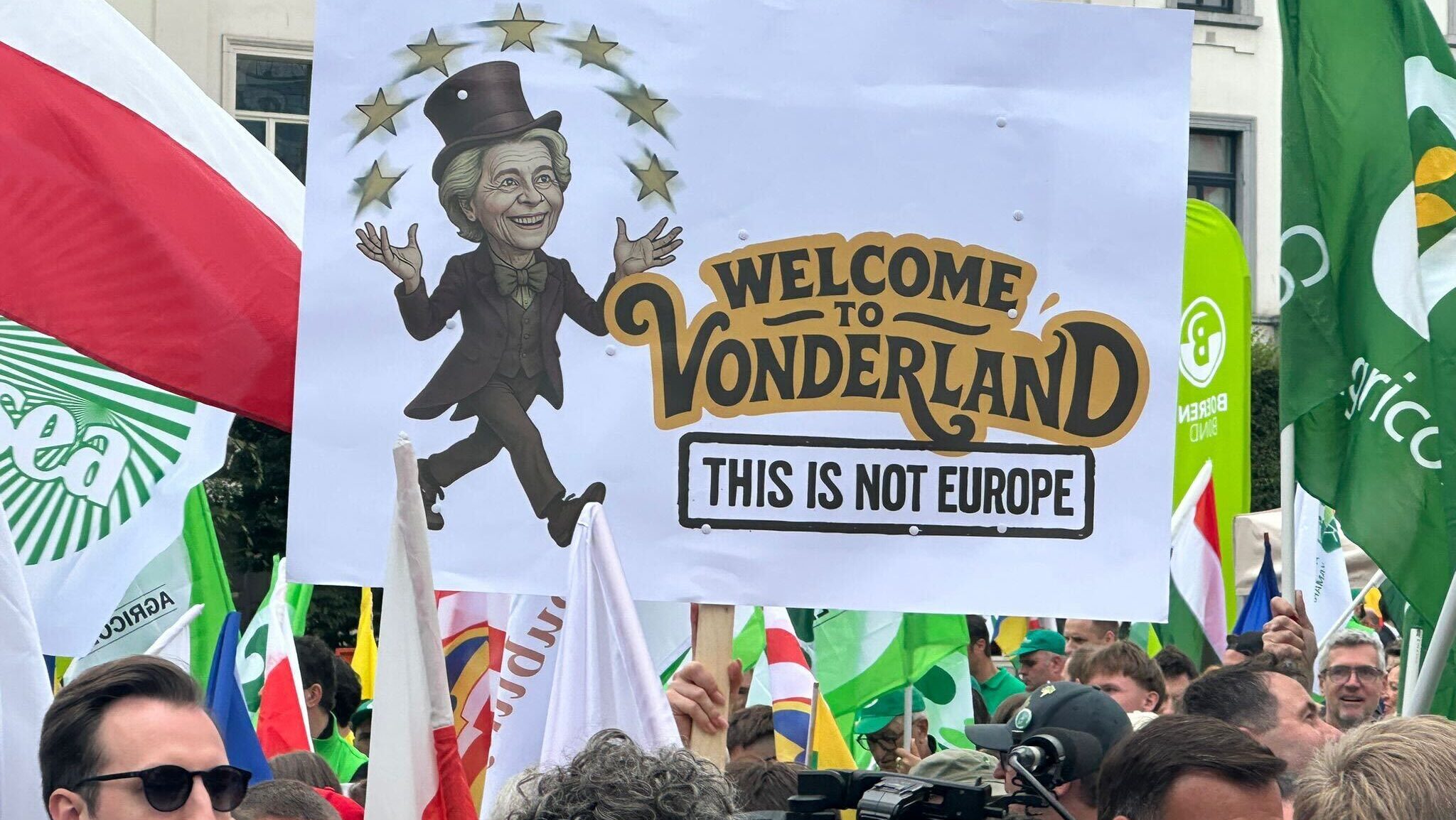
Sign at farmers’ protest in Brussels, 16 July 2025.
Javier Villamor
Hundreds of farmers from across Europe marched yesterday from Luxembourg Square to the European Commission headquarters in Brussels to protest a fresh assault on their livelihoods: the drastic budget cut proposed for the Common Agricultural Policy (CAP) for the 2027–2034 period. On foot, carrying signs, flags, and loudspeakers, the protesters expressed their outrage toward a Commission that—in their words—has completely lost touch with the realities of rural Europe.
The European Commission, led by Ursula von der Leyen, has proposed reducing the CAP budget from its current €386.6 billion to just €300 billion. Although Brussels insists that direct payments to farmers are protected, agricultural professionals remain skeptical.
“The Commission says it’s protecting us, but in reality, it’s stabbing us in the back,” was a repeated sentiment among the demonstrators, many of whom were members of cooperatives, farmers’ associations, and family-run farms. From the makeshift stage outside the Berlaymont building came sharp and direct criticism.
Patrick Pagani, Deputy Secretary General of COPA-COGECA, Europe’s largest umbrella organization for farmer unions, pointed out Brussels’ contradictions to europeanconservative.com:
It makes no sense for the EU to outsource production to other countries. We comply with all the standards, yet they keep demanding more and more regulations. That’s why we are also completely opposed to the Mercosur agreement. We need to secure production within Europe. Today we have representatives from all political parties here, and that’s good—but we need the European Parliament and the Council to support our budget.
His words summarize one of the sector’s main complaints: the Commission imposes increasingly strict environmental and labor standards on European producers, while facilitating imports from third countries that don’t comply with the same rules, such as Morocco or Brazil. For many, this equates to unfair competition and agricultural deindustrialization.
Pedro Barato, National President of ASAJA, Spain’s largest farm union, was even more blunt:
Von der Leyen will go down in history as the gravedigger of the Common Agricultural Policy—practically the only thing still common in Europe. The best CAP is one in which products are valued at what they’re truly worth, and we’re not suffocated by unnecessary regulation.
Barato also denounced the EU and Spanish government’s double standards regarding countries like Morocco:
The hypocrisy is outrageous. If we’re in a market, I’m not afraid to compete—but only if we play under the same rules and conditions. Right now, there’s no real reciprocity. Who’s going to control hormone-injected beef from Brazil? Are they planning to create yet another agency?
Outrage is mixed with a sense of abandonment. Leaks about the budget cuts, they say, hit especially hard in the most vulnerable rural areas, where the CAP is not only an economic lifeline but a cultural and social pillar.
There were also strong critiques of EU climate policies. Mireia Borrás, MEP for VOX, lashed out against the Green Deal: “We are seeing the totalitarian Green Deal suffocating our farmers, and now Von der Leyen wants to dissolve the CAP into a single fund. Enough of these attacks on our countryside.”
The Commission not only fails to address the real problems, but it actively encourages unfair competition. We saw it with Mercosur and Morocco. Even if a ruling from the EU Court of Justice declared the EU-Morocco agreement illegal, the Commission looks the other way. Farmers and ranchers are the backbone of Europe. Food security—especially access to high-quality food—comes even before military security.
While Agriculture Commissioner Christophe Hansen attempted to calm tempers in Parliament by assuring that the €300 billion figure is a legally protected “minimum base,” farmers on the streets saw this as political sleight of hand.
“Don’t try to sell us a 25% cut as a success story,” exclaimed a European People’s Party MEP, in a rare unified front with socialists and conservatives, despite being one of those most responsible for the current situation. COPA-COGECA called the day a “Black Wednesday for European agriculture,” accusing the Commission of acting “radical, unilateral and cynical”.
“They’re dismantling 70 years of European history,” said Massimiliano Giansanti, head of COPA. “If they want a declaration of war on farmers, we are ready.”
For rural Europe, the budget debate is not technical—it’s existential. In a context of geopolitical crisis, inflation, and growing threats to food security, farmers are demanding stability, reciprocity, and respect for their work. Yesterday, they voiced this demand loudly in the streets of Brussels. The ball is now in the court of the European Parliament and the Council.
What’s at stake is not only the future of the CAP but also Europe’s very food sovereignty.