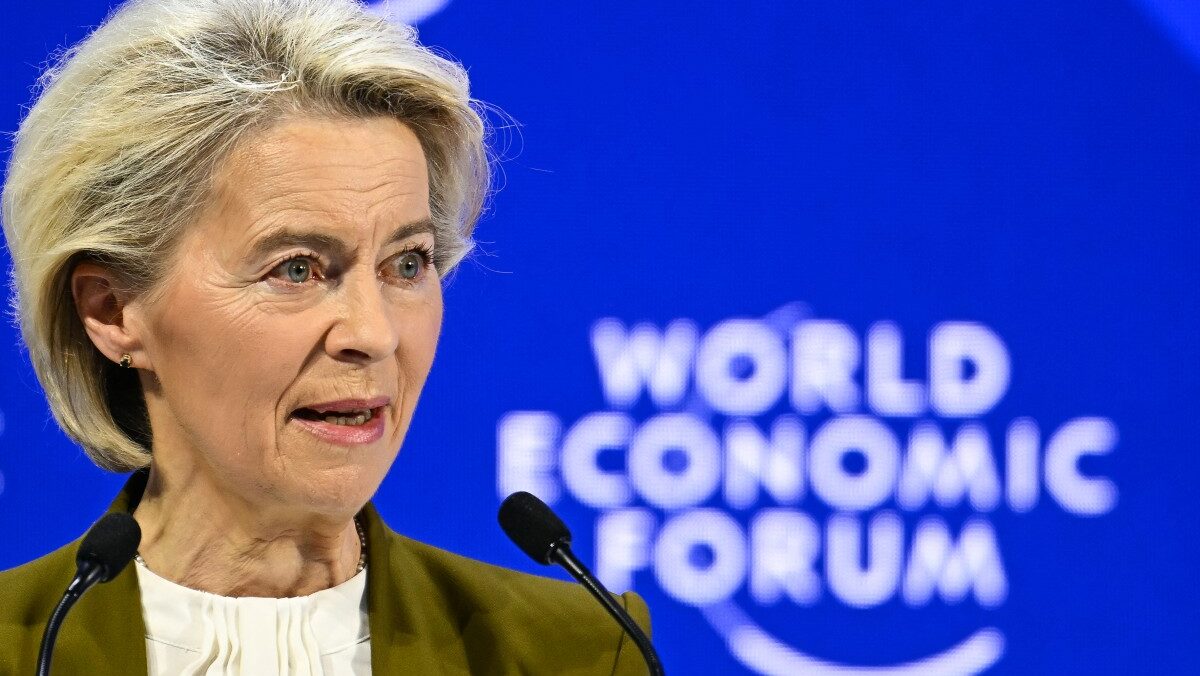
European Commission President Ursula von der Leyen delivers a speech during the World Economic Forum (WEF) annual meeting in Davos on January 20, 2026.
FABRICE COFFRINI / AFP
The European Parliament on Thursday, January 22nd, rejected a new motion of no confidence against Commission President Ursula von der Leyen, the fourth in just seven months.
The outcome—390 votes against and 165 in favour, out of a total of 565 cast—secures the formal continuity of the EU executive but does little to dispel the growing perception of political paralysis and erosion of credibility surrounding her leadership, particularly in the wake of the trade agreement between the European Union and Mercosur.
The initiative, introduced by French MEP Jordan Bardella on behalf of the Patriots for Europe group, challenged the Commission’s push for the Mercosur deal because it weakens European economic sovereignty, exposes farmers to unfair competition, and reduces democratic oversight by fast-tracking the agreement. The motion was widely expected to fail, but its mere repetition—four such votes in a short period—is unprecedented in the Union’s history and points to persistent political discontent.
The immediate context compounds this erosion. One day earlier, the European Parliament voted to request an opinion from the Court of Justice of the European Union on whether the EU–Mercosur agreement complies with the EU Treaties. Adopted by a narrow margin, the decision effectively freezes ratification and puts von der Leyen’s strategy on hold, after she had invested significant political capital in securing rapid approval to bolster the EU’s global standing.
While the Commission’s policies stall or are delayed, its leadership remains unchanged. Von der Leyen was not even present in Strasbourg during the no-confidence vote, as she was attending the World Economic Forum in Davos. Several MEPs interpreted her absence as a sign of disconnection from an increasingly fragmented chamber that is sceptical of major trade agreements.
The substance of the deal also divides the main political families. Although the European People’s Party and the Socialists & Democrats have closed ranks to prevent the Commission’s fall, a significant share of EPP lawmakers voted in favour of referring the pact to the EU’s judiciary, reflecting national—particularly French and Polish—and sectoral tensions. That internal split weakens von der Leyen’s ability to present the Commission as a coherent and effective actor.
Motion de censure : si les groupes favorables hier à la saisine de la CJUE étaient cohérents, VDL serait déjà en train de faire ses valises.
— Julie Rechagneux (@jrechagneux) January 22, 2026
La cohérence et l’Europe des peuples, c’est nous.
Le sectarisme et la compromission permanente, c’est eux ! #Mercosur pic.twitter.com/h8e5EkTuEz
From within the Commission, the argument persists that Mercosur is strategic for European competitiveness and for avoiding marginalisation in an adverse geopolitical environment. Yet the accumulation of controversies—from transparency to trade policy—feeds a narrative of a Commission presidency that survives more by parliamentary inertia than by genuine political consensus. The fourth failed no-confidence vote does not bring her down, but it leaves a mark: that of an executive who endures without persuading.
Ultimately, the cost extends beyond von der Leyen herself. The prolonged delay of key decisions, the judicialisation of strategic agreements, and repeated crises of confidence affect the European Union as a whole, projecting an image of paralysis at a time of intense external pressure. The Commission remains in command, but each politically lost vote—however numerically won—further erodes its authority and the credibility of the European project it claims to defend.