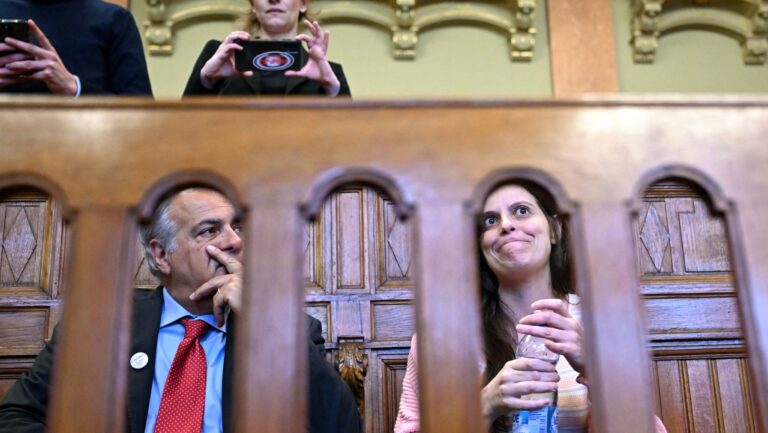
A woman walks past the Seine River and the French National Assembly in Paris on August 11, 2025.
Martin Lelievre / AFP
Just weeks ahead of a vote of confidence he himself called, French Prime Minister François Bayrou is in a weak position, according to two recent polls. MThe majority of the French wants to see him gone, while more than six in ten also believe President Emmanuel Macron himself should resign. The prospect of a new government crisis looms large over Paris, adding to a long list of political shocks that have marked Macron’s second term.
Bayrou, who announced on August 25th that he would submit his government to a vote of confidence on September 8th, had hoped to regain momentum after unveiling a €44 billion savings plan to tackle France’s ballooning public debt. His gamble was to present himself as a responsible statesman willing to “face reality” and commit to budgetary discipline. Yet public opinion appears unmoved: IFOP and Elabe surveys show that 56% and 69% of French citizens favour dissolving the National Assembly and holding fresh elections. Even more strikingly, 68% of respondents told IFOP that Macron should resign—a figure unheard of for a sitting French president, save in times of acute scandals or national tragedies.
The government’s draft budget is deeply unpopular, the polls found. An overwhelming majority of respondents see Bayrou’s plan to cut two public holidays while sparing the wealthiest and many businesses as unfair. According to Elabe, 82% of respondents believe the distribution of the burdens is unjust, and 76% see the 2026 budget as ineffective in curbing debt. It seems that Bayrou’s attempt to explain the plan through a summer-long YouTube campaign has failed to change minds.
Inside parliament, the numbers are hardly better. Only the parties directly linked to the governing coalition—Renaissance, MoDem, Horizons, and a portion of Les Républicains—have pledged support. Even under perfect discipline, they would secure barely 210 votes, far short of the 288 needed for an absolute majority. Opposition forces on the left and the right have already decided to vote against Bayrou.
The political class now openly discusses four possible scenarios after the confidence vote: one, Macron could appoint a new prime minister; two, Bayrou might scrape through with outside help but lose legitimacy; three, France could head to snap legislative elections; and finally—the most radical option—Macron himself could resign. None of these options suggests stability in the short term.
For his part, Macron has publicly offered “full support” to Bayrou’s decision, framing the upcoming vote as a test of principle rather than a verdict on the government’s specific policies. Yet even within the presidential camp, unease is evident. Former prime minister Gabriel Attal described the decision as questionable, while Justice Minister Gérald Darmanin admitted that new elections “cannot be ruled out.”
As for Macron, this is a culmination of a failing presidency that since 2022 has faced waves of social unrest, institutional gridlock, and multiple confidence crises without a fundamental reset. The “Bloquons-tout” (Block everything) movement, which plans to paralyze the country on September 10th, has only reinforced perceptions of a government increasingly detached from social realities.
If Bayrou falls, Macron will face the challenge of appointing yet another prime minister tasked with the impossible job of an increasingly fragmented parliament and an electorate impatient with austerity. If Bayrou survives, it will be by a razor-thin margin, leaving him too weakened to govern effectively. Either way, the latest polls confirm that France is entering a period of deep political turbulence that could mark the twilight of Macron’s presidency well before 2027.