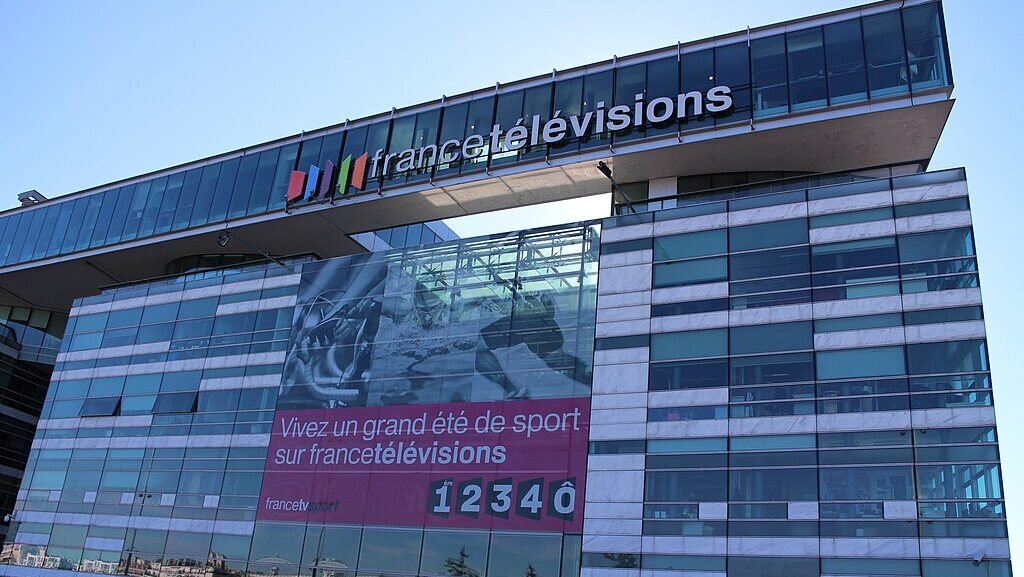
France Télévisions
Suicasmo, CC BY-SA 4.0, via Wikimedia Commons
As part of the parliamentary inquiry launched by allies of the Rassemblement National into the functioning of French public broadcasting, France Télévisions chairwoman Delphine Ernotte appeared before MPs on Wednesday, September 10th. Targeted by numerous scandals, both for her financial management and her ideological bias, she attempted to defend herself by arguing for the introduction of ‘opinion channels’ on television, similar to newspapers.
Since the inquiry began, attacks have focused on Ernotte, the president of public broadcasting, who appears to be responsible for the many dysfunctions observed within French public television: skyrocketing operating costs; excessive benefits for staff; ideological bias among journalists; and programming that is openly militant in its wokeism and progressivism.
Ernotte, however, said she was “very calm” when giving her account to MPs.
Her motto: sidestep and deflect the issues. When questioned about the mismanagement of France Télévisions, Ernotte blamed everything on inflation: “Taking inflation into account, France Télévisions costs the French 500 million euros less than when I arrived, which is 20% less than ten years ago.” But inflation alone cannot explain the exorbitant differences in the group’s employee salary scale compared to the national average or the undue privileges granted to certain partner companies.
Ernotte, who a few weeks ago attacked the conservative channel CNews, owned by Catholic billionaire Vincent Bolloré, describing it as “far-right,” defends herself against any criticism but assures her objectivity: “I said that CNews was an opinion channel, and I described an opinion, which represents a significant part of the population. It was not a value judgement,” Delphine Ernotte said in an exclusive interview with Le Figaro ahead of her hearing, with obvious hypocrisy, as it is true that the label ‘far-right’ is now a guarantee of infamy.
Her defence strategy consists of counterattacking. For her, the solution to guarantee pluralism within French television would be to authorise “opinion channels,” in the same way that there are ideologically oriented newspapers. “This evolution corresponds to a transformation of society,” she explained to Le Figaro. “In the United States, there is a clear polarisation of news channels, with Fox News on one side and CNN on the other … In France, this phenomenon is new.” As it stands, French law, which dates back to 1986, does not allow for opinion-based channels. The head of CNews defends himself against any accusation of a single line: “We are an opinions channel with an s,” he emphasises.
“Applying the rule of ‘external’ pluralism to television would be clearer for the public. We would know where everyone stands,” argues Delphine Ernotte.
The proposal is clever: it creates the illusion of pluralism—opinion channels could thus operate ‘openly’ and assume an ideological stance—without public broadcasting having to question its own ideological biases, since, according to her, it remains the bastion of impartiality and objectivity. She believes that CNews and the public service “do not do the same job.” “We are not seeking to shape opinion, simply to inform, which is the duty of the public service,” she explains in defence of a code of ethics based on neutrality, which contrasts with other statements she has made in the past, in which she explained that she deliberately wanted to put the public broadcasting service at the service of a progressive agenda.
The confidence with which Ernotte faces the commission of inquiry proves her absolute conviction that she is in the right, despite the near bankruptcy of the institution she heads and the mounting evidence of her betrayal of the public service mission to serve all French people that is incumbent upon her. But Ernotte, unlike her counterpart at the BBC caught up in the scandal of Trump’s hijacked videos about the march on the Capitol, will not resign—that’s what we may call the French privilege.