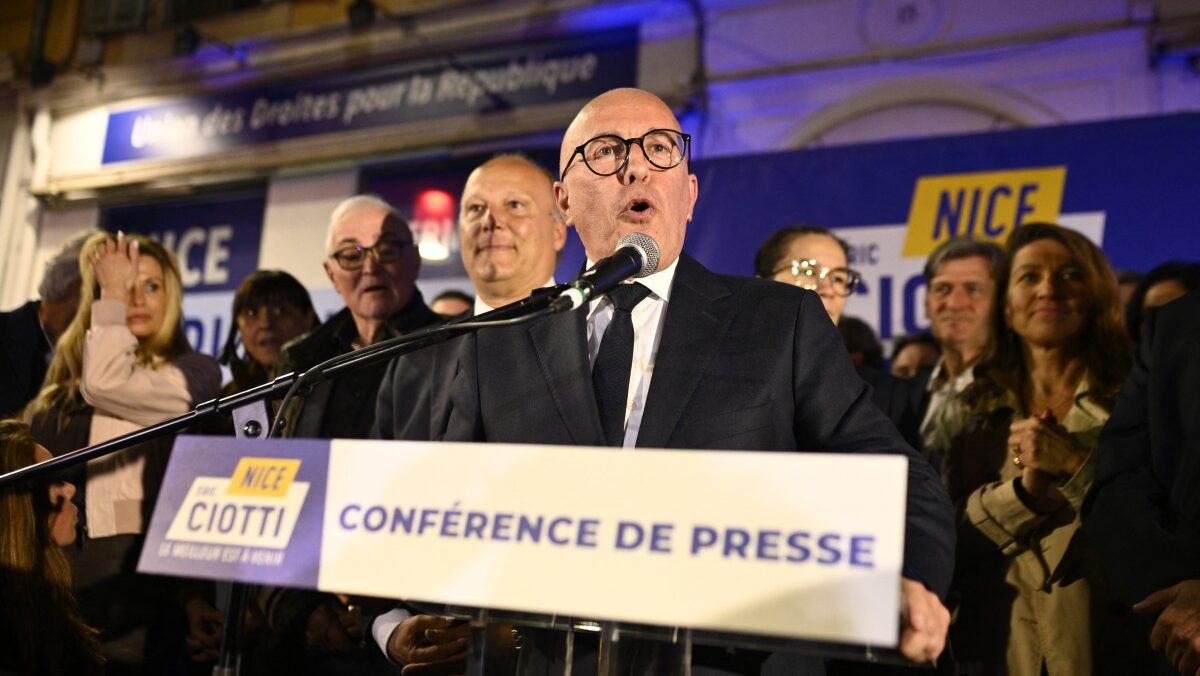
President of UDR parliamentary group and Nice mayoral candidate Eric Ciotti speaks following the results of the first round of France’s 2026 municipal elections in Nice, southeastern France, on March 15, 2026.
FREDERIC DIDES / AFP
The second round of French municipal elections on March 22nd, marked by a 57% turnout, reveals a contrasting political landscape just over a year before the presidential election. Beyond the local results, this election appears to be a true test of alliance strategies, both on the Right and the Left.
One of the main issues at stake in this second round was the effectiveness of merger strategies on the Left, particularly those involving La France Insoumise (LFI).
Contrary to what party leaders would have us believe—quick to highlight symbolic victories, such as that of Bally Bagayoko, elected in Saint-Denis in the first round, or that of David Guiraud, who won the city of Roubaix in the North in the second round—Jean-Luc Mélenchon’s party is far from winning the match. Moreover, the party appears, even to left-wing voters, to be an effective deterrent: in several major cities, alliances between Socialists (PS) and LFI failed to retain or capture strongholds. In Limoges, the PS-LFI alliance failed to retake the city, which remains in the hands of the right. In Clermont-Ferrand, a historic stronghold of the Left—which had reigned unchallenged there since 1919—the strategy of uniting the Socialists and LFI resulted in a historic defeat, with the city swinging to the right for the first time in over a century. This shift is highly symbolic: the alliance with LFI, which was supposed to save the place, seems instead to have precipitated its fall.
The same observation holds true in Besançon and Poitiers, where the incumbent Green teams were defeated and replaced by right-wing majorities.
In Toulouse, the right-wing won against LFI despite an overall balance of power favouring the Left, illustrating an inability to translate a sociological majority into an electoral victory. Generally speaking, left-wing voters seem to have at times shunned alliances perceived as artificial or imposed by political apparatuses.
Nevertheless, despite these difficulties in symbolic cities, the Left retains or wins certain key cities. In Marseille, Benoît Payan was comfortably re-elected with 54% of the vote, at the expense of RN candidate Frank Allisio, who faced a ‘Republican front’ mobilising against him—uniting left-wing and centre-right voters, who preferred to support a Socialist rather than risk backing a right-wing coalition dominated by the RN. In Lyon, the incumbent Green mayor Grégory Doucet also won.
But the greatest tragedy remains the comfortable election of Emmanuel Grégoire as mayor of Paris, a worthy heir to Anne Hidalgo—for the worst of what she represented. Rachida Dati’s candidacy turned out to be a disaster. While there is a surge to the Right across the country, and though Dati benefited from a merger with the centrist Pierre-Yves Bournazel and the explicit support of the national right-wing candidate Sarah Knafo, the PS won by a margin of more than 10 points—proving that Dati was definitely not the right candidate to enable the Right to retake the capital.
The signs of celebration lie elsewhere. The real lesson of the election lies in the remarkable gains made by the RN at the local level. The party claims a “greater breakthrough in its history,” with approximately 1,300 municipal officials elected in the first round and a three- or even fourfold increase in its municipal councillors in the second round.
There were a few bitter and hard-to-swallow defeats for the party led by Marine Le Pen and Jordan Bardella. For instance, in Nîmes, where the right-wing bloc garnered nearly 60% of the vote split between the RN and the ruling right-wing party LR, RN candidate Julien Sanchez was defeated by a Communist candidate due to the Right’s refusal to form an alliance with him. In Toulon, conservative candidate Laure Lavalette, on whom many hopes had been pinned, was also defeated.
But the RN prevailed in a range of medium-sized cities, such as Agde, Carcassonne, Carpentras, and even Menton—where the highly media-savvy Louis Sarkozy, son of the former president of the Republic, was running—and conquered new territories, such as the small town of Montargis in the Paris basin. This progress reflects a successful strategy of local grassroots organising, long considered the party’s weak point. The case of Montargis is particularly telling: ravaged during the riots sparked by the death of Nahel in June 2023 and the scene of extremely violent crimes involving immigrants, the small town is eager to restore order and calm.
For Laurent Jacobelli, the party’s spokesperson, the gamble has paid off: RN candidates already in office were re-elected, often by a landslide, and a significant number of new towns have chosen RN local leadership—a full-scale test of the National Right’s ability to govern.
In Nice, France’s fifth-largest city, UDR (Union des Droites pour la République) candidate Éric Ciotti, allied with the RN, was elected against Macronist Christian Estrosi. For Ciotti, who did not hesitate to challenge his former party’s leadership in 2024 to advocate for an alliance with the national Right, this serves as confirmation that the only strategy for the future is a union of the right focused on clear convictions regarding order, security, immigration, and identity.
Beyond the example of Nice, the union of the right is the big loser of the election, as evidenced by the cases of Nîmes and Marseille. Within the leadership of Les Républicains (LR), officials are pontificating and reassuring themselves by analysing a few local successes. The party claims to have won the highest number of votes and local elected officials, thereby purporting to confirm its status as the leading local political force, but its results must be interpreted in the opposite way to those of the RN: local roots are merely a mask for an inability to embody a national narrative. The debates on television, as the results were being announced, revealed a high level of tension within the party, which, according to Jean-François Copé, mayor of Meaux, will not escape a “schism”—something that, incidentally, already occurred around Ciotti in 2024.
On the side of the centrist bloc, the situation appears more ambivalent. Eight years after Emmanuel Macron came to power, his party, Renaissance, is still struggling to establish a lasting foothold in the regions. Admittedly, the number of elected officials is growing, even doubling, but all this seems rather meagre for the party of a man who has been in power since 2017. The reelection of former Prime Minister Édouard Philippe in Le Havre with 47.7% captured everyone’s attention. His speech, laden with clichés of ‘respectable’ republican rhetoric, is more than ever designed to position him as the system’s ‘natural’ candidate in 2027.
On the evening of the second round, each camp claimed victory, proof of the complexity of interpreting the election results. The only indisputable lessons lie in the fragility of La France Insoumise, increasingly seen as a party to be sidelined, and in the local roots of the RN. For the rest, uncertainty reigns. In the coming months, the parties will face daunting strategic choices regarding alliances in the hope of securing presidential victory.