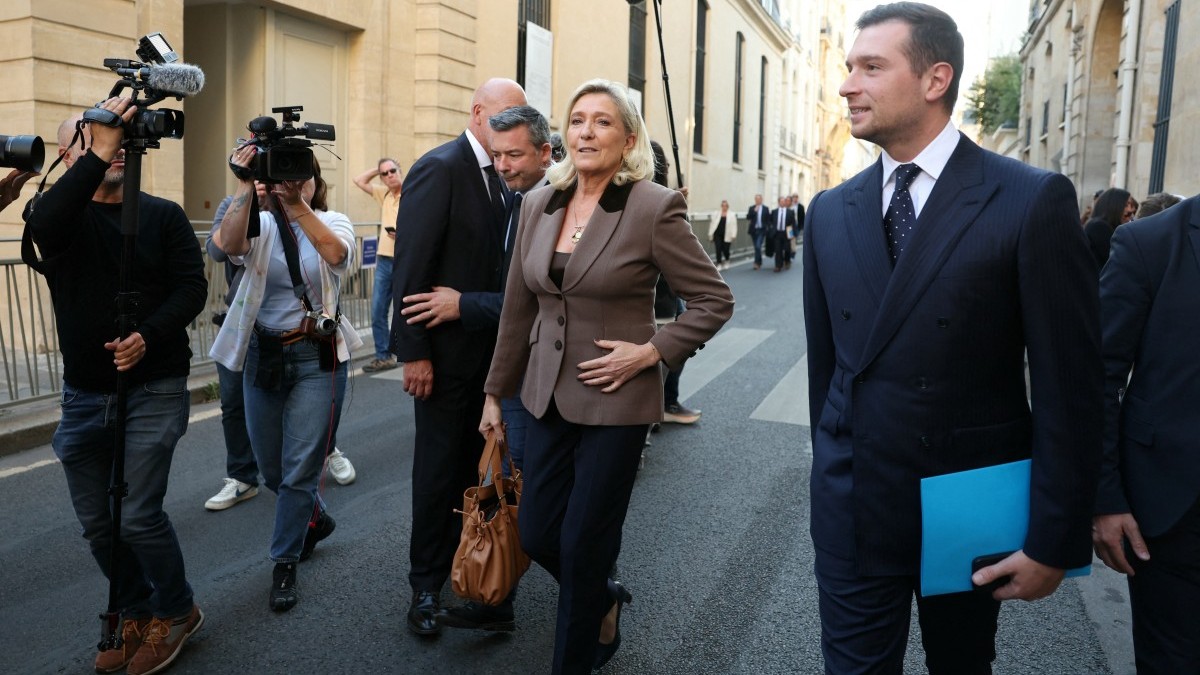
President of Rassemblement National (RN) Jordan Bardella (R) and President of the party’s parliamentary group Marine Le Pen (C) leave following a meeting with the French Prime Minister in Paris, on September 17, 2025.
Alain Jocard / AFP
There are still 18 months to go before the next French presidential election, set to mark the end of the Macron era. Although the candidates are not yet known at this stage, there is a clear trend in favour of the Rassemblement National (RN), which is pulling ahead of its opponents, whoever they may be.
A poll conducted for BFMTV and TF1 now puts the RN, represented by Jordan Bardella—in the event that Marine Le Pen is unable to stand due to a court conviction—in the lead in the first round, with 37.5%. Several other polls also place him at around 35%. In all cases, he is 15 to 17 points ahead of his closest rival. If Marine Le Pen were to stand, she would achieve similar, albeit slightly lower, results.
The other interesting fact shown by this poll is the inability of Macron’s camp to put forward a credible candidate who is likely to exceed the 10% threshold. The survey tests the hypothesis of a candidacy by Gérald Darmanin, the current minister of justice, who barely reaches 7%, competing with the centre-right minister of the interior from the Les Républicains party, Bruno Retailleau, who would get 8.5%.
With a year and a half to go before the election, there is a great deal of uncertainty, especially as it is not yet known who will stand as Emmanuel Macron’s successor, carrying his cumbersome legacy: it could be Darmanin, or one of the former prime ministers, Édouard Philippe or Gabriel Attal.
While Philippe and Attal would fare better than Darmanin, none of them currently appear capable of rivalling the RN. Worse still, Philippe has long been presented by the French press as a ‘favourite’ candidate of the French people, but the momentum in his favour has now passed.
In all the polls currently published, it appears that the Right as a whole is gaining an increasingly significant share of the vote. Bernard Sananès, president of the Elabe polling institute, notes that in 2022, the Right won 32.35% of the vote in the first round. Now, it has more than 40%. “This creates a very strong dynamic for the second round,” he explains.
But the RN’s seemingly unassailable dominance is paralysing many, who are unable to envisage a strategic alliance that could lead to victory. The rivalries that had culminated in 2022 during the previous election have not been overcome, far from it. Alongside the RN, polemicist Éric Zemmour, who had launched his own movement, Reconquête, garnering success with the media but not at the polls, is preparing to run again. In an interview with BFM TV on November 2nd, he suggested that his partner and campaign manager, Sarah Knafo, could run in his place, given the strong support she currently enjoys among part of the right-wing electorate. “It’s quite extraordinary to see this woman, who was unknown to the public 18 months ago, now credited with 6 or 6.5% in the presidential polls,” he explained, not without bias. Sarah Knafo is actually polling better than Zemmour himself.
The essayist also said he was open to the idea of organising an expanded primary within the French right wing in an attempt to reach a consensus on a single candidate. The idea resurfaces with every election and has so far failed every time.
On the Left, at least in rhetoric, the reflexes of unity are much stronger. The figures announced for the RN trigger alarmist rhetoric among activists who are replaying the well-known tune—going on for 90 years—of the need for an “anti-fascist coalition.” Worryingly, Jean-Luc Mélenchon, president of the far-left party La France Insoumise, who had suffered in the polls due to the outrageous and antisemitic remarks made by his party, seems to be holding his own, fuelling his ambitions to once again appear as the leading candidate of the Left.