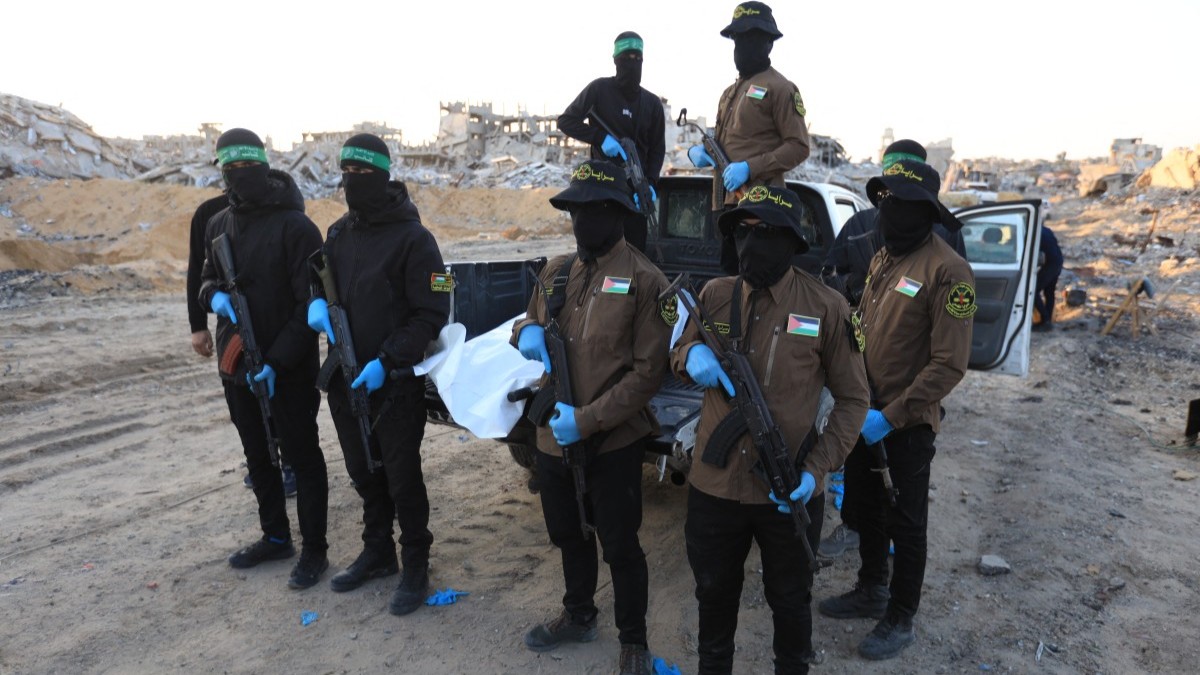
Islamic Jihad and Hamas terrorists with a white body bag believed to carry the remains of an Israeli hostage in the town of Beit Lahia in the northern Gaza Strip on December 3, 2025.
AFP
When the European Commission carried out an urgent review in November 2023 of its aid programmes to Palestine following the October 7th massacre, it concluded that “there were no indications” that European money had directly or indirectly benefited Hamas. Brussels maintained payments and defended its control mechanisms, although it announced new clauses against incitement to hatred and increased scrutiny of NGOs.
One year later, internal Hamas documents–seized by the Israeli army and analysed by NGO Monitor–reopen the debate on the EU’s real capacity to operate in Gaza without falling at least partially under the influence of the Islamist group. Without demonstrating a direct diversion of funds, the reports describe a network of “guarantors,” ministries controlled by Hamas, and mechanisms of pressure that allow the organisation to influence staff selection, projects, and the flow of information.
According to the report Puppet Regime: Hamas’ Coercive Grip on Aid and NGO Operations in Gaza, all NGOs working in the Strip–including those receiving European funds–must coordinate with the Ministry of Interior and the Ministry of Social Development (MoSD), both under Hamas control. The key tool is the “guarantor,” a liaison approved by the security services, who often holds a management position within the NGOs.
A 2022 memorandum details the profiles of 55 guarantors in 48 organisations, some described as “members” or “affiliated” with the Islamist movement and susceptible to being “exploited for security purposes” to infiltrate foreign associations. NGOs that have managed EU-funded projects–such as Oxfam, the Norwegian Refugee Council, the International Medical Corps, or CESVI–appear in these lists.
The documents reveal an extensive surveillance system: identification and classification of guarantors, permanent technological monitoring of NGO facilities, and infiltration through “human sources.” They include notes on personal habits, religious li, and social media activity, and even contemplate using “moral” information to blackmail project officials.
The pressure is also financial. In 2019, Hamas closed the offices of the International Medical Corps for a week after it refused to hand over administrative reports; it was only allowed to reopen after accepting an inspection. Another document mentions alleged “financial violations” by the U.S.-based NGO ANERA, detected after months of attempts to access its accounts.
The files show that Hamas seeks to steer certain humanitarian projects toward its military needs. A 2021 document describes an irrigation programme implemented by Oxfam in a “security-sensitive” border area, where the planted trees are considered potential cover for armed activities. NGO Monitor argues that the project coincides with an Oxfam Novib initiative funded by the EU.
In cash-aid programmes, such as one run by Mercy Corps, the MoSD, controlled by Hamas, provides beneficiary lists and demands changes to questionnaires to remove any question that could identify members of the “resistance.”
Since 2019, the MoSD in Gaza has been led by Ghazi Hamad, a member of Hamas’s political bureau and designated by the United States as a “senior official” of the group. This ministry is central to cash-transfer and food voucher programmes run by the UN and NGOs funded by the EU and several European states.
Aid delivery depends largely on lists prepared by the MoSD, allowing Hamas to channel resources toward its social base. In addition, the digital wallet system used for distribution generates withdrawal commissions of up to 20%. Reports cited by NGO Monitor state that many money changers operate with capital linked to Hamas, charging commissions of up to 40%, turning part of the international aid into revenue for affiliated intermediaries.
Oxfam and IMC reject any connection with Hamas and defend the strength of their monitoring systems. The European Commission’s extraordinary 2023 review examined 119 contracts worth €330 million and detected “no cases of fund diversion” to terrorist organisations, although it declared seven programmes “non-viable” and tightened implementation conditions.
Brussels announced new “anti-incitement” clauses, increased control over subcontractors, and stricter criteria to prevent suspicious entities from accessing funding. MEPs such as Germany’s Niclas Herbst insist that NGOs must undergo independent verification and that, otherwise, they should not receive European funds.
While the documents do not prove that European aid has gone directly into Hamas coffers, they do show that Gaza’s humanitarian ecosystem operates under a climate of coercion and surveillance that enables the Islamist organisation to influence aid management.