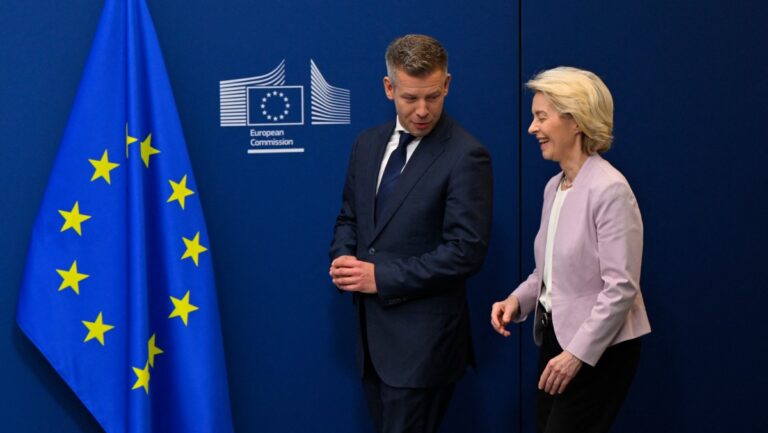
German Interior Minister (then designate) Alexander Dobrindt pictured at the Bundestag on May 6, 2025.
Photo: Tobias Schwarz / AFP
Some sectors view Germany’s new interior minister, Alexander Dobrindt’s announcement about rejecting asylum seekers at its land borders as a firm turn toward migration control. However, scratching just a little beneath the surface reveals that we are, once again, facing an exercise in political rhetoric rather than real transformation.
It must be remembered that Friedrich Merz, who heads the new German government, just hours after winning the elections, had already softened his own campaign promises against immigration..
Dobrindt’s statements, therefore, fit into a well-known strategy: symbolic gestures meant to reassure the center-right voter anxious about the rise of further-right parties, while avoiding any structural reform that would truly limit mass immigration.
The minister explained that he is formally revoking a 2015 verbal instruction that prevented the Federal Police from rejecting asylum seekers at the border. But this administrative act, by itself, does not imply a revolution. Despite that, Bild splashed across its front page the following headline:
Historic: This Signature Ends Merkel’s Border Policy!
Nothing could be further from the truth. Germany, with its more than 3,800 kilometers of borders and thousands of deployed police officers, has for years been applying controls with varying degrees of intensity, such as those initiated in October 2023 at the borders with Poland, the Czech Republic, and Austria.
Now, Dobrindt promises to gradually increase the number of officers—from 11,000 to 14,000—and to reinforce controls. But he remains clear that they will not close the borders or overburden neighboring European countries. He speaks of selective rejections, of stricter controls, but not of a real closure of migratory flows nor of profound legal reforms that could stop the massive arrival of immigrants that has been pressuring Germany and Europe for years.
In his speech, the minister emphasized that vulnerable groups—children and pregnant women, among others—will continue to receive special protection. While this is humanly understandable, it also leaves a huge door open for the maintenance of considerable flows, given that in practice it is extremely difficult to reject applications without facing complex legal and humanitarian objections.
Moreover, the use of articles such as Article 18 of the Asylum Law or Article 72 of the Treaty on the Functioning of the EU guarantees nothing new. These are legal tools that were already available and that, until now, have not been used with sufficient determination to produce drastic change.
In reality, what we perceive is an attempt by European governments— Germany included—to adapt their discourse to capture votes, threatening to shift toward political options that are more forceful on migration matters. This does not mean they are willing to take the tough measures necessary to curb mass immigration. The gestures—announcements, speeches, administrative adjustments—buy time, calm the moderate electorate, and flex muscle in the media, but do not change the underlying trends.