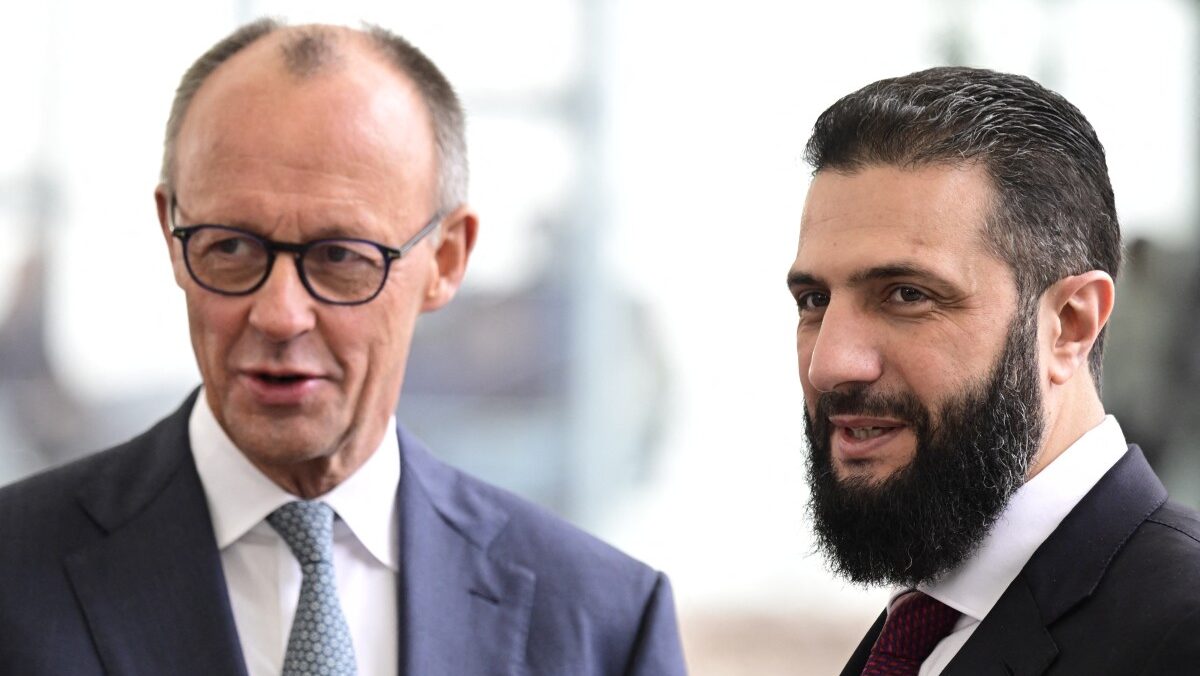
Friedrich Merz (L) welcomes Syria’s Ahmed al-Sharaa in Berlin, March 30, 2026.
John MACDOUGALL / AFP
Germany wants up to 80% of Syrians living in the country to leave within three years, Chancellor Friedrich Merz announced yesterday—a target that would mean the return of hundreds of thousands of people.
Appearing alongside Syria’s interim president, Ahmed al-Sharaa, Merz set out a plan linking large-scale returns to Syria’s reconstruction. No binding deal has yet been signed, but both sides have agreed to set up a joint task force to begin turning the idea into policy.
Berlin says the approach is straightforward: send back those without a right to stay—starting with offenders—while allowing Syrians who are settled and working to remain. Damascus, meanwhile, is pushing for “circular migration,” allowing skilled workers to move between the two countries as Syria rebuilds.
The scale of what is being proposed is vast. By the end of 2024, more than 900,000 Syrian citizens were living in Germany, with another 713,000 registered as asylum applicants, according to Destatis. In total, around 1.22 million people of Syrian background now live in the country. Last year alone, more than 83,000 Syrians were granted German citizenship.
This is no longer a recent influx, but a large, established population—one that cannot easily be reversed.
That is what makes the 80% target so difficult to realise. Current return figures are nowhere close. Germany’s main voluntary return scheme recorded just over 10,000 departures in 2024 across all nationalities. In 2025, the Federal Office for Migration and Refugees reported around 16,500 voluntary returns, with Syrians among the main groups.
Even taken together, those numbers fall far short of what would be needed to return hundreds of thousands of people within three years.
And the barriers go beyond logistics. EU policy still insists that returns must be “safe, voluntary and dignified,” in line with UN standards. That position, reaffirmed in recent guidance on Syria, places clear limits on any attempt to carry out large-scale forced returns.
Berlin may be able to speed up deportations at the margins, especially after recent moves in the Bundestag to tighten asylum rules. But scaling that up to the level now being discussed would almost certainly run into legal challenges at every level—national, European and international.
What emerged from yesterday’s announcement is less a detailed plan than a clear political signal. Germany wants to use Syria’s post-war transition to redraw the terms of its asylum system. Syria, for its part, wants people, skills, and legitimacy.
Between those aims lies a much harder reality. Turning an 80% return target into something concrete would require a legal, administrative, and political effort on a scale Germany has never attempted—and one that, for now, looks far more ambitious than achievable.