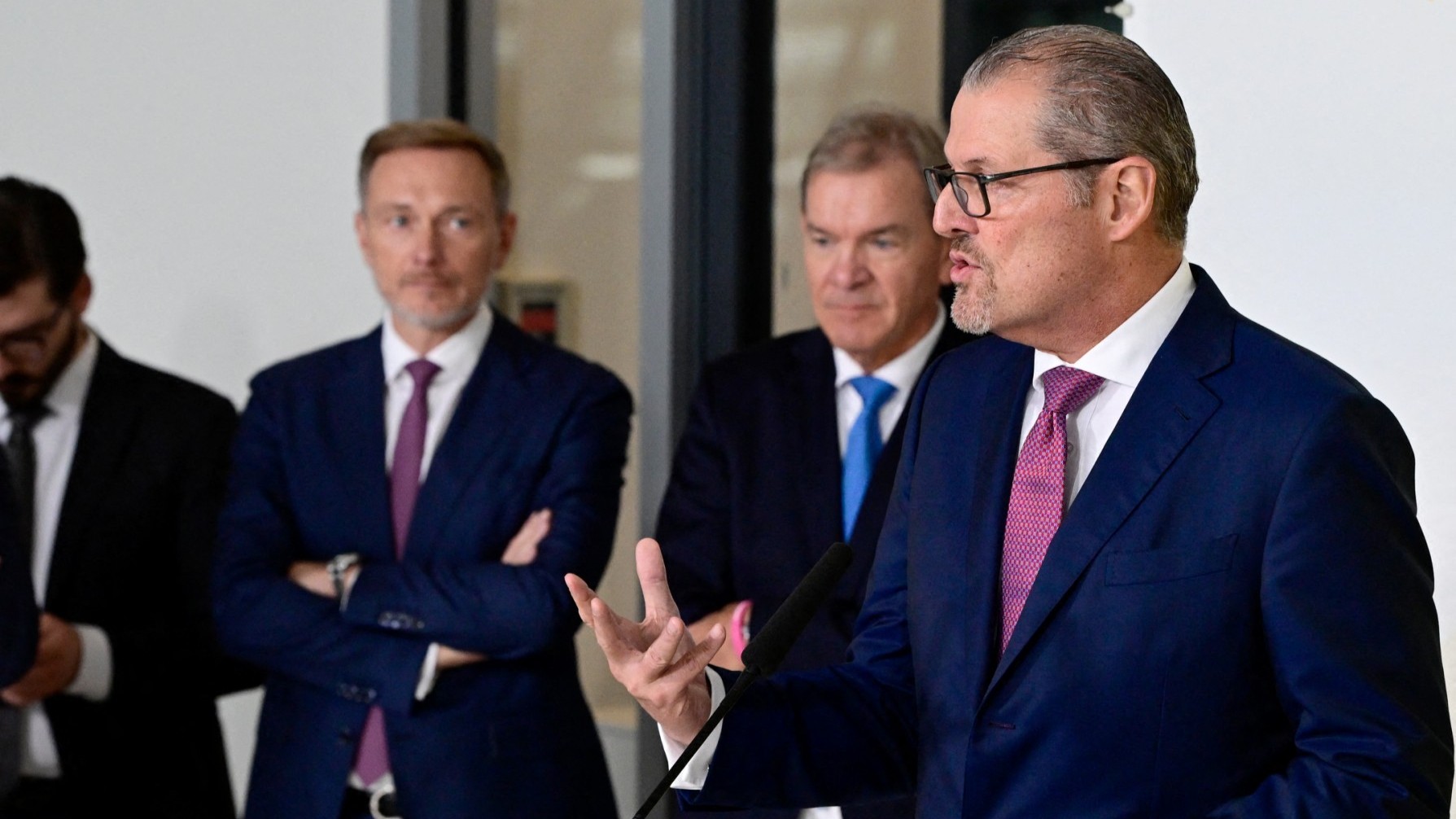
(Former) German Finance Minister Christian Lindner (3rd R), also leader of Germany’s free democratic FDP party, listens as Rainer Dulger (R), President of the Confederation of German Employers’ Associations (BDA), gives a statement on October 29, 2024 in Berlin.
John MacDougall / AFP
Berlin, Paris, Madrid. Gradually, European governments are beginning to prepare their citizens for what, until recently, was taboo: the welfare system, as it has been known in Western Europe since the end of World War II, is no longer sustainable. The continent’s remilitarization, the consequences of runaway public debt, mass immigration, and a social model dependent on ever-increasing spending have pushed several capitals to verbalize the need for structural reforms. Translation: cuts.
In Germany, the president of the Confederation of German Employers’ Associations, Rainer Dulger, has issued a stark warning: “If we carry on like this, the welfare state will collapse. And when it does, it won’t benefit anyone.” In his view, maintaining all current benefits is no longer possible, and he has called for urgent reform. “We can’t afford everything we wish for,” he declared, highlighting the 25 billion euros spent solely on administrative costs of the German social system.
Paradoxically, while warning of the model’s collapse, the federal government has approved a record increase in social spending, reaching 219 billion euros by the end of the legislative term. Part of that money will be allocated to the ‘Bürgergeld (citizen’s benefit), which will increase by five billion this year alone.
However, a discursive offensive is already underway that no longer hides its goal: to adjust the model by reducing so-called non-wage labor costs. Dulger has even warned that democracy may not withstand the social pressure if workers continue to see “neighbors who have never worked or paid contributions living just as well as they do thanks to the State.”
What is most striking, however, is that the business sector is simultaneously ramping up its demands to import more low-skilled workers. The hospitality association, Deutsche Bahn, and the postal service are calling for fast-track pathways to hire immigrants with minimal qualifications—at a time when Germany already hosts more than five million welfare recipients and one million Syrians.
The contradiction is glaring: while German citizens are asked to accept cuts and fewer benefits, pressure is mounting to fill the country with cheap labor from third countries. All of this is done without seriously addressing the productivity problem or the lack of incentives for domestic employment.
This pattern is not exclusive to Germany. In France, the government of Emmanuel Macron has commissioned reports to prepare a “deep reform of the social contract.” And in Spain, voices such as that of Cayetana Álvarez de Toledo (PP) have begun to publicly ask “what sacrifices are we willing to make” to sustain the system. In all cases, the narrative centers on the need for “fiscal responsibility” and “sustainability”—concepts that serve as the prelude to sweeping cuts.
In truth, it is the same governments that fueled public indebtedness—through ideology, mismanagement, or crises provoked by their own decisions—that now present themselves as saviors in the face of the abyss. And they do so without abandoning the dogma of open borders or structural spending on massive subsidies.