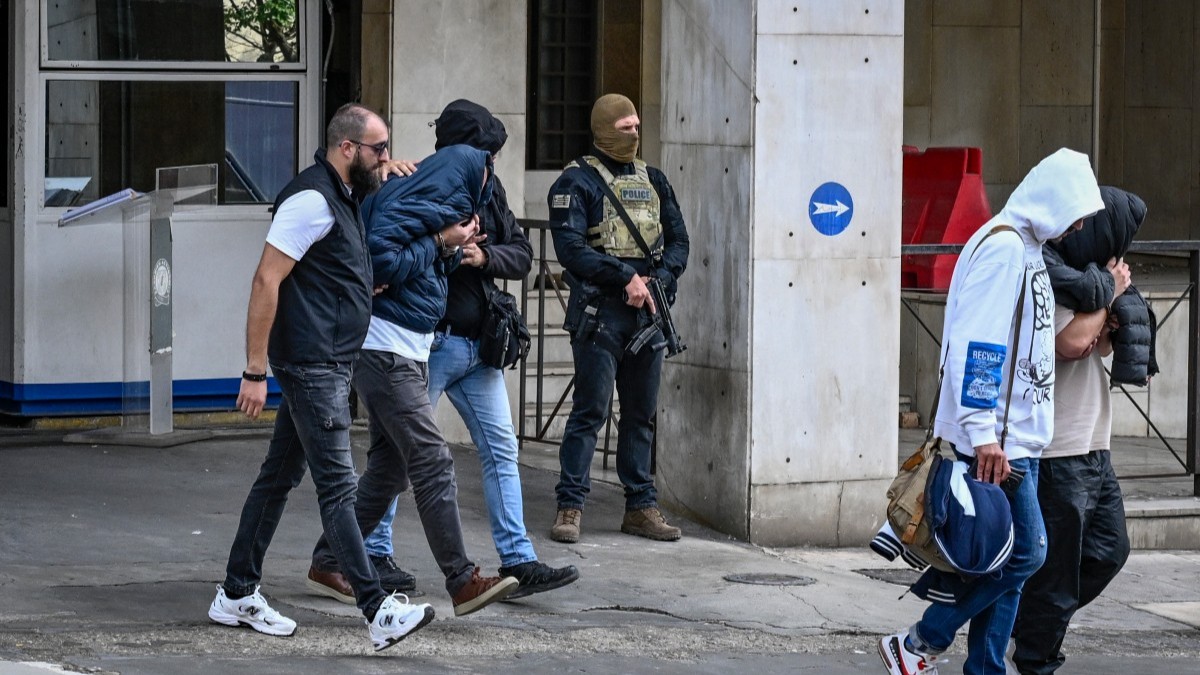
Arrested suspects, allegedly “involved in large-scale agricultural funding fraud and money laundering” according to the European public prosecutor’s office (EPPO), are escorted by plainclothes police officers in Athens on October 23, 2025.
ARIS MESSINIS / AFP
Eleven MPs from Greece’s governing party, New Democracy, appeared in front of the Parliament on Tuesday over an alleged fraud involving European Union agricultural subsidies. All declared themselves innocent. All also asked for their parliamentary immunity to be lifted so that the investigation could proceed.
For any government, the scene would have been politically damaging. For Prime Minister Kyriakos Mitsotakis, it comes at the worst possible moment.
The scandal has already forced the resignation of several senior officials, including former agriculture minister Kostas Tsiaras, and now threatens to trigger the most serious political crisis inside New Democracy since the party returned to power in 2019.
The European Public Prosecutor’s Office (EPPO) accuses the eleven MPs of taking part, to varying degrees, in a scheme to divert EU farm subsidies to beneficiaries who were not entitled to receive them.
Parliament is expected to vote after April 19 on whether to strip the MPs of immunity, a necessary step before criminal proceedings can begin.
Among those named is former transport minister Kostantinos Karamanlis, whom prosecutors link to an allegedly illegal payment of €224,000 to 37 farmers in the northern region of Serres.
“I am innocent and I wish to prove my innocence wherever I am required,” Karamanlis said in a written statement.
The case also involves former migration minister Notis Mitarakis and MP Katerina Papakosta, whom prosecutors accuse not only of facilitating the misuse of EU funds but also of computer fraud and issuing false documents.
Nine other MPs face a lesser charge of harming the EU’s financial interests because the alleged sums involved were below €120,000.
Athens is trying to portray the affair as a limited episode—an administrative problem inflated by the opposition. Mitsotakis this week called on the EPPO to move “as quickly as possible” in order to clarify responsibilities.
But the issue is no longer merely judicial. It is political.
The scandal arrived after a long series of controversies that have steadily weakened the Greek government. First came the Predator spyware affair that erupted in 2022, with allegations that journalists and opposition figures had been monitored. Then came the deadly Tempe rail disaster, which shattered public confidence in the state and in the government’s competence. Now the controversy concerns European money.
The pattern is becoming harder to ignore. Each new case points to the same underlying structure: concentration of power, clientelist networks, and institutions used to protect the political core around Mitsotakis.
Greece is still growing economically. It continues to attract foreign investment and remains, at least outwardly, one of the more stable countries in southern Europe. Yet beneath that image, the political cost is mounting.
The case also matters far beyond Greece because New Democracy belongs to the European People’s Party, the political family of Ursula von der Leyen and Manfred Weber.
For years, the EPP has defended Mitsotakis even when the European Parliament adopted resolutions criticising the deterioration of the rule of law in Greece, pressure on the media, and illegal surveillance practices.
In 2025, the European Parliament adopted its first resolution specifically devoted to Greece and the rule of law. The EPP tried to water down the text and ultimately voted against it.
Now the party faces the same political choice once again: continue backing one of its most valuable allies or admit that the problem now reaches into the core of one of its own governments.
There is little sign that it will choose the second option.
Mitsotakis remains too useful. Greece is one of the few countries in southern Europe where the traditional centre-right still governs comfortably. New Democracy provides key seats for the EPP in Brussels and remains firmly pro-EU, pro-NATO, and aligned with the European strategy on Ukraine.
That is why no one in Brussels is talking about a break. The most likely outcome is a familiar formula: political support, rhetorical distance, and vague calls for transparency.