Within the European Union, Giorgia Meloni has always taken a pro-Atlantic stance, accentuated by the Italian prime minister’s close relationship with Donald Trump. Since the Greenland crisis erupted, Meloni has insisted on the need not to sever ties with the American president, which has angered the Italian opposition, who accuse her of betraying Italy and Europe.
On Thursday, January 22nd, the European Council is set to examine the activation of the anti-coercion instrument requested by French President Emmanuel Macron.
In this highly tense context, Meloni is striving at all costs to maintain balance.
Italy is an observer on the Arctic Council and, as such, has significant scientific and economic interests in the area. Traditionally, as Professor Emidio Diodato, a specialist in international relations at the University of Perugia, points out, Rome has defended the idea of the Arctic as an open space for navigation, with resources available to all and governed by international maritime law—the opposite, therefore, of Trump’s current aims regarding Danish dependence. In a private exchange with the U.S. president, Meloni described the current U.S. strategy of punishing European countries with customs duties as a “mistake.”
However, the Italian prime minister has no intention of severing ties with the United States. This is a very realistic position: the balance of power is currently very much against Europe, which will always lose out in a trade war or military engagement with the United States. Meloni believes that Trump will not go so far as to take Greenland by force—something the U.S. president verified in his Davos speech on Wednesday—and that an armed confrontation must be avoided at all costs: this is why she did not want Italian soldiers to take part in the reconnaissance mission to Greenland. Her defence minister was also very sceptical about this manoeuvre: “Imagine fifteen Italians, fifteen French and fifteen Germans in Greenland. It sounds like the beginning of a joke,” he said at the time.
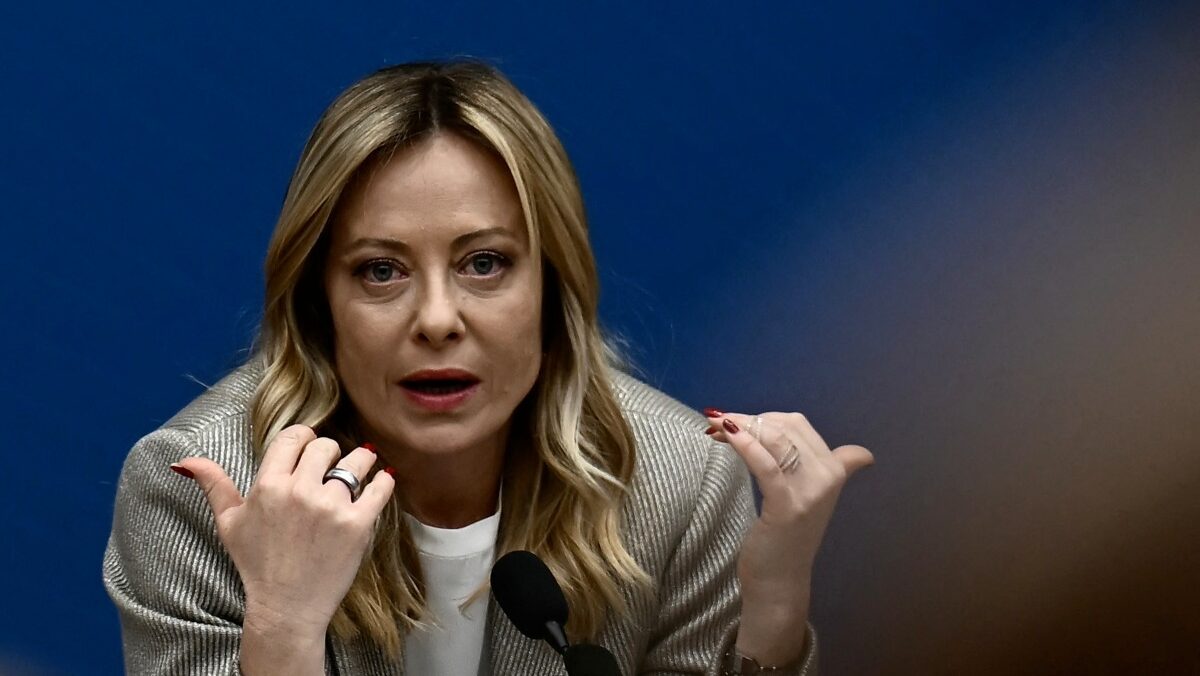
At a January 9 press conference, the Italian prime minister defended herself in these terms: “There are many things on which I disagree with Trump. For example, I believe that international law must be upheld.” She says she prefers to seek “the light rather than the shadows with our partners.”
Her objective is also explained by domestic political motivations: she knows that her line is shared by her ally Matteo Salvini. The president of Lega was delighted that Italy was excluded from Trump’s promise to raise customs duties, which he sees as confirmation of his country’s Atlanticist strategy—where the defence minister expressed concern about the humiliation imposed on Italy’s European allies.
Italy is therefore expected to oppose the activation of the anti-coercion mechanism by the European Council. It will prefer to negotiate until the very end. However, the question remains open: in the context of these negotiations that Italy is calling for, what can be given to Trump as a guarantee that will satisfy him without going as far as annexation?