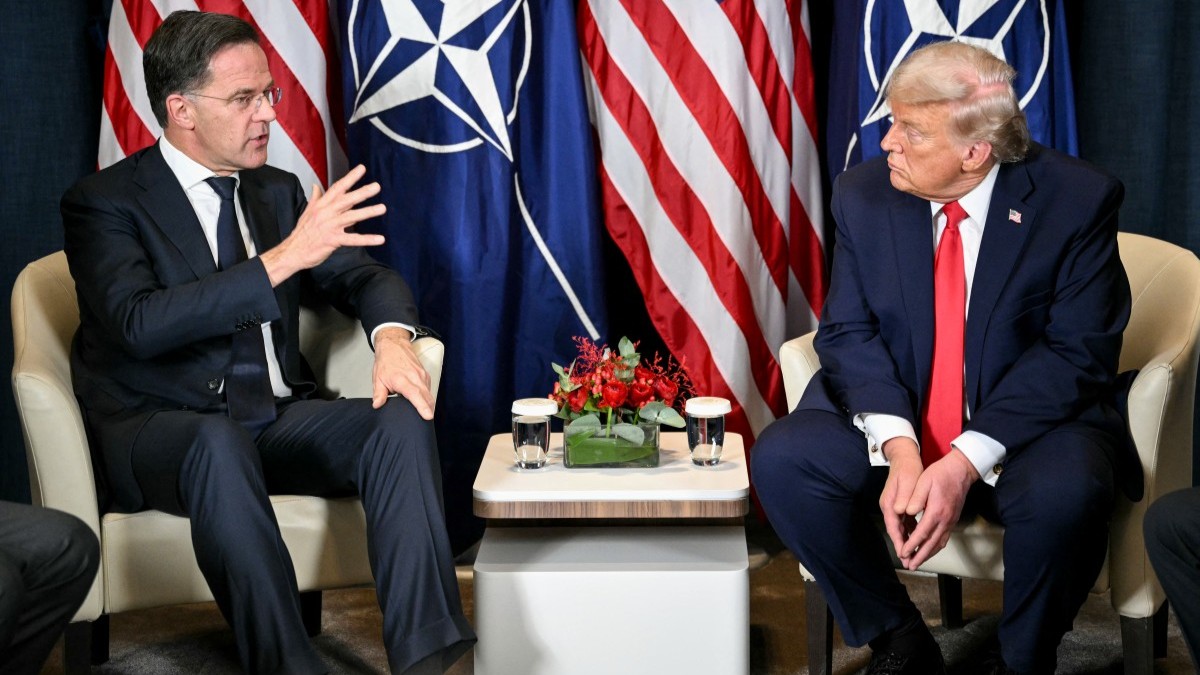
U.S. President Donald Trump (R) speaks with NATOs Secretary-General Mark Rutte during a bilateral meeting on the sidelines of the World Economic Forum (WEF) annual meeting in Davos on January 21, 2026.
Mandel Ngan / AFP
The announcement by U.S. President Donald Trump on Wednesday of the existence of a “framework agreement” with NATO regarding the future of the Arctic island has added a new layer of complexity to transatlantic relations already strained by trade policy, Arctic security, and the broader redefinition of Western leadership.
According to Trump, the understanding was reached following direct talks with NATO Secretary General Mark Rutte, and would open the door to an expanded U.S. presence in Greenland—potentially under arrangements reminiscent of the British sovereign base areas in Cyprus.
Although the details remain deliberately vague, the mere consideration of a form of functional U.S. sovereignty over zones designated for military bases represents a qualitative leap beyond traditional defense agreements.
The underlying message remains unchanged: Washington views Greenland as an indispensable strategic asset. Its geographic position, control over emerging Arctic routes, and access to critical minerals make the island a central piece in the competition with Russia and China.
Trump has repeatedly argued that only the United States possesses the real capacity to guarantee Greenland’s defense, openly questioning the effectiveness of lease agreements or licenses and insisting that “ownership,” in his view, is the only true guarantee of security.
This rhetorical shift was accompanied by a tactical move: the withdrawal of threats to impose new tariffs on several European countries that had backed Denmark and the Greenlandic authorities. Politically, Trump combined maximum pressure with a calculated de-escalation, signaling a willingness to negotiate—but strictly from a position of strength.
This logic is consistent with his transactional view of alliances, in which Atlantic solidarity is subordinated to U.S. national interest. That has never truly been otherwise; the difference now is that the pretense has been dropped.
From NATO’s side, the response has been cautious. The Alliance has limited itself to noting that negotiations should continue between the United States, Denmark, and Greenland, with the shared objective of preventing any Russian or Chinese penetration of the island. However, statements by Greenlandic representatives have underscored that matters are far from straightforward. For many in Nuuk, the idea that their strategic future could be discussed without their explicit consent is unacceptable, reinforcing the perception that major powers continue to treat the Arctic as a chessboard detached from local communities.
Meanwhile, and at least formally outside these NATO-track contacts, the European Union faces its own test of cohesion. An extraordinary European Council summit opens this Thursday in Brussels, convened to assess both U.S. ambitions regarding Greenland and the trade threats that, though temporarily shelved, remain very much on the table. The stated aim is to forge a common position defending international law, territorial integrity, and solidarity with Denmark and Greenland.
Yet consensus is precisely what proves hardest to achieve. European capitals arrive with divergent priorities: some are focused on avoiding a trade escalation with Washington; others fear that any concession could set a dangerous precedent on Arctic sovereignty; and there are also those who see Trump’s move as further confirmation of Europe’s structural dependence on the United States for security.
Commission President Ursula von der Leyen has acknowledged that transatlantic relations are “at a crossroads”—a formulation that captures both the gravity of the moment and the absence of a clear European strategy.
Ultimately, the possible agreement on Greenland is not merely a matter of Arctic geopolitics. It is a test of NATO’s internal balance, of the nature of the relationship between the United States and its European allies, and of the EU’s ability to act as a coherent actor in an increasingly competitive environment. Trump has made clear that he will not abandon his strategic objective, even if he is prepared to adjust the means. Europe, for its part, continues to search for a common voice amid external pressure and internal division.